Tag Archives: overcomer

He who Overcomes, Part 4: Background Information

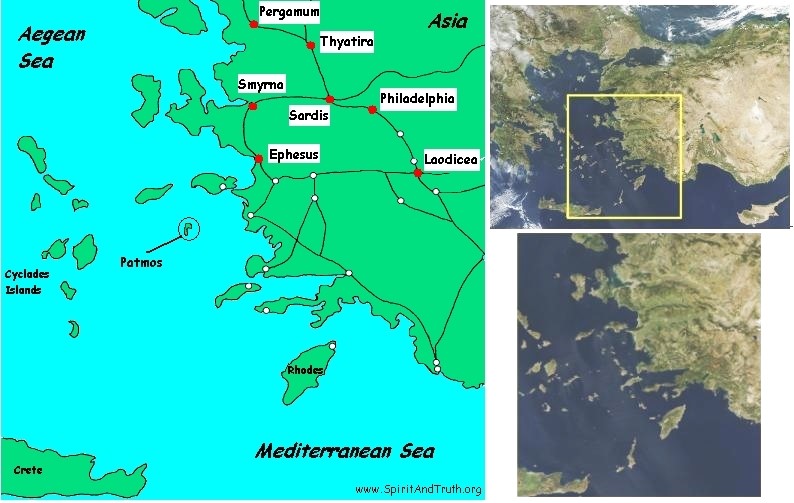
The seven churches mentioned in turn through Revelation Chapters 2 & 3 are all situated in a small geographic area in south west Turkey.

The letters that John wrote to them were given to him using Jesus’ own words which makes them quite special among all the New Testament writings.  Apart from some sentences in Acts to Paul, there are no other places in the NT where Jesus speaks after his ascension like this that I can recall.

A messenger could go to each church delivering the message for that church in the order in which they were written.  However there is no doubt that though each church had a specific message (or at least the angel of that church did), the message of each letter was of value to all the churches.

Each letter follows the same format.  Each starts with an address to the angel of the church.  What exactly that means is hard to know.  I like to think that it means that it is the culture /collective spirit of the church that is being addressed and not just individuals in it or the main pastor or anyone else who may or may not have responsibility in it.  It always amazes me how different churches led by the same Spirit can have different spiritual cultures – different angels if you like.  We spent 18 years in our first church together and coming up to 15 years in our present one (www.openarms.ie) so we have got to know both pretty well.  There is no doubt that the same Holy Spirit that led one also led the other but you would be hard pressed to come across two more different cultures.  It seems from the short descriptions that we have that each of the seven churches of Revelation were equally diverse.  Is this what is meant by the seven spirits of God (Rev. 3:1, 5:6)?

The overall format is:

1) A command to write to the angel of the church

2) A description of Jesus in his glorified state

3) A commendation or praise of the church (only Laodicea doesn’t get this)

4) A complaint or rebuke (but not to Smyrna or Philadelphia)

5) An exhortation or warning

6) A promise to the overcomer (or he who is victorious as the NIV puts it)

It is the last of these sections of the letters that I want to look at in this series of blogs.

It is interesting that the promises to overcomers are set in the context of letters to some local churches.  They didn’t have to be.  In some ways they don’t have anything to do with the messages to each church and could have stood on their own.  I believe that the reason they were put in this context is because the Holy Spirit is indicating that you probably won’t be an overcomer in any other context than full participation in the life of Christ’s body in a local church.  A local church is full of those that need a doctor – those who are well rarely come in (Matt. 9:12).  The spiritually poor, hungry and often lost people that are welcomed into a healthy church give lots of opportunities for those who have been made well by the grace of God to be overcomers.  If you can stick it in a local church it is because you have had to come over and over again to the throne of grace to find help in time of need.

I know, church can be wonderful, just saying…. stick around, overcome…..

Always remember, I could be wrong about anything I write here (1 Cor. 8:2).  Let the Holy Spirit instruct you and not me (Hebrews 8:11).  And ask your pastor or whoever you trust in this kind of thing if you need to.

[Acknowledgements to SpritandTruth.org for the picture but I have to confess I haven’t read their Revelation commentary – or anything else their writers have written (at least not yet)].

He who Overcomes Part 1: Heaven is for Real

There is no point in me talking about the promises to overcomers unless you also share my understanding of what the Scriptures say about heaven. Overcomers are at the end of their sometimes long, and always testing, journey with the Lord and are looking forward to rewards. A lot of these rewards are related to the next life so it is good to know a bit more about that. Scripture is full of revelations about heaven.

First let us draw a (biblical) distinction between the heaven and earth that now exists (2 Peter 3:5-7) and that which is to come, i.e. the new heaven and new earth:

Then I saw “a new heaven and a new earth,” for the first heaven and the first earth had passed away, and there was no longer any sea. 

Rev. 21:1.

(I’ve written in an another article about the significance of the mention of a sea in this verse.)

Everyone who lives on it is familiar with this old earth and the heaven we can see in all its glory around us on a starry night. Most people also vaguely think about heaven in terms of where they might go when they die. Very few think about the distinctions between the old and new heaven and even fewer think about the implications of there being a new earth to come.

nature_clouds_heaven_019281_

Heaven Now.

Paul says in 2 Cor. 12:2-4 that he knew someone (evidently himself) that was caught up to the third heaven or paradise. This implies that there are three heavens. The rest of Scripture would lead one to believe that the first one is the heavens we see around us physically (Psalm 8:3), the second is where the prince of the power of the air and other various spirits rule (Ephesians 6:12). The third is where God, Christ (and us in Christ) are seated. There is a hierarchy to these heavens, the third rules over the second and first, and the second rules over the first.

There is also a connection between each of these heavens and predestination and free will. From the view point of the third heaven everything is predestined – we ought to live in that as much as possible (Hebrews 4:14-16, 10:19-25) – the devil looks up from the second heaven and knows his time is short and manipulates all he can in the first. The first is all most people see and they think from there that their choices determine everything – as indeed they do.

Do you believe in predestination or free will? The answer is yes.

Of course only God can make all three views true at the same time. Equally, because all three viewpoints are true we quickly reach the inadequacy of intellectual comprehension and rational thought to describe it all. I don’t have a problem with that. I’ll continue to use my mind anyway whilst knowing its limits.

As far as the third heaven is concerned there are others who have gone into it and returned. Jesus of course came from it and returned to it. The others went to it and returned from it like Paul. Moses looked into it when he went to the top of Mount Sinai and copied what he saw when he made the tabernacle (Exodus 24 – 31 and Hebrews 5:5). Daniel saw Jesus presenting His blood to the Father on the mercy seat after His resurrection (Daniel 7:13-14, Hebrews 9:16 – 10:22), Isaiah saw the throne room and got his sins forgiven there (Isaiah 6:1-7) and Ezekial saw the motorised version of the Lord’s throne (Ezekial 1). Zechariah saw Jesus there (Jesus in Greek = Joshua in Hebrew) (Zechariah 3-4). Stephen looked into it when he was being stoned (Acts 7:55, 56). However the person who gives us the most detailed description of what it looks like is John in Revelation. As homework, look up each of the passages above and note down all the similarities between what each of them saw. I think  you will find that the same place is being described in each case.

[I’m quite convinced that others have gone to the third heaven and returned since like Colton Burpo (of Heaven is for Real) but, while interesting, I don’t think we need to go outside Scriptural examples to prove the point.]

picture-for-heaven-blog-post

The new heaven is not of this creation. In the sequence of events detailed in Revelation 20-22, the old heaven and earth are done away with, the great white throne judgement occurs and then the new heaven and earth are ushered in. There is a three fold aspect to this new heaven also. The new heaven exists on the new earth, the new earth holds the third heaven (or inner sanctum) which is the heavenly Jerusalem. Which of these heavens we can enter into can be deduced from the messages to the overcomers as well as other Scriptures which I shall deal with later in this series.

And of course there is the lake of fire also. We’ll deal with that a bit too.

I’m going to write this disclaimer at the end of the rest of this series: Always remember, I could be wrong about anything I write here (1 Cor. 8:2).  Let the Holy Spirit instruct you and not me (Hebrews 8:11). And ask your pastor or whoever you trust in this kind of thing if you need to.

He Who Overcomes Part 3: What is an Overcomer?

Everyone who loves the Lord is called by Him to be a disciple, next they are called to become a saint and then an overcomer. There is progression but there are also so many similarities between these terms that they could be thought of as similes. A disciple is a follower of Jesus, a saint is in fellowship with the Church and an overcomer keeps on coming over and over again to the Lord, s/he perseveres.word_of_god_jesus1

The Scriptures are only really written for disciples/ saints/ overcomers. It is unlikely that you will read them consistently, over and over again unless you are one. Only those who love the Lord will continue to receive from Him the freshness of His speaking through them. Saints don’t have to read the Scripture but they will probably want to. It has a way of getting in on you when you love Him. But like anything else it would be a mistake to be prescriptive about these things. A disciple doesn’t have to read the Scripture to be in a living and ongoing relationship with Jesus. But if you can read it you probably will if you are an overcomer.

So as you read through the New Testament note the progression and similarities between disciples, saints and overcomers. An overcomer comes last in the progression. As you persevere in being a disciple and a saint you become entitled to be called an overcomer – or at least you do if you persevere to the end, until the day you die in Christ.  As we explore the promises to overcomers we will see why that is important.

For those interested in this kind of thing, the word for overcomer in the Greek has the same root as nike – the brand that took its inspiration from the Greek god of victory. There is a finality to it which is very fitting.

To be continued …