Category Archives: Discipleship Series

Biblical Rejoicing

“Consider it all joy, my brethren, when you encounter various trials”

James 1:2

Biblical rejoicing has nothing to do with being happy or experiencing pleasure and everything to do with faith.

“In this you greatly rejoice, even though now for a little while, if necessary, you have been distressed by various trials, 7so that the proof of your faith, being more precious than gold which is perishable, even though tested by fire, may be found to result in praise and glory and honor at the revelation of Jesus Christ; 8and though you have not seen Him, you love Him, and though you do not see Him now, but believe in Him, you greatly rejoice with joy inexpressible and full of glory,”

1 Peter 1:6-8

We rejoice because we believe.  Our rejoicing in trial proves our faith.

Blessed are you when people insult you and persecute you, and falsely say all kinds of evil against you because of Me.12Rejoice and be glad, for your reward in heaven is great;

Matthew 5:11-12  (a beatitude from the Sermon on the Mount)

As an example of rejoicing in adversity consider this testimony of a brother of two of the Egyptian martyrs beheaded by ISIS in Libya a few weeks back.

I had a bit of a sore leg today and I was trying out the rejoicing from within that the Holy Spirit seems to always be doing in me, if I’d but listen.  Seemed to work.  I had this curious sense of experiencing the pain and considering it a joy though not enjoying the experience in any sensual way:

Not only that, but we rejoice in our sufferings, knowing that suffering produces endurance, and endurance produces character, and character produces hope, and hope does not put us to shame, because God’s love has been poured into our hearts through the Holy Spirit who has been given to us.

Romans 5:3-5

Rejoice always!

Finally my brethren rejoice!

He Who Overcomes, Part 7: Two Resurrections?

Some years ago I remember being very struck by Paul’s admission in Philippians 3 that he hadn’t yet attained to the resurrection from the dead:

” I want to know Christ—yes, to know the power of his resurrection and participation in his sufferings, becoming like him in his death, 11 and so, somehow, attaining to the resurrection from the dead.

1Not that I have already obtained all this, or have already arrived at my goal,but I press on to take hold of that for which Christ Jesus took hold of me.13 Brothers and sisters, I do not consider myself yet to have taken hold of it. But one thing I do: Forgetting what is behind and straining toward what is ahead, 14 I press on toward the goal to win the prize for which God has called me heavenward in Christ Jesus.15 All of us, then, who are mature should take such a view of things. And if on some point you think differently, that too God will make clear to you.”

My first problem is with the idea of attaining to the resurrection of the dead.  I can understand attaining a better place in heaven or a greater closeness to God.  However, surely everyone is resurrected?  There is no choice there right?  And being resurrected has nothing to do with attaining anything, it is going to happen regardless of what you have attained:

“Do not marvel at this; for an hour is coming, in which all who are in the tombs will hear His voice, 29and will come forth; those who did the good deeds to a resurrection of life, those who committed the evil deeds to a resurrection of judgment.” (John 5:28,29)

Paul himself argues very strongly that there will be a resurrection in his first letter to the Corinthians (chapter 15) and there is no mention of having to attain to it there:

12But if it is preached that Christ has been raised from the dead, how can some of you say that there is no resurrection of the dead? 13If there is no resurrection of the dead, then not even Christ has been raised. 14And if Christ has not been raised, our preaching is useless and so is your faith. 15More than that, we are then found to be false witnesses about God, for we have testified about God that he raised Christ from the dead. But he did not raise him if in fact the dead are not raised. 16For if the dead are not raised, then Christ has not been raised either. 17And if Christ has not been raised, your faith is futile; you are still in your sins. 18Then those also who have fallen asleep in Christ are lost. 19If only for this life we have hope in Christ, we are of all people most to be pitied.

20But Christ has indeed been raised from the dead, the firstfruits of those who have fallen asleep. …..

29Now if there is no resurrection, what will those do who are baptized for the dead? If the dead are not raised at all, why are people baptized for them? 30And as for us, why do we endanger ourselves every hour?31I face death every day—yes, just as surely as I boast about you in Christ Jesus our Lord. 32If I fought wild beasts in Ephesus with no more than human hopes, what have I gained? If the dead are not raised,

“Let us eat and drink,

for tomorrow we die.”

My second problem was with Paul saying that he hadn’t yet attained to it.  If Paul hadn’t attained to the resurrection from the dead after planting churches and being called an apostle of Jesus Christ, what hope is there for the rest of us?

So I went digging a bit deeper and discovered that the word Paul uses for resurrection in Philippians 3:11 is different from when it is used elsewhere in the NT.  There is a preposition tacked onto the front of the word used for resurrection which means “out of” i.e. ανάστασις is the Greek word for resurrection used elsewhere in the bible but in this case it has the preposition ἐξ prepended to it:  ἐξανάστασις.  Greek scholars (I’m not one) will tell you not to read too much into this but I don’t think it is unreasonable to translate it as “resurrection out from among the dead”.

Of course, the most explicit reference to a first and subsequent resurrection is to be found in Revelation 20:

4I saw thrones on which were seated those who had been given authority to judge. And I saw the souls of those who had been beheaded because of their testimony about Jesus and because of the word of God. They had not worshiped the beast or its image and had not received its mark on their foreheads or their hands. They came to life and reigned with Christ a thousand years. 5(The rest of the dead did not come to life until the thousand years were ended.) This is the first resurrection. 6Blessed and holy are those who share in the first resurrection. The second death has no power over them, but they will be priests of God and of Christ and will reign with him for a thousand years.

I am not sure about the beheading bit but the rest of it seems clear enough.  When you add this to the promise to the overcomer in Rev. 2:11b: “He who overcomes will not be hurt by the second death.”  I think it is easy enough to see the connection.  It sure is hard to interpret it in another way.  What possible resurrection could Paul not have attained to if not this one?  Later in 2 Timothy 4:8, near the end of his life, he seems assured of having reached it.  He also talks in that verse of those who love His appearing attaining to the same crown.

There are other verses that make sense in the context of two resurrections.  Paul says in 1 Cor. 6:

2Or do you not know that the saints will judge the world? If the world is judged by you, are you not competent to constitute the smallest law courts? 3Do you not know that we will judge angels?”

Judging the world would seem very difficult if the judges are involved in the same judgement day in the same way as those being judged! Have a look at Rev. 20:4 above again.

So I believe it is clear that the saints that Paul refers to are the same as the overcomers that John refers to in Revelation.  At the judgement of the dead described in Revelation 20:11 – 15 these are the judges along with Christ the supreme judge who witness to the works of those being judged.  Matthew 25:31-46 refers to the same judgement.   I believe that when Jesus says to the sheep and goats: “Inasmuch as you did it to one of the least of these my brethren” that the brethren he is referring to are sitting on either side (or in front) of Him and are the judges also.

Let’s imagine the Judgement Day for a minute.  Here are billions of people being judged by, perhaps, millions of saints in the presence of the Supreme Judge.  Everyone is coming up to be separated into sheep and goats.  Ahead of you in the line you see people who you think should go to heaven but they end up in the lake of fire and others who you think should be in the lake of fire end up in heaven.  You weren’t faithful to death so you lost that assurance that comes from being in vital contact with the Father and you find yourself naked and confused and not knowing if you are a sheep or a goat. The terror of that is to taste of the second death.

There are other verses that make sense in the context of a first and second resurrection:

“…others were tortured, not accepting their release, so that they might obtain a better resurrection.”  Hebrews 11:35b

And the curious case of those who said that the resurrection was past even though they were obviously there to say it:

“Among them are Hymenaeus and Philetus, 18who have departed from the truth. They say that the resurrection has already taken place, and they destroy the faith of some.” (2 Timothy 2:17b, 18)

The resurrection that could have already taken place could be the first one.  Perhaps they were trying to get at Paul’s followers by pointing out that the first resurrection had already happened and Paul wasn’t in it.

Of course none of this is main stream, evangelical Christian theology and doubtless there are people who have studied the Scriptures all their lives as a full time profession who could make mincemeat of my arguments. But I’ve been saying these things to many people for over 15 years now and so far no one has come up with a better explanation of these verses.

If you who have read this far can come up with some good counter interpretations of these verses then please let me know them.  Otherwise, I would say: Go for the first resurrection. It mightn’t be easy but it will certainly be worthwhile.


He who Overcomes, Part 6: Smyrna and the Second Death

“He who overcomes shall not be hurt by the second death.”  Rev. 2:11

I don’t think there can be any controversy about what the second death is according to Scripture:

“This is the second death, the lake of fire.  And if anyone’s name was not found written in the book of life, he was thrown into the lake of fire.”  Rev. 20:14a, 15.

This is the place Jesus said that it would be better to lose an eye or a hand than to go there (Matt. 18:8-9).  It is hard to be a bible believing Christian and not believe in hell as some seem not to do.

However the great thing about being an overcomer –  someone coming over and over again to the Father through the action of the Holy Spirit on the ground of the redemption that is in Christ Jesus – is that you won’t be hurt by the second death at all. There is a similar promise in Rev. 20:6: “Blessed and holy is the one who has a part in the first resurrection; over these the second death has no power, …”

The book of life is mentioned again in Rev. 3:5 so we will deal with it there. However the topic of first and second resurrections is worth pursuing further I think and I will deal with it in the next blog.

The Word of God and the Salvation of our Spirit, Soul and Body

The Power of the Word of God

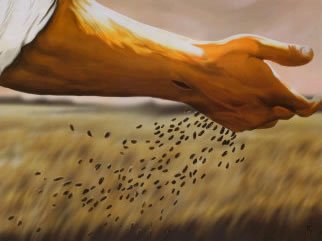
Jesus is the Word of God (John 1:1). It is His word that saves us (Matthew 8, Mark 4 and Luke 12) as it is sown into our lives by those who preach the gospel to us (Romans 10:14-17).  It is His DNA that is in His word so that when it is sown in our lives it grows up into Christ in us, our hope of glory (Col. 1:27).

The Tripartite Nature of Man

Like God, whom we are made in the image of (Gen. 1:27), we have three parts to our being: spirit, soul and body (1 Thess. 5:23).  Each of them is saved in a different way according to the Scriptures.  The salvation of all of them is brought about by the action of the Word of God in our lives.

The Salvation of the Spirit (Past)

We are born again by the Word of God (1 Peter 1:23-25).  That is, our spirit is made alive and we are a new creation (2 Cor. 5:17).  Our spirit is eternal and once united with the Spirit of God is imperishable or indestructible (1 Peter 1:23-25).  So our spirit is saved the moment God’s spirit, or the word of God, is conceived in us (John 3:7).  This is the sense in which Paul says we have been transferred from the kingdom of darkness into the kingdom of His Son (Col. 1:13).  Wherever it talks about salvation in an instant sense you can take it that the Scripture writers are referring to the salvation of the spirit of a person.  The spirit of a man is in the very centre of a man, in his heart.  Because our spirits are made alive when we are born again we can worship God in spirit and in truth (John 4:23-24) and truly eat His flesh and drink His blood (John 6:53, 63).  The salvation of our Spirit is the down payment or promise of the salvation of the rest of us (Eph. 1: 13-14).  To be saved you must be born again (or born from above, John 3:3,7).

The Salvation of the Soul (Present)

Whenever the scriptures speak of working out your salvation (Phil. 2:12) – or salvation being an ongoing work – they are referring to the work of the word of God growing through the soul.  The word of God is living and active and divides between the spirit and the soul so you can tell the difference (Heb. 4:12). The fact that our soul needs to be saved is evident in the struggle between the flesh and the spirit that goes on in it (Gal. 5:17, Rom. 8:5-13).  It is in the salvation of our soul that our decisions matter and this affects our eternal destiny. Being conformed to God’s image by beholding the glory of the Lord (2 Cor. 3:18) takes a definite turning to Him and refers to the salvation of the soul.  And there are many Scriptures like that.  In fact our whole life on this earth from the time we are born again until the time we “fall asleep” or, in other words, when this mortal flesh returns to dust, is taken up with the salvation of our soul.  We must work out our salvation with fear and trembling (Phil. 2:12).

The Salvation of the Body (Future)

Jesus is the first born from the dead (Col. 1:18), the first to have a bodily resurrection.  No one else has been raised bodily yet, we either have to physically die first or be able to look Him in the eye when He returns (1 John 3:2).  When that happens our bodies are transformed from this one of flesh and blood (where the perishable life is in the blood Deut. 12:23) to one of flesh and bone (where the eternal life is in the spirit). Jesus’ resurrected body had flesh and bone and he could eat (Luke 24:36-43) and so will we when our bodies are saved.  We live in hope of this though our outward man is decaying day by day (2 Cor. 4:16).  The whole process by which our bodies are saved is described in detail in 1 Cor. 15.

A Blessing

Now may the God of peace make you holy in every way, and may your whole spirit and soul and body be kept blameless until our Lord Jesus Christ comes again.

1 Thessalonians 5:23.

He who Overcomes, Part 5: First Love

One of the most wonderful things about coming to God again and again (i.e. being an overcomer) is experiencing His presence.  Being in love with God is a wonderful thing.  There is nothing as fulfilling, nothing as satisfying to your mind, soul and spirit as being in experiential communion with the Father, in Christ and by the action of the Holy Spirit in our lives.  I’ve been 38 years experiencing God, experiencing His love, knowing His touch. I’ve had visions, embraces, revelations.  It has been like paradise on earth to be raised up in the Spirit before the throne of the Father because of the redemption that is in Christ Jesus.

And this is what the first promise to the overcomer is all about.   S/he who overcomes has the right to eat from the tree of life, which is in the paradise of God (Rev. 2:7).

That is not just a promise for the future, it is a promise for now.

He who Overcomes, Part 4: Background Information

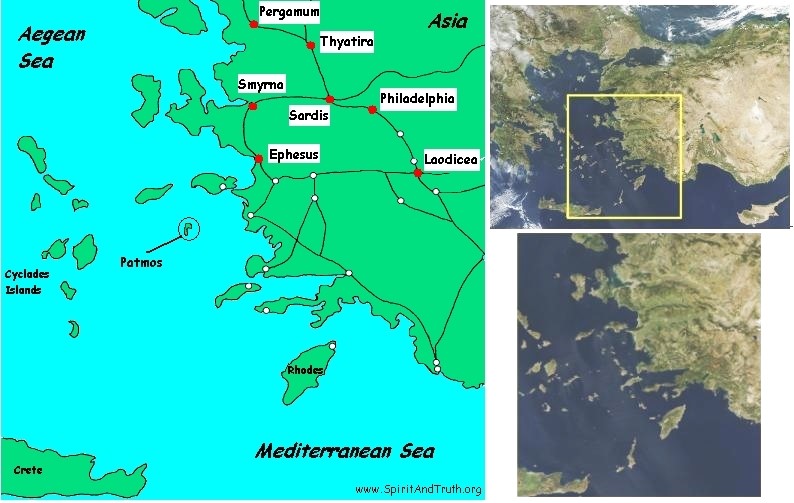
The seven churches mentioned in turn through Revelation Chapters 2 & 3 are all situated in a small geographic area in south west Turkey.

The letters that John wrote to them were given to him using Jesus’ own words which makes them quite special among all the New Testament writings.  Apart from some sentences in Acts to Paul, there are no other places in the NT where Jesus speaks after his ascension like this that I can recall.

A messenger could go to each church delivering the message for that church in the order in which they were written.  However there is no doubt that though each church had a specific message (or at least the angel of that church did), the message of each letter was of value to all the churches.

Each letter follows the same format.  Each starts with an address to the angel of the church.  What exactly that means is hard to know.  I like to think that it means that it is the culture /collective spirit of the church that is being addressed and not just individuals in it or the main pastor or anyone else who may or may not have responsibility in it.  It always amazes me how different churches led by the same Spirit can have different spiritual cultures – different angels if you like.  We spent 18 years in our first church together and coming up to 15 years in our present one (www.openarms.ie) so we have got to know both pretty well.  There is no doubt that the same Holy Spirit that led one also led the other but you would be hard pressed to come across two more different cultures.  It seems from the short descriptions that we have that each of the seven churches of Revelation were equally diverse.  Is this what is meant by the seven spirits of God (Rev. 3:1, 5:6)?

The overall format is:

1) A command to write to the angel of the church

2) A description of Jesus in his glorified state

3) A commendation or praise of the church (only Laodicea doesn’t get this)

4) A complaint or rebuke (but not to Smyrna or Philadelphia)

5) An exhortation or warning

6) A promise to the overcomer (or he who is victorious as the NIV puts it)

It is the last of these sections of the letters that I want to look at in this series of blogs.

It is interesting that the promises to overcomers are set in the context of letters to some local churches.  They didn’t have to be.  In some ways they don’t have anything to do with the messages to each church and could have stood on their own.  I believe that the reason they were put in this context is because the Holy Spirit is indicating that you probably won’t be an overcomer in any other context than full participation in the life of Christ’s body in a local church.  A local church is full of those that need a doctor – those who are well rarely come in (Matt. 9:12).  The spiritually poor, hungry and often lost people that are welcomed into a healthy church give lots of opportunities for those who have been made well by the grace of God to be overcomers.  If you can stick it in a local church it is because you have had to come over and over again to the throne of grace to find help in time of need.

I know, church can be wonderful, just saying…. stick around, overcome…..

Always remember, I could be wrong about anything I write here (1 Cor. 8:2).  Let the Holy Spirit instruct you and not me (Hebrews 8:11).  And ask your pastor or whoever you trust in this kind of thing if you need to.

[Acknowledgements to SpritandTruth.org for the picture but I have to confess I haven’t read their Revelation commentary – or anything else their writers have written (at least not yet)].

He who Overcomes Part 1: Heaven is for Real

There is no point in me talking about the promises to overcomers unless you also share my understanding of what the Scriptures say about heaven. Overcomers are at the end of their sometimes long, and always testing, journey with the Lord and are looking forward to rewards. A lot of these rewards are related to the next life so it is good to know a bit more about that. Scripture is full of revelations about heaven.

First let us draw a (biblical) distinction between the heaven and earth that now exists (2 Peter 3:5-7) and that which is to come, i.e. the new heaven and new earth:

Then I saw “a new heaven and a new earth,” for the first heaven and the first earth had passed away, and there was no longer any sea. 

Rev. 21:1.

(I’ve written in an another article about the significance of the mention of a sea in this verse.)

Everyone who lives on it is familiar with this old earth and the heaven we can see in all its glory around us on a starry night. Most people also vaguely think about heaven in terms of where they might go when they die. Very few think about the distinctions between the old and new heaven and even fewer think about the implications of there being a new earth to come.

nature_clouds_heaven_019281_

Heaven Now.

Paul says in 2 Cor. 12:2-4 that he knew someone (evidently himself) that was caught up to the third heaven or paradise. This implies that there are three heavens. The rest of Scripture would lead one to believe that the first one is the heavens we see around us physically (Psalm 8:3), the second is where the prince of the power of the air and other various spirits rule (Ephesians 6:12). The third is where God, Christ (and us in Christ) are seated. There is a hierarchy to these heavens, the third rules over the second and first, and the second rules over the first.

There is also a connection between each of these heavens and predestination and free will. From the view point of the third heaven everything is predestined – we ought to live in that as much as possible (Hebrews 4:14-16, 10:19-25) – the devil looks up from the second heaven and knows his time is short and manipulates all he can in the first. The first is all most people see and they think from there that their choices determine everything – as indeed they do.

Do you believe in predestination or free will? The answer is yes.

Of course only God can make all three views true at the same time. Equally, because all three viewpoints are true we quickly reach the inadequacy of intellectual comprehension and rational thought to describe it all. I don’t have a problem with that. I’ll continue to use my mind anyway whilst knowing its limits.

As far as the third heaven is concerned there are others who have gone into it and returned. Jesus of course came from it and returned to it. The others went to it and returned from it like Paul. Moses looked into it when he went to the top of Mount Sinai and copied what he saw when he made the tabernacle (Exodus 24 – 31 and Hebrews 5:5). Daniel saw Jesus presenting His blood to the Father on the mercy seat after His resurrection (Daniel 7:13-14, Hebrews 9:16 – 10:22), Isaiah saw the throne room and got his sins forgiven there (Isaiah 6:1-7) and Ezekial saw the motorised version of the Lord’s throne (Ezekial 1). Zechariah saw Jesus there (Jesus in Greek = Joshua in Hebrew) (Zechariah 3-4). Stephen looked into it when he was being stoned (Acts 7:55, 56). However the person who gives us the most detailed description of what it looks like is John in Revelation. As homework, look up each of the passages above and note down all the similarities between what each of them saw. I think  you will find that the same place is being described in each case.

[I’m quite convinced that others have gone to the third heaven and returned since like Colton Burpo (of Heaven is for Real) but, while interesting, I don’t think we need to go outside Scriptural examples to prove the point.]

picture-for-heaven-blog-post

The new heaven is not of this creation. In the sequence of events detailed in Revelation 20-22, the old heaven and earth are done away with, the great white throne judgement occurs and then the new heaven and earth are ushered in. There is a three fold aspect to this new heaven also. The new heaven exists on the new earth, the new earth holds the third heaven (or inner sanctum) which is the heavenly Jerusalem. Which of these heavens we can enter into can be deduced from the messages to the overcomers as well as other Scriptures which I shall deal with later in this series.

And of course there is the lake of fire also. We’ll deal with that a bit too.

I’m going to write this disclaimer at the end of the rest of this series: Always remember, I could be wrong about anything I write here (1 Cor. 8:2).  Let the Holy Spirit instruct you and not me (Hebrews 8:11). And ask your pastor or whoever you trust in this kind of thing if you need to.

Knowing the Truth and Systematic Theology  

It is the glory of God to conceal a matter but it is the glory of kings to find it out.  Proverbs 25:2

Aragorn's considering that

I know the Truth because I know Jesus (John 14:6).

But of course that is not the same thing as saying I know every particular detail of everything there is to know.

Wouldn’t it be great if there was a systematic theology that told you all or at least most of what there is to know about Jesus?  Of course there isn’t but that is not the same as saying there is no value in systematic theology.

Now by the phrase “systematic theology” I mean an intellectual construction of arguments and proofs that explain something about the Truth.

Paul’s letter to the Romans is systematic theology.  He builds argument upon proof to show the basic doctrines about the Gospel and judgement (chapters 1-4) the flesh and the spirit and the relationship between the two (chapters 6-8) as well as dealing with predestination (chapters 9-11) and other fundamental subjects.  These have been of great value to the church over the centuries and show just what a good systematic theology can do.  Paul had special revelation and built his theology on that and used the Old Testament to back up much of what he said.  Nothing he wrote was independent of his relationship with Jesus, and nothing was a lie about Him or was not found in Him.  Christ for Paul was the beginning and the end of all revelation as it ought also to be for all systematic theology.

Being a logical kind of thinker (or at least I think I am, others can judge) I love systematic theology.  It is so like the engineering discipline that I use every day.  There are fundamental things that are true about creation, maths and machines that have to be obeyed and considered if I am to do my job right.

So you can see, perhaps, why I like systematic theology.  If there is any subject that I like to dig deeper into and find out more about it has to be Jesus Christ.  And I believe there is a place for deductive reasoning and analysis when doing so.  The creation that Jesus Christ is in, through and for, and the ways he wants us to act in it are simple in one way:

  • Love the Lord your God with all your heart, with all your soul, with all your mind and with all your strength.
  • Love your neighbour as yourself.

(see Mark 12:30-31)

But creation and the creator are more complex than a computer system as Paul’s letter to the Romans explores.  I want to explore God the way Paul did and I believe there is value and endless depths in doing so.

Having said that, it is essential that we recognise the limits that our intellects have.

Firstly, we actually can know nothing that is not revealed to us.  As Christians, creation and the Scriptures are our main means of revelation and prayer and preaching are the best delivery mechanisms (catalysts if you like) for revelation.  According to the Christian gospel you can’t even begin to have this kind of revelation unless you are born from above (John 3:3, 1 Cor. 2:9, 10).  Secondly, there is a limit to what the intellect can know about God.  As Paul, quoting from Isaiah, says at the end of his discourse on predestination in Romans: “Oh, the depth of the riches of the wisdom and knowledge of God!  How unsearchable his judgements and his ways past beyond finding out!  For who has known the mind of the Lord that he should be his counsellor?” Romans 11:33.

But we do have the mind of Christ (1 Cor. 2:16).  And God does want us to use it.

The posts I am putting up currently about “He who Overcomes” are a form of systematic theology.  The subject matter is mainly eschatological and the conclusions are not always main stream evangelical but the application is here and now and the hope is eternal.  I’ve found the understanding of what an Overcomer is and the implications of the promises to an overcomer very helpful for the last 20 years or so since God first began to show me these things.  I’m really praying you will too.

There is a warning though, if you are looking for a debate I’m not interested.  If you think I am wrong prove it from the Scripture but please do it in love.

He Who Overcomes Part 3: What is an Overcomer?

Everyone who loves the Lord is called by Him to be a disciple, next they are called to become a saint and then an overcomer. There is progression but there are also so many similarities between these terms that they could be thought of as similes. A disciple is a follower of Jesus, a saint is in fellowship with the Church and an overcomer keeps on coming over and over again to the Lord, s/he perseveres.word_of_god_jesus1

The Scriptures are only really written for disciples/ saints/ overcomers. It is unlikely that you will read them consistently, over and over again unless you are one. Only those who love the Lord will continue to receive from Him the freshness of His speaking through them. Saints don’t have to read the Scripture but they will probably want to. It has a way of getting in on you when you love Him. But like anything else it would be a mistake to be prescriptive about these things. A disciple doesn’t have to read the Scripture to be in a living and ongoing relationship with Jesus. But if you can read it you probably will if you are an overcomer.

So as you read through the New Testament note the progression and similarities between disciples, saints and overcomers. An overcomer comes last in the progression. As you persevere in being a disciple and a saint you become entitled to be called an overcomer – or at least you do if you persevere to the end, until the day you die in Christ.  As we explore the promises to overcomers we will see why that is important.

For those interested in this kind of thing, the word for overcomer in the Greek has the same root as nike – the brand that took its inspiration from the Greek god of victory. There is a finality to it which is very fitting.

To be continued …

He Who Overcomes, Part 2: A way to interpret Revelation

Some people say Revelation is purely symbolic.

Some people say it is literal.

Personally I consider most of the images of Revelation open to a literal interpretation, i.e. it was literally what events on earth looked like from the vantage point of heaven to a human transported there (i.e. John).

John is in the third heaven where Paul went, the same place Moses saw from the mountain and others like Daniel and Isaiah also saw.  He is in eternity looking down at events on earth occurring in time.  There is bound, even for this reason alone, to be considerable differences between what he saw of the same events in comparison to someone viewing them from an earthly viewpoint and in time.

I also believe that he was looking at the spiritual rather than the physical bodies of each participant.

This should make the imagery in Revelation more easily understood (perhaps ….).

Here are some thoughts:
The sea is how time looks and it also gives a spiritual view of events on earth – c.f. Rev. 13, Daniel 7:2.

All the images in Revelation to do with this earth and time arise from the Sea.

In Chapter 13:1 we see a spiritual being (the dragon or Satan) standing on the shore of the Sea.  Jesus is of course enthroned above the Sea, seated at the right hand of the Father.

Animals represent creatures/ corporations with no relationship with God.

Humans represent creatures/ corporations capable of a relationship with God.

Corporations in this sense are collectives of people with one spirit, e.g. nations, empires, etc.

When Revelation speaks of life and death it is normally spiritual life and death that is meant. Of course, this is far more important than physical life and death (see Matt. 5:29-30).

Revelation can be very hard to understand. John was in the spirit in eternity. Does Revelation make more sense if what John saw and describes are actually the spirits of nations, empires and kings and not physical views of those things? What if the sequence of events recorded in Revelation is not in time (where it is linear) but in eternity (the events happen more like a disk)?

In particular take note of Rev. 15:2 – those who can be seen rising up and standing on the Sea and praising God, I believe this is us the Church worshiping here and now:

And I saw something like a sea of glass mingled with fire, and those who have the victory over the beast, over his image and over his mark and over the number of his name, standing on the sea of glass, having harps of God. They sing the song of Moses, the servant of God, and the song of the Lamb, saying:

“Great and marvelous are Your works,
Lord God Almighty!
Just and true are Your ways,
O King of the saints!
Who shall not fear You, O Lord, and glorify Your name?
For You alone are holy.
For all nations shall come and worship before You,
For Your judgments have been manifested.”

Revelation 15:2-4