Category Archives: Law & Grace

Materials for a lesson in the His Story Module.

Leviticus! Chap. 3: Peace

So far we have seen that:

  • Leviticus 1 deals with the need for everyone to have a saviour – a sacrifice that is perfect – before we can come to God.  From the New Testament we learn that that Sacrifice is Jesus’ sacrifice on the cross for us (Hebrews 8 & 9).
  • Leviticus 2 deals with our words in the presence of God.  These can be words in song, worship, prayer, preaching or writing such as I am doing now.  In order to please God with our words they should be refined (not coarse), anointed, directed to Him in prayer with no sin and not sensual – inappropriate.

In Leviticus 3 we are introduced to the peace offering and a new type: Fat.

Then he shall offer from the sacrifice of the peace offering an offering made by fire to the Lord. The fat that covers the entrails and all the fat that is on the entrails, the two kidneys and the fat that is on them by the flanks, and the fatty lobe attached to the liver above the kidneys, he shall remove; (Leviticus 3:3-4)

Now you don’t have to be a biblical scholar to realise that fat represents excess.

Another part of the peace offering is the blood of the sacrifices poured out on the altar:

And he shall lay his hand on the head of his offering, and kill it before the tabernacle of meeting; and Aaron’s sons shall sprinkle its blood all around on the altar.  (Leviticus 3:8)

Blood represents life – see Leviticus 17:11.

So the simple message of Leviticus 3 is that if you want to be at peace when you are before God offer Him your life and all your excess.  Just give it all to Him and you will have peace.  “All excess is the Lord’s” according to v. 16.

Bill Hybels has written a book called “Simplify” and others have recognised the stress we allow to accumulate with our excess.  Excess weight is an obvious one, but excess possessions including excess money also cause stress for a Christian.  Give your excess to the Lord, He will know what to do with it.

In the end it is all going to go up in smoke anyway (2 Peter 3:7).

Leviticus! Chap. 1: Acceptance

Now the Lord called to Moses, and spoke to him from the tabernacle of meeting, saying, “Speak to the children of Israel, and say to them: ‘When any one of you brings an offering to the Lord,….

Leviticus 1:1-2 (NKJV)

Some decades ago when I was a young Christian I used to meet with about 300 other Christians of a similar background and faith in a small village campsite called, rather aptly, Redcross.  It was the highlight of the year for there were far fewer of us then in the Republic of Ireland than there are now.  Nowadays I have the privilege of meeting with that many fellow believers every week.

One day one of the speakers at this tent based conference shared about how he had met another believer – a guy called Eamon – down by the river having a time alone with God.  Apparently he was quite excited and enthused about what he was reading in Leviticus.  Most of the people there knew Eamon and we were all quite amused since it seemed in character.  He was the kind of guy who you would think could get enthusiastic about Leviticus: saintly, serious and studious with a winning and constant smile, the perfect saint in type.  No doubt he wouldn’t have agreed but then that would only have added to the picture.

Roll forward 30+ years and here I am getting all excited about Leviticus!  It is a kind of Christian 101 in the Old Testament: simple, elegant and thorough.  The main theme of the book goes like this:  people want to approach a holy God so how can they do it?  Leviticus shows us how.

Leviticus sits in the middle of the 5 books of Moses called the Pentateuch.  In many ways it speaks of nothing else other than how to approach God.

In chapter one the Lord calls Moses over and says to him “When any man brings an offering to the Lord”.  There is no qualification here, it is any man whether saint or sinner, priest or commoner.  To be accepted (v. 3, 4) he had to bring an animal offering without defect.  This is the first thing that had to happen before someone could come to God, there had to be a sacrifice.

Many centuries later the writer of the Letter to the Hebrews explains (in chapters 9 & 10) that the animal sacrifices written about in Leviticus were just a type or foreshadowing of Christ’s sacrifice. They had no power to remove sin – the barrier between us and God’s presence –  but Jesus’ sacrifice does.

So now we come to God our Father through Jesus and the first thing to know and remember is that there has been a bloody sacrifice to enable us to do that.  We don’t need the animal sacrifices but we sure need His perfect redemption.  Without it we can’t even start to come to God.

Kneeling to Pray

The US NFL controversy (in 2017) brings up that old problem about a Christian’s submission to civil authority.  On the one hand Romans 13:1-7 is very clear:

“Everyone must submit to governing authorities. For all authority comes from God, and those in positions of authority have been placed there by God. So anyone who rebels against authority is rebelling against what God has instituted, and they will be punished. For the authorities do not strike fear in people who are doing right, but in those who are doing wrong. Would you like to live without fear of the authorities? Do what is right, and they will honor you. The authorities are God’s servants, sent for your good. But if you are doing wrong, of course you should be afraid, for they have the power to punish you. They are God’s servants, sent for the very purpose of punishing those who do what is wrong. So you must submit to them, not only to avoid punishment, but also to keep a clear conscience.

Pay your taxes, too, for these same reasons. For government workers need to be paid. They are serving God in what they do. Give to everyone what you owe them: Pay your taxes and government fees to those who collect them, and give respect and honor to those who are in authority.”

On the other hand the Scriptures have some clear examples of Christians not obeying the governing authorities of the day. In Acts 4:1-21 for example Peter and John have been hauled before the authorities of the day who “commanded them never again to speak or teach in the name of Jesus.” Their reply was “Do you think God wants us to obey you rather than him? 20 We cannot stop telling about everything we have seen and heard.”

The two passages above describe the dilemma faced by Colin Kaepernick and other By Mike Morbeck - Flickr: Colin Kaepernick, CC BY-SA 2.0, https://commons.wikimedia.org/w/index.php?curid=30174119Christians like him who believe they are faced with the choice between honouring a flag / country and honouring Christ.

In fact we can all face the same dilemmas in some simple things like paying the full amount of taxes we owe or standing for the national anthem in Ireland as a Christian. If born again believers in the US have a problem with the President of that country because of his perceived stance on racism and decide to kneel during their national anthem as a result then what should we do who have an openly proselytising gay Taioseach and a lesbian Minister for Children?

Nothing? Perhaps. At least we can openly share the Gospel in this country. I would find it hard to come up with a Scriptural principle which says that we should oppose authorities (and only ever peacefully) over anything less than something I could not do even if they commanded me. For like Peter and John I can’t help but speak of the love of God expressed through the sacrifice of Jesus on the cross and of His wonderful resurrection life now living in and through me.

I really don’t want to make a fuss about anything else. It’s all secondary and not the main thing.

But if you believe God is calling you to take a stand on something like abortion or LGBT then who am I to say you are wrong?

Priorities

Pierce my earI was speaking recently with a good friend about the law and he said to put the word “instruction” where you see the word “law” and that gives a better sense of the meaning.

So what is the next instruction that God puts in Exodus after the Ten Commandments? Actually it is about altars. But what is the one after that (in Exodus 21)?

“If you buy a Hebrew slave, he may serve for no more than six years. Set him free in the seventh year, and he will owe you nothing for his freedom. If he was single when he became your slave, he shall leave single. But if he was married before he became a slave, then his wife must be freed with him.

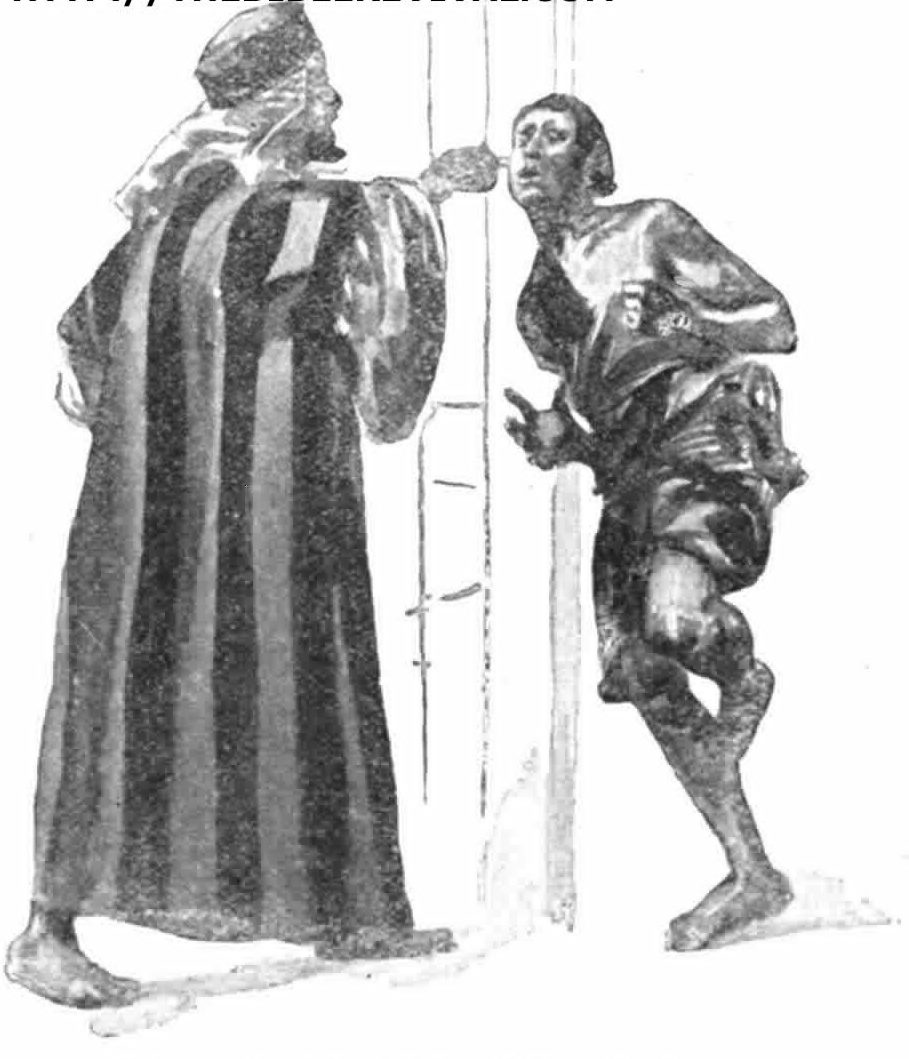
“If his master gave him a wife while he was a slave and they had sons or daughters, then only the man will be free in the seventh year, but his wife and children will still belong to his master. But the slave may declare, ‘I love my master, my wife, and my children. I don’t want to go free.’ If he does this, his master must present him before God. Then his master must take him to the door or doorpost and publicly pierce his ear with an awl. After that, the slave will serve his master for life.”

I don’t want to go free, God has given me everything.  Pierce my ear to the door of your house, O Lord!

Doing away with law

law-books1So here’s the thing:  any law gives sin power (Romans 7:13) and fallen human nature being what it is as soon as we see a law we long to break it (Romans 7:21-24). To make things worse, there can be great pleasure in breaking laws.

But I’m not living on that planet. Well I am but my spirit isn’t. I’m somewhere else (Ephesians 2:6). I died to the law when I was born again to a new life in the Kingdom of Light, the one where the great Lover is king.

I recently asked a friend to quote the 10 commandments. She began by saying: “Love the Lord your God with all your heart and all your soul and all your mind and all your strength. And love your neighbour as yourself.”  (Matthew 22:34-40). Just like a true Christian should. It’s all about love. We have died to the law (all laws including the ones in the bible) and now we live in a love relationship with Yeshua (Romans 7). Of course, being in love, all our thoughts are wrapped up in Him and what we can do to please Him.

There is a problem – we are in a long distance relationship. We are in love, so He lives by His Spirit in our hearts, we know what He wants, we can hear His voice in our hearts and follow in His ways. But He is not here bodily, He is in heaven. Thankfully He sent us a lot of good love letters over the ages which tell us all sorts of His/stories about how He deals with people and what pleases Him and what doesn’t. Included among them are a lot of commandments, laws and prescriptions for life. We don’t have to do them of course – we are not under law – but if we do them we may find that that pleases Him depending on the law and the heart with which we carry it out. Laws are also a good way of checking if we are still in first love. If they are a burden to carry out then it is probable that we are not in first love. His yoke is easy and His burden is light (Matthew 11:30). Sacrifice doesn’t feel like sacrifice when it is done in love (Hosea 6:6, Matthew 9:13, 12:7).

So recently I’ve been challenged to think about doing those laws that please Him like keeping the Sabbath holy. For me the Spirit in me is indicating that that means sitting around all day reading the bible, which is nice. He also has shown me that (again for me- we are not under any law in these matters) that it starts at 6pm on a Friday evening and ends at 6pm on a Saturday. The great thing is that you can take it or leave it, I on the other hand, have so enjoyed the extra fellowship and time with my first Love that I can’t wait to do it again. Well I can but you know what I mean.

None of us

“No one is righteous – not even one.

No one is truly wise;

No one is seeking God.

All have turned away; all have become useless.

No one does good, not a single one.”

For no one can ever be made right with God by doing what the law commands.  The law simply shows us how sinful we are.

But now God has shown us a way to be made right with him without keeping the requirements of the law.

We are made right with God by placing our faith in Jesus Christ.  And this is true for everyone who believes no matter who we are.

For everyone has sinned; we all fall short of God’s glorious standard.  Yet God, with undeserved kindness, declares that we are righteous.  He did this through Christ Jesus when He freed us from the penalty for our sins.  For God presented Jesus as the sacrifice for sin.  People are made right with God when they believe that Jesus sacrificed His life, shedding His blood.”

The above is extracted from Romans 3 (NLT in case you didn’t recognize it). It seems Paul wrote the first two chapters of Romans to make sure that he set the standard of God’s requirements out of reach for both the irreligious and the religious alike. As he says later on: “For God has imprisoned everyone in disobedience so he could have mercy on everyone.” (Romans 11:32 NLT). Which must surely be one of the most mind boggling statements in the Bible. No wonder Paul goes on to say: “How impossible it is for us to understand His decisions and His ways!”

But understanding it all is not where it is at. Believing and trusting in Him is.

Having said that Paul gives understanding its best shot in Romans. I personally like that.

Hypocrisy

As I’ve mentioned in at least two of my other blogs (if not more) it is clear that Jesus reserves His harshest words for religious hypocrites. Paul does something similar in Romans 2. To make it perhaps more relevant I’ve changed a few of the words while attempting to retain the spirit of them.

But first of all have a good read of the whole chapter – there is nothing untrue about any of it. None of it is abrogated by Jesus’ death on the cross even in the context of what later chapters say. The key word is “continue”. If you continue in sin and refuse to repent of it you will suffer punishment no matter what your experience has been or what you think you have believed in the past.

Starting in v. 17:

“You who call yourselves Born-Again Christians are relying on the Bible and you boast about your special relationship with Him.  You know what He wants; you know what is right because you have been taught by your pastors.  You are convinced that you are a guide for the blind and a light for people who are lost in darkness.  You think you can instruct the ignorant and teach children the ways of God.  For you are certain that the Bible contains all the knowledge and truth that is required.

“Well then, if you teach others, why don’t you teach yourself?  You tell others not to steal, but do you steal from the Government in tax evasion or your employer or the Church or God by not bringing Him your tithes?  You say it is wrong to commit adultery, but do you commit adultery every day with your eyes?  You condemn idolatry, but do you watch TV programs and DVDs glorifying pop bands and models and take selfies all the time?  You are so proud of knowing the law but you dishonour God by breaking it.  No wonder the man in the street blasphemes the name of God because of you.

“Being baptized by full immersion in water or in the Spirit has value only if you obey God.  But if you don’t obey God you are no better off than anyone else.  And if the man in the street obeys God’s law, won’t God declare them to be his own people? In fact the average joe who keeps God’s law will condemn you born again believers who have been baptized in the Spirit and possess a bible but don’t obey Him.

“For you are not a true disciple just because you were born of Christian parents or because you have gone through the ceremony of full immersion baptism.  No a true Christian is one whose heart is right with God.  And true baptism is not merely obeying the letter of the law; rather it is a change of heart produced by God’s Spirit.  And a person with a changed heart seeks praise from God, not from people.”

And if you think I’ve gone too far just read on further into the New Testament – 1 Corinthians 13, Hebrews 6 & 10, 2 Peter, Jude. There is no shortage of places where mere religion, no matter how holy sounding, is condemned as useless before God.

But if your heart condemns you, remember that God is greater than your heart and He knows all things (1 John 3:20).

Here is the original:

17 Indeed you are called a Jew, and rest on the law, and make your boast in God, 18 and know His will, and approve the things that are excellent, being instructed out of the law, 19 and are confident that you yourself are a guide to the blind, a light to those who are in darkness, 20 an instructor of the foolish, a teacher of babes, having the form of knowledge and truth in the law. 21 You, therefore, who teach another, do you not teach yourself? You who preach that a man should not steal, do you steal? 22 You who say, “Do not commit adultery,” do you commit adultery? You who abhor idols, do you rob temples? 23 You who make your boast in the law, do you dishonor God through breaking the law? 24 For “the name of God is blasphemed among the Gentiles because of you,” as it is written.

25 For circumcision is indeed profitable if you keep the law; but if you are a breaker of the law, your circumcision has become uncircumcision. 26 Therefore, if an uncircumcised man keeps the righteous requirements of the law, will not his uncircumcision be counted as circumcision? 27 And will not the physically uncircumcised, if he fulfills the law, judge you who, even with your written code and circumcision, are a transgressor of the law? 28 For he is not a Jew who is one outwardly, nor is circumcision that which is outward in the flesh; 29 but he is a Jew who is one inwardly; and circumcision is that of the heart, in the Spirit, not in the letter; whose praise is not from men but from God.

Romans 2:17-29 (NKJV)

Tainted Windows

Yesterday my teenage daughter came to me and said she was bored and needed money and could I pay her for washing the windows of our house? I explained to her that I could get a professional window cleaner to do the whole house inside and out including the conservatory for less than €50. I also explained that it was not a simple job and that it would take her several hours just to do the downstairs windows inside and out to the standard a professional would do. But she insisted and we agreed on a price and I helped her out with some tips. Only I forgot one and that was to ensure that the cloth she used for buffing was clean – or use newspapers which also works.

So she got through a lot of windows. At the back of the house is our conservatory which is mainly glass. The sun sets on that side and here in these northern climes we get long evenings of low sun. Having spent 2-3 hours cleaning windows the sun began to reveal things as it does when shining low into windows in the early morning or late evening. Every smear mark, every missed part of every window was shown up.  Needless to say she was quite discouraged.

However in the morning I came down to the conservatory. It was a bright morning but the sun was on the other side of the house. No joke, you couldn’t see any of the smears without looking very closely. All the windows looked clean!

Yesterday I also was listening to a man giving a TED talk. He had done more good in his life for more people than many a Christian man. He claimed to be a humanist and gay and had helped raise millions for charity. By some light he seemed a good man. But still I wonder, if the Son shines His gaze on his life, will it look as well as in the duller light of our understanding of good?

Isaiah said all our good works look like dirty underwear in His sight. (Isaiah 64:6)

I think I’ll trust in Jesus for my righteousness. I’ll also let Him do the judging about what that means in my life or in anyone else’s. What about you?

Letting Grace do her work

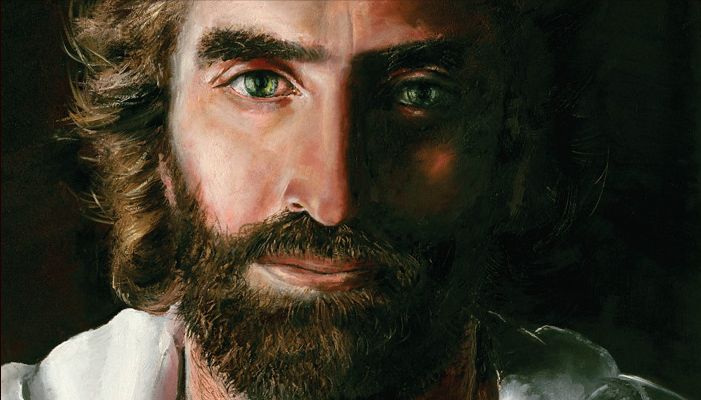
Jesus Christ Prince of Peace (painting by Akiane)

My youngest just “is”. She is impossible to describe but she does me good every day. Unaffected, innocent, pure, without a trace of worry and unconscious of the good she is doing, she works on my soul like a tonic reminding me every day of her namesake’s work in my spirit soul body. There is turmoil in my being at times, probably like everyone, and the cure now seems to be to let Grace do “her” work. The being I am is far too great, terrible and fantastic for me to handle, only Grace can do that. Sin shall not have dominion over me, not because I follow any law, but because of Grace. For I am not under law and she works continuously even when I am not conscious of her.

Or should that be He works?

If you see it you will remember it…

When it comes to visual aids God is no slouch.  Knowing us like He does means that He also knows how to get a message across in a 3D visualisation.  One of the best of these is the Tabernacle.

But what was the Tabernacle?  There are a few ways it could be described but my favourite is from Hebrews 8:5 – a copy and shadow of the heavenly things.  Hebrews 9 further elaborates on this particularly in verses 23 to 24:

“Therefore it was necessary that the copies of the things in the heavens should be purified with [blood of animal sacrifices] but the heavenly things themselves with better sacrifices than these.  For Christ has not entered the holy places made with hands which are copies of the true but into heaven itself, now to appear in the presence of God for us”

Well if it is a copy of the true then the true must be like it, right?  So to look at the tabernacle is to look at a copy of heaven, the real thing.

Moses looked into heaven when he was on Mt. Sinai (Exodus 24 -32, 34).  Stephen looked into it when he was being stoned (Acts 7:55, 56).  Here is a list of others who have seen it:

  • Isaiah 6:1-7
  • Ezekiel 1
  • Daniel 7:9-14
  • Zechariah 3, 4
  • Paul in 2 Cor. 12:2
  • John in Revelation 4 -20

These – and others  –  all saw the same place and recorded various elements of it.  Some described things Moses wasn’t told to represent, e.g. the four living creatures.  Others saw the same things but described them differently.

So here is a question:  What was God’s original purpose for the Jewish people?  Here’s a hint:  it’s the same purpose He has for the Church today.  The answer is in Exodus 19:6 and 1 Peter 2:9 – we are a kingdom of priests.

Jesus is central to the whole thing.  Our eternal High Priest, He took His own blood into the true tabernacle which is not of this creation.  Hebrews 9 gives the details.  Daniel also hints at what happened when he saw “One like the Son of Man” present Himself to the Ancient of Days in Daniel 7:13-14.  And because Jesus has gone into heaven so can we.  In fact we can enter the Holy of Holies because Jesus has removed the veil that was in front of the Father’s presence.

Apart from being a copy of heaven, which is amazing in itself, the tabernacle has many other things to teach us.  I’m going to choose two fundamental ones: 1.  Becoming a Christian, 2. The main practices of the Christian Life.

1.  Becoming a Christian.

 So what are the stages to becoming a Christian?

The Narrow Gate

You need to enter through the narrow gate at the front of the tabernacle (Matt 7:13-14).  There is a picture here of passing from one dimension to another since it is through this narrow door that we enter into (the copy of) heaven (John 10:7).  Jesus also called it being born again (John 3:5).  Birth is a picture of passing from one place where we breathe and ingest one type of substance (water) to a place where we breathe and ingest quite another (air).

The Cross

Then the Cross (the big bronze altar) is the first thing you see  (Hebrews 10:10-14, 1 Cor. 15:1-4, Isaiah 53).  It’s also the thing God sees.  That altar is too big for us to sacrifice on, there was only one offering good enough and Jesus supplied that with His own body once for all.

Baptism

Baptism (in the Spirit and in water) is represented by the bronze laver or sea.  The first time a priest entered the holy place he had to be completely washed (Exodus 40:12, c.f. Romans 6:3-7).  After that he only needed to wash his hands and feet before he went in (c.f. John 13:10).  Water baptism is our response to the gospel, the testimony of a conscience cleared (1 Peter 3:21).  Spirit baptism is a work of God.  Some people say it is a second experience after being born again, some say it is the same as being born again.  Personally I think the Scriptures point to the second interpretation.  Whatever you believe about it just make sure you have it!

Now the way is clear to enter the Holy Place and start practicing the Christian life.

2.  The Practices of a Christian.
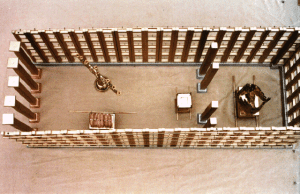
Becoming a Christian means becoming a priest (Exodus 19:6, 1 Peter 2:9).  After the priests in the old testament received their first complete wash, they were clothed in beautiful garments and were able to enter the Holy Place.  When they entered they found three things:

  1. The Lampstand
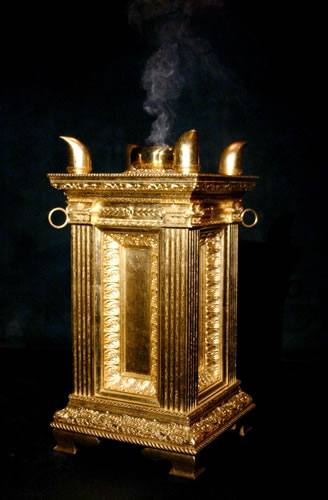
  2. The Altar of Incense
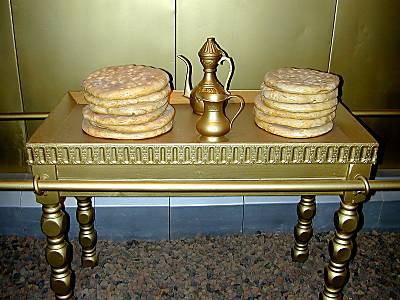
  3. The Table of Show Bread

I believe these three items represent three practices, which if followed diligently will ensure we continue to be a blessing to the God who loved us and our fellow man (Matt. 22:37-40).

The Lampstand
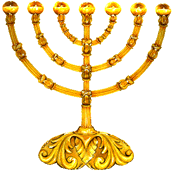
In heaven (of which Moses’ tabernacle was a copy remember) according to Revelation 1:20 the lampstand(s) is the Church.  In particular Jesus walked in the midst of the seven lampstands (local churches) in the New Testament whereas the Old Testament lampstand was just one object.  A lampstand is a place to present a light or, in the case of a New Testament church, the place to present the Light of the World (John 8:12).  It was the job of the priests to ensure that the lamp never went out.  In the New Testament this speaks to us about our role as priests to ensure we do not quench the Spirit (1 Thess. 5:19) and to ensure the light is shining forth to the world around (Matt. 5:14-16) not hidden under a basket.

So the first practice is to be an active member of a local church.

2.  The Altar of Incense
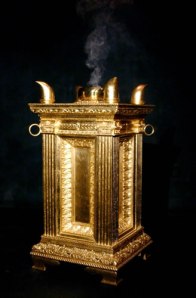
In heaven, according to Revelation 5:8, there was an altar upon which the prayers of the saints rose up before the throne of God.  This is represented in Moses’ tabernacle by the altar of incense.  An altar is a place of sacrifice.  This altar is much smaller than the one outside the Holy Place but it is solid gold and speaks of the sacrifices Christians are called upon to make.  These sacrifices have to originate from relationship with God in prayer and through prayer be continued.

So the second practice is to pray and sacrificially act upon the prayers.

3.  The Table of Show Bread
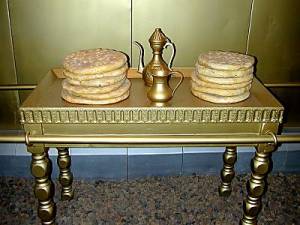
When making the copy of heaven, Moses was commanded to make a table upon which was to be placed fresh bread every day.  Jesus said that “Man shall not live by bread alone but by every word that proceeds from the mouth of God” (Luke 4:4) and there are many references to bread and grain being the word (e.g. Matthew 13, John 6:48 and others).  Bread is refined, milled and ground grain with the chaff removed.  This is rather like the bible but more especially like the word(s) of God spoken to us through fellowship with Jesus.

So the third practice is to spend time with Jesus and to hear His words (Luke 10:38-42).

Where is this all going?

Well one place only really – the throne of God.  Thanks be to Jesus the veil that used to separate us from God is removed (Hebrews 10:19-22) and we can enter the presence of the Most High without fear as children coming to a loving father.

We were made for this.