Category Archives: Life College

Faith Tests

So God speaks to you, not once but often, promising something huge.  He tells you to do something about it and you obey.  And then all hell breaks loose.

First of all, the exact opposite to what God promises happens.  You pray for healing believing God has spoken to you saying that that person, or yourself, will be healed and you feel more sick.  You pray for money because God has promised you will be rich financially and your poverty gets worse. You ask for that deliverance from addiction that you know He has promised and you fall more heavily than ever.

If that is your experience you are in good company.  Moses had exactly the same experience in spades. You can read all about it in the first 6 chapters of the book of Exodus in the bible.

There was no doubting God had spoken to him in that burning bush.  He had seen the signs of the rod turning into a snake and his leprous arm miraculously clean.  Aaron, his brother, was with him and he also knew that God had spoken to them both.  Then they went and did what they were told.  They went right up to the ruler enslaving their people and told him that the Lord had commanded him to let the people of Israel go.

So now Pharoah rolls over and out walk the people of Israel taking with them a bunch of Pharaoh’s people’s goods and money.  You wish!!

No, the first thing that happens is the very opposite of what they asked for: the slavery gets worse.  The people are discouraged and no one believes Moses and Aaron anymore.

22 Then Moses went back to the Lord and protested, “Why have you brought all this trouble on your own people, Lord? Why did you send me? 23 Ever since I came to Pharaoh as your spokesman, he has been even more brutal to your people. And you have done nothing to rescue them!” (Exodus 5:22-23).

God then repeats His promises and explains why He is going to deliver the people of Israel.  Moses is still not convinced that it will happen if it has anything to do with him:

12 “But Lord!” Moses objected. “My own people won’t listen to me anymore. How can I expect Pharaoh to listen? I’m such a clumsy speaker!”

In my own experience I have found that when something God has said to me is challenged I don’t doubt God, I usually doubt myself.  The promise is clear enough and there is no doubting God’s ability to bring something about.  So I reckon that the reason it is not happening must be to do with me.  It seems the most logical explanation.

Moses did have something to do.  He and Aaron were given orders from God for the people and for Pharaoh.  The Lord commanded and they obeyed.

Now if you are reading the passage that I am referring to in Exodus 6 you will notice a strange thing happening at verses 14-30.  The writer goes into this seemingly pointless listing of Moses & Aaron’s ancestors.  I can just imagine this story being told around a camp fire by a Jewish village elder to children and others who may have been hearing it for the first time.  The suspense is deliberate.  Our heroes have been told by God to do something and all that has happened has been the opposite to what they have been promised.  Instead of taking us out of our suspense we are left waiting.  What will happen next?  How will God deliver His people as He has promised?  When will it happen, next week, next month, next year? In 400 years?!

In this case we know the story.  The miracles of the rod and Moses’ leprous arm are almost petty in comparison to what God does next.  It doesn’t take God long to fulfil His promise to deliver the people out of slavery and it sure is spectacular when He does.

There are, of course, other stories in the bible of people who got a promise from God and then experienced the exact opposite immediately or soon afterwards.  Abraham is one example, David is another.  In their cases the time spans between the promise being given and being fulfilled were quite different and called for even more patience.

However, in every case the promises God gave were fulfilled.

If you are in the middle of waiting for a promise from God to be fulfilled and it looks like the opposite – or nothing – is happening, take heart, you are in good company.

Faith shows the reality of what we hope for; it is the evidence of things we cannot see.Through their faith, the people in days of old earned a good reputation.

Hebrews 11:1,2.

Liberals and Conservatives

Mankind just loves to put people into categories. Once we do that we can then begin to take a position.  Once we take a position, the other position is wrong. We love to fight and argue and we need positions to argue from.

There are many ways of creating categories but one of the most popular is to put people into the position of being a liberal or a conservative. The danger is in expressing an opinion on something. Once I express a position I am immediately put into a camp. I am a liberal if I support climate change regardless of any other position on any other subject I may hold. I am a conservative if I am against abortion, again that is regardless of any other position on any other subject I may hold.

But of course Jesus was neither a conservative nor a liberal.

C.S. Lewis has this to say about extremes:

I feel a strong desire to tell you—and I expect you feel a strong desire to tell me—which of these two errors is the worse. That is the devil getting at us. He always sends errors into the world in pairs—pairs of opposites. And he always encourages us to spend a lot of time thinking which is the worse. You see why, of course? He relies on your extra dislike of the one error to draw you gradually into the opposite one. But do not let us be fooled. We have to keep our eyes on the goal and go straight through between both errors. We have no other concern than that with either of them.”

Lewis, C. S.. Mere Christianity (p. 77). HarperCollins Publishers. Kindle Edition.

He who believes in Me

“If anyone thirsts let him come to Me and drink. He who believes in Me in the way Scripture says, out of his innermost being shall flow rivers of living water.”

These are the words of Jesus quoted in  John 7:37, 38. I love the way the Old Testament foreshadows this in unexpected ways:

The words of a man’s mouth are deep waters; The fountain of wisdom is a bubbling brook. Proverbs 18:4.

The distinction between a babbling fool and a bubbling brook of wisdom is critical here. The source is always the most important thing. The channel it comes through is also important. Jesus says that you have the capability to be a channel for His wisdom. It is a holy task to find out how that works in your life so that you can continually be a bubbling brook of refreshing and life giving words to those who are thirsty for them.

It is also a lifetime’s work.

What is the Church?

A couple of people close to me recently asked me a question which seemed to betray a misunderstanding of church. The question was: “Why do people get hurt going to church?” The implication was that if the church is part of the Body of Christ how could God’s body do anyone any harm?

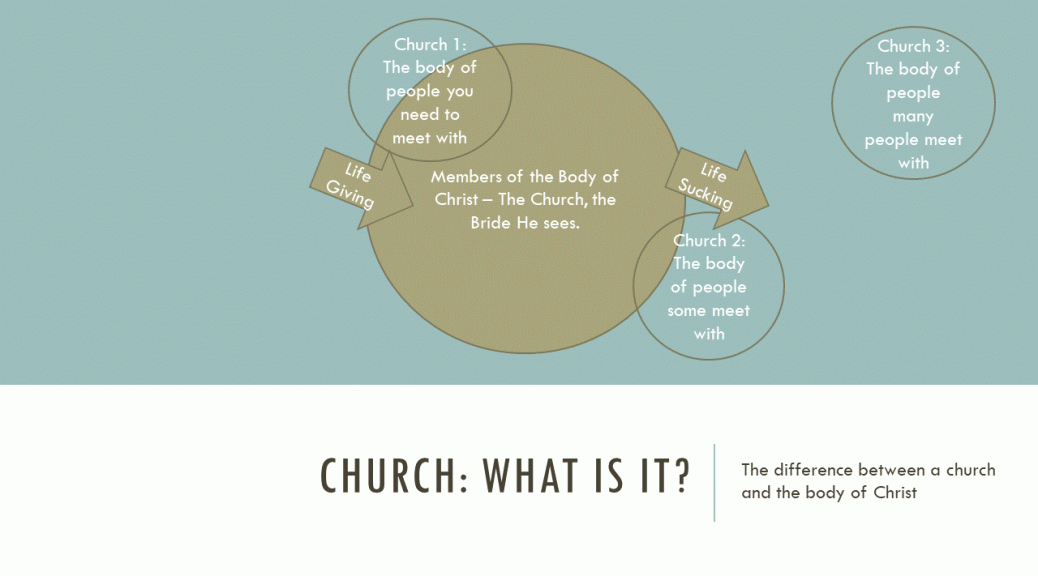
I think the misunderstanding is most easily cleared up by using a diagram.

In the diagram I show a large circle in the centre which shows the Body of Christ worldwide. Around the edges and to one side I draw three other circles that represent what most people call churches. The first thing to note is that no church (as the term is commonly understood) consists fully of people in the Body of Christ. I can say with confidence that there is no large group of people meeting on a Sunday morning on this earth whose members are all members of the Body of Christ. There may be smaller bodies of people who meet together, particularly in countries where the church is persecuted, that are all members of the Body of Christ but, even then, it can be a very hard thing to assess. How do you know whether everyone you meet with knows Jesus or not? (Part of the answer to that question can be found in 2 Timothy 2:19, i.e. “The Lord knows those who are His” and He can tell you and “Let everyone who names the name of Christ depart from iniquity” – you can know a believer by their consistent behaviour and character manifestation over a long period.)

Among these churches I have drawn a distinction between three types of congregations.

Type 1 is what I would call “life giving”. These are churches you need to go to if you are a member or aspire to be a member of the Body of Christ.  They encourage you to love Jesus and through Him to love the Father , your fellow brothers and sisters in Christ and your neighbour as yourself.

Type 2 is what I would call “life sucking”. These are congregations of people that do not encourage you to love God with all your heart or your neighbour as yourself.  They are often dying in the sense that they are reducing in numbers but that isn’t always a reliable sign.

Type 3 is just plain dead. There actually may be some people in it (unlike in the diagram) that are in the Body of Christ but they might as well not be since the church itself is doing nothing related to Jesus. These types of churches are all too common. There main distinguishing feature is that they are more interested in continuing their existence than they are in the well being of their attendees.

Diagrams like the above are of course limited in reflecting reality which is often more complicated and messy. Anyone, whether a believer or not, is capable of walking in the flesh and, as a result, either hurting someone or being hurt by someone.

The main point is this: don’t expect people in churches to act like the Body of Christ should act.  Not even most of the time. They are not the same thing. Be prepared to be hurt by people in church and you will be a bit more prepared and less disillusioned when it happens.

Mere Christianity

C.S. Lewis was asked by the BBC to give a series of talks on the radio during the second world war called “Mere Christianity”.  These were later expanded into a book which is one of the best summaries of Christianity out there.

One of the most famous passages from this book is the following statement about who Jesus is.  It is commonly known as “Lewis’ trilemma” or  the “Mad, bad or God” argument.  It is well worth reading this passage in context and, indeed, reading the whole book:

“Yet (and this is the strange, significant thing) even His enemies, when they read the Gospels, do not usually get the impression of silliness and conceit. Still less do unprejudiced readers. Christ says that He is ‘humble and meek’ and we believe Him; not noticing that, if He were merely a man, humility and meekness are the very last characteristics we could attribute to some of His sayings. I am trying here to prevent anyone saying the really foolish thing that people often say about Him: ‘I’m ready to accept Jesus as a great moral teacher, but I don’t accept His claim to be God.’ That is the one thing we must not say. A man who was merely a man and said the sort of things Jesus said would not be a great moral teacher. He would either be a lunatic—on a level with the man who says he is a poached egg—or else he would be the Devil of Hell. You must make your choice. Either this man was, and is, the Son of God: or else a madman or something worse. You can shut Him up for a fool, you can spit at Him and kill Him as a demon; or you can fall at His feet and call Him Lord and God. But let us not come with any patronising nonsense about His being a great human teacher. He has not left that open to us. He did not intend to.”

Lewis, C. S.. Mere Christianity (p. 24). HarperCollins Publishers. Kindle Edition.

Faith and Waiting

There is a pattern of God’s working with men that seems almost like He is teasing us, but the aim is to test and show our faith, remove idolatry and make us more dependent on Him.

When Abraham was told at the age of 75 that his descendants would be like the stars of heaven or the sands of the seashore (Gen. 15:1-6), his expectation was probably that he would have a son almost immediately and that there would be at least tens of descendants before he died.  As it turned out, he had just two descendants (Isaac & Jacob), to whom the promise applied, by the time he died 100 years later (see Gen. 25).

Joseph might have been forgiven for thinking that the trajectory of his life would not have involved kidnapping, prison and servitude from the age of 17 to 40 after getting dreams of his parents and his siblings bowing down before him (Gen. 37 – 40).

Moses probably didn’t anticipate Pharaoh making things much harder for the the people of Israel when he was sent to deliver them from bondage (Exodus 5).  Watching the bondage actually increase when he was told that God would deliver them must have been hard.  God didn’t tell Moses that that was going to happen first and it didn’t exactly inspire faith in his story in the ones he had come to deliver either (Exodus 5:21).

Another significant example of the same principle in practice can be seen in the life of David.  He was anointed king at around 17 (1 Sam. 16:1-13) but was running for his life for a large part of his career after that and didn’t see the fulfilment of the promise until he was 30 (1 Sam. 18 – 2 Sam. 5).

So, if you have been given a promise from God and the exact opposite seems to be happening don’t be surprised.  You are in good company.

God will come through for you.

“..we also glory in our sufferings, because we know that suffering produces perseverance; perseverance, character; and character, hope.”

Romans 5:3-4

Faith and Desire

God knows your deepest desires and isn’t surprised by any of them.  I believe that He has an answer to them all in Christ both for this life and the next.

As believers one of the things we have to get used to is that the line between this life and the next is very thin indeed.  There is a major transition involved, we need to shake off this mortal body and put on an immortal one.  But apart from that nothing else changes – much!  It does take faith to look over that gap and see our lives continuing on.

However, one of the keys of living a contented Christian life here is to hope and believe in satisfaction and contentment throughout our existence.  Some desires will be satisfied here during this mortal life, many will be satisfied there during the immortal stage.

God commends this kind of faith.  In the letter to the Hebrews, the writer ends up his panegyric about the heroes of faith in chapter 11 by saying this:

“All these people earned a good reputation because of their faith, yet none of them received all that God had promised.”

The saints of the Old Testament are still waiting for our time to come to a close before they will get all they desire.

So, if you are facing unfulfilled desires in this life, ask yourself whether God hasn’t planned to fulfil them in the next.  No, better still, ask God.  You might be surprised at His answer.


Basic Faith

Faith is the confidence that what we hope for will actually happen; it gives us assurance about things we cannot see.

It is impossible to please God without faith.  Anyone who wants to come to Him must believe that God exists and that He rewards those that sincerely seek Him. (Hebrews 11:1, 6 NLT)

When people ask me what we have to believe I have often said the Gospel requires very little faith in reality, at least to start with.  All we need to believe is that God exists and that He is good.  Everything else can be logically built upon those two foundations.  If God exists and is good then it follows that He would do all that the bible says He has done.

No one can prove God is, but then neither can any of us prove that anything ultimately exists since we cannot know the basic materials on which matter is built.  The more we split the atom, the more there is to split.  So, rather than being unreasonable, we logically believe in some basic building blocks (atoms, nucleus, protons, neutrons and electrons) and our engineered inventions (everything from fridges to freight carriers and beyond) are built on those beliefs.  They work because the things we believe about materials are true, i.e. God made materials the way we have found out (Proverbs 25:2).  We then build our lives on these beliefs even though we cannot see the basic building blocks of anything.  Depending on what we work at and, to some extent, what we want to find out, we know these things at different levels.

Take the example of a microwave oven.  You can “know” a microwave at different levels.

  1. A user might just know how to turn it on and what level to set it at to heat up the food he puts into it.
  2. A curious person might get to learn that a microwave works because it heats up the water in food using a specific type of electro magnetic wave.  This might help them to understand why some things shouldn’t be put in a microwave.
  3. At a deeper level someone else might understand the size of a water molecule and the wave length of the electro magnetic wave used in a microwave.  The connection between the two is what causes the water to heat up.
  4. The manufacturers of microwave ovens may need a team of people with different understandings of how it works and how to improve the design to stay ahead of the competition.

And so it goes on.

In the same way, the bible tells us to be reasonable.  Believe in some basic things: God is and He is good.  After that, everything God has caused to be written in His book is reasonable and makes sense.  And you can go as deep or be as shallow in knowledge as God and you want to be with that book – and Him.  Whatever about knowledge (1 Cor. 8:1-3) just make sure you are not content with being shallow in His love (Eph. 3:19).

God says: “I AM” (Exodus 3:14).  He is.

The bible goes onto say that God gave His only Son that whoever believes in Him should not perish but have eternal life (John 3:16).  He is not willing that anyone should perish (1 Tim. 2:4).  In other words He is good.

Start there.

Understanding the Closeness of God

When we are dealing with the God who made everything, including every cell in our physical bodies and all the space He inhabits within our atoms – in Him we live and move and have our being (Acts 17:28) – there is every justifiable reason why we might get confused about hearing His voice or experiencing His presence.  He is so close!  In fact the English word “close” does not do justice to the amazing interaction of God with those He has an intimate relationship with.

So we can often think we are just imagining things when it is in fact God speaking to us.  One of the great things to learn how to do is to recognise that still, small voice that speaks to us out of the chaos and noise of everyday life (see 1 Kings 19:11-13).  To know His presence is even more intricate.  It is so intangible, so outside of, and yet works through, our emotional state.  We forget that we were made, designed, to know these things.  God’s voice and His presence can seem so natural we can just dismiss them as our imagination.  But even our imagination was made to enhance and help us understand the voice and presence of God.

“Today, if you hear His voice, do not harden your hearts.” (Hebrews 3:7, 15).  Actually, this is the nub of the matter: Do you really want to hear what God is saying to you (see John 7:17)?  Might He be saying, get out of the way and let Me work?  Possibly, though He will say it, if He has to, more graciously than that.

Mesmerised

2250 AD Martin was in front of the four living creatures and had fallen over onto his face again.  “I thought you said he would be able for this,” an angel said. “He will be ok it’s just that even in his new body he finds it hard to cope with things that don’t relate to anything else he has experienced before,” Jesus responded.

Martin began to come around.  As he regained consciousness he remembered to prepare himself for the shock.  He didn’t want to go into that catatonic state or whatever it was he had just experienced again.  So he concentrated hard and managed to get a hold of all the various impulses coming to him through all his senses and extra sensory perceptions.  The flood of impressions coming at him from the four living creatures this close up was the closest thing to pain he had felt this side of the rapture.  He could feel himself wobbling again and getting giddy.

“Look at Me.”  It was Jesus saying the only sensible thing to do.  So Martin looked into Jesus’ eyes.  Strength and power flowed through his new body and he found he could stand firm.  His admiration for John, Ezekiel and Daniel grew.

Patricius, the angel, asked Martin if he was ready for a short journey to the regions beyond.  Martin thought he was so he went with the angel into the living creatures.