
Category Archives: His Story

A Cosmological World View based on Holy Scripture
A module in Life College

Fruit

We have two fruit trees in our back garden, a plum and a pear tree.  Both have produced an abundant crop this year (2017), a crop unlike any of the other 8-10 years they have been planted.

The fruit of the plum tree is super abundant.  It is hard to imagine how such a small tree can produce so many plums.  There must be at least a thousand plums on the tree.

20170819_121823

Over the last few Sundays we have brought a lot of the plums to the church we attend where they were eagerly devoured in a matter of minutes.  Olive also made a couple of plum tarts for the family which we all enjoyed.  During the weeks of the harvest I have been eating a couple of plums a day, the rest of the family have been eating some as well.

However a lot of the fruit is not as sweet as we would like it to be.  It’s quality is not great and we seem to remember that in other years the fruit tasted better even though there was much less of it.

20170910_104326

During the months leading up to the harvest we neglected the tree.  One day when I did get out to look at it late in the season before the fruit was ripe, I noticed that the tree was utterly infested with greenfly.  The leaves were curling and some branches had grown with no fruit but totally covered with greenfly.  I took away the worst infested of these.  This action seemed to improve the situation later.
20170910_104539

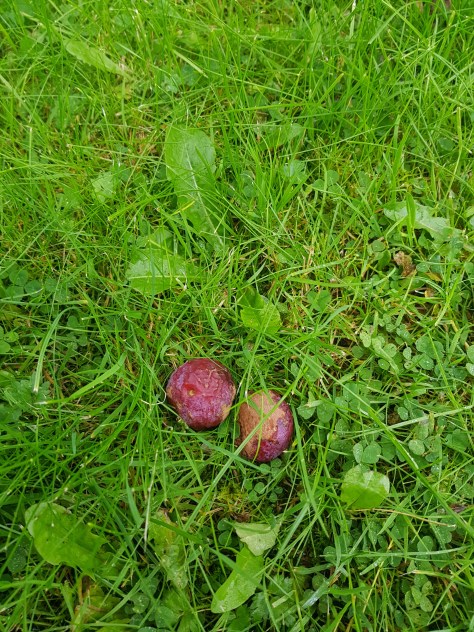
Nevertheless the fruit kept coming.  In the end a lot of it fell off the tree and was inedible as soon as it was on the ground for any length of time.  Slugs and other less visible insects quickly spoil the fruit.  Some of it shriveled on the tree and never fully ripened, others were attacked by wasps and spiders while still on the tree.

20170910_104427

At various stages I was torn as to whether to harvest the plums off the tree or not.  We didn’t seem to get enough sun and the plums didn’t seem ready to fall off the tree.

I imagine this is a spiritual picture of what can happen if we neglect the spiritual fruit of our lives or allow sin to take over.  The results can be mixed.  Much of the fruit is good and useful but a lot is lost through neglect, disease and demon interference.


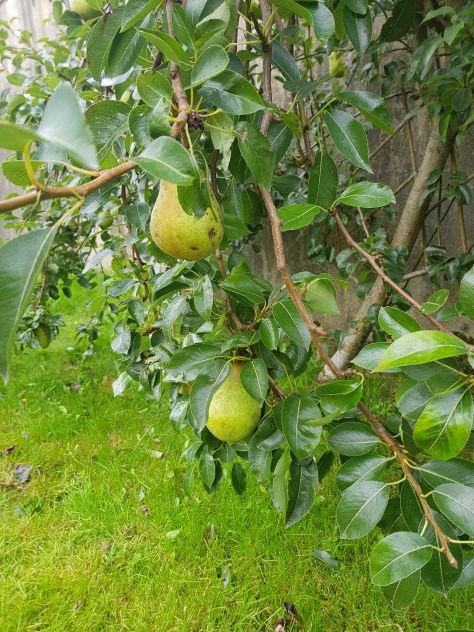
The pear tree has also produced a lot of fruit.  There must have been about 100 pears.

20170910_105030

In contrast with the plums this fruit is almost perfect.  We have lost a couple to windfall but on the whole we have been very successful in harvesting and using them.
20170910_105036

We brought some to the church, made cakes out of others and I and the family have been having one each per day for the last few weeks.  The cakes didn’t last long.


Fruit is a seasonal phenomenon.  Based on how little or how much attention we pay during the earlier parts of the year, and on the weather, next autumn there could be more or there might be very little fruit on the trees.  Professional fruit growers seem to know how to produce a large, high quality fruit harvest on trees year after year though I think even they are at the mercy of the weather.  It takes God’s favour, and a farmer’s skill, nurturing and time to create a consistently abundant, high quality harvest.

How is your fruit?

Significance

I was watching a documentary about the Voyager space missions called “The Farthest” last week.

For those who don’t know, the Voyager space missions took advantage of a rare planetary alignment to launch two space probes to explore the outer planets of the solar system. The missions started in the ’70’s and both probes are still transmitting back information to earth.

After watching the documentary and listening to the scientists and engineers who worked on the project, my overwhelming impression was one of pathetic insignificance. This is epitomized in a documentary by Carl Sagan who presented the speck of dust – the pale blue dot picture that was taken by Voyager 2 from somewhere beyond Neptune. Earth is seen as a barely perceptible speck in the brightest of the bands in the photo.

Many of the scientists talked during the documentary of how significant it was that mankind had managed to send a vehicle into outer interstellar space for the first time. But no, this is not Star Trek, not even close.


So I wake up for a morning’s quiet time with God.

“God I’m nothing.

Less than nothing.

We are all less than nothing.

Why do you bother?”

Then my sin – my falling short – pops up its ugly head again.

Like a fleshy root or fungal growth out of my flesh, like Alien it is too powerful for me. It looms large in my imagination, overwhelming me, threatening to completely take over my life and destroy it, me, my family and destroy Christ’s reputation in work, church, friends.

Whoa, stop, back up, it really is no more significant than I am. It’s also pathetic.


Then I hear a voice gently calling my name:

“Brendan”

“Yes, that’s pathetic little me” I think.

“Brendan”

Is that really the God of the universe calling my name?

“Brendan, I am LOVE, that’s why

And then it all comes rushing back.

God is infinite powerful love.

He cares about me, us, everything.

One day He will put me to sleep and remove this sin that so easily entangles me maybe on my last mortal day, maybe before then.

In the meantime there are good works to do which He has prepared beforehand.  Works that He cares about, works that give us significance.

What a wonder it is to be called a child of God!

Truth

It has always been the case that Jesus is the Truth and what He says is true.

In this time where lies seem to be billowing out like black smoke across the world’s media as much as they ever did in Mussolini’s Italy or Hitler’s Germany it is so encouraging to remember that He has seen this all before and, for Him, nothing has changed.  He is still the Truth and what He says is still as true as it has always been.

And He says this:

“Amen, truly I say to you, if you have trust and do not try and work it out….all things which you ask in prayer believing you will receive.” (Matthew 21:21a, 22; Greek literal translation).

Create in me a clean heart O God.  I have never needed it as much as I do now.

Five types of people: 1. Never Heard

When it comes to entering into eternity it is possible to categorise people into 5 types:

  1. Those who never heard the gospel;
  2. Those who heard but didn’t understand it;
  3. Those who heard, received it and when the going got rough, gave up;
  4. Those who heard, received it and got worn down or deceived;
  5. Those who heard, received it and produced multiplied fruit.

This categorisation is based on the parable of the sower in Matthew 13, Mark 4 and Luke 8 as well as other Scriptures.

Category 1: Never Heard

The first category is those billions through the ages that never heard the gospel during their lifetime.  Scripture says this about them (Romans 2:14-16, NLT):

“Even Gentiles, who do not have God’s written law, show that they know his law when they instinctively obey it, even without having heard it. 15 They demonstrate that God’s law is written in their hearts, for their own conscience and thoughts either accuse them or tell them they are doing right. 16 And this is the message I proclaim—that the day is coming when God, through Christ Jesus, will judge everyone’s secret life.”

Evangelicals can hold some strange positions when it comes to those who haven’t heard the Gospel.  They often categorise them as the “unsaved” which makes no sense in the context of 1 John 2:2 (see also John 3:16-18, 1 Peter 3:18):

“He himself is the sacrifice that atones for our sins—and not only our sins but the sins of all the world.”

According to Matthew 25:31-46, God and the saints (1 Cor. 6:2) will judge them according to their works and their relationship to the saints and God in their hearts (inasmuch as you did it to the least of these my brethren, you did it to Me).  Some will be shown to be sheep destined for eternal life and some will be revealed as goats destined to the second death.

The Schoolyard

Jesus said that the people of his time were like children playing a game in the public square:

16 “To what can I compare this generation? It is like children playing a game in the public square. They complain to their friends,

17 ‘We played wedding songs,
    and you didn’t dance,
so we played funeral songs,
    and you didn’t mourn.’

18 For John didn’t spend his time eating and drinking, and you say, ‘He’s possessed by a demon.’ 19 The Son of Man, on the other hand, feasts and drinks, and you say, ‘He’s a glutton and a drunkard, and a friend of tax collectors and other sinners!’ But wisdom is shown to be right by its results.”

(Matthew 11:16-19 NLT).  

This could probably translate to a schoolyard in our time just as well.  In the passage he describes the reactions of the other children to John and himself.  They are playing the normal games and these guys just won’t fit in.

I’ve tried to paraphrase it a bit, bring it up to date and look at it from a neutral observer’s point of view:

[A few days in] “So the other day we were playing the usual games of tag and the new guy – John – starts going on about something.  He not only doesn’t want to play but he starts up a new thing of his own over near the drinking fountain.  He doesn’t dress like the rest of us and he doesn’t go along with the gang.  I think he has special needs.”

[Sometime later] “John has managed to get a surprising amount of people to put their heads under the drinking fountain!   The teachers are getting involved now.  He has even been telling them they are wrong in what they are teaching in religion class!  Apparently he doesn’t agree with them saying one thing and doing another.  Keeps going on about judgement coming.  I don’t think the teachers like it much.  I still think he has special needs.”

[Later still] “John’s cousin turned up today.  The first thing he did was to go up and put his head under the drinking fountain.”

children-playing

[Later] “John has got expelled.  His cousin is hanging out with all the druggies, drinkers and girls who everyone knows have slept around. It seems like he has gone the complete opposite direction to his cousin. I don’t think the teachers like him either though.”

So I guess we all know how this ends.  But at the time Jesus drew this analogy (in Matthew 11:16-19) this was roughly where things were at.

Interestingly, it wasn’t that either John or Jesus were wrong even though they both had such polar opposite ways of approaching their relationships with their peers.  John is confrontational, Jesus is winsome (at least at this point – that changes later).   Jesus ends his little analogy with the comment that there is wisdom in both approaches.

I think teenagers in particular struggle with that breadth of acceptance of those they perceive to be different.  But they are not the only ones.

Possibly Impossible

There are a lot of tensions in Scripture:

  1. Predestination v. Free Will
  2. Deity and Humanity of Christ
  3. Old and New Testaments
  4. Law v. Grace
  5. Holiness v. Grace
  6. etc.

We’ve only been to a few churches and we have usually spent a long time at each.  The last church I attended for 18 years and my wife was there for longer.  This current one we have been at for over 11 years now.

The two churches in many ways could not be more unalike.  There are many differences but the one difference I want to look at today was their approach to the character of Christians/ God.  Holiness v. Grace.

One church very strongly emphasized something that I believe is true from Scripture:  It is possible to be “perfect as your Heavenly Father is perfect” as Jesus commands us to be in the Sermon on the Mount (Matthew 5:20, 48).  In fact the Scriptures tell us how.  First be born again (otherwise you can’t even see the Kingdom of God), second consecrate yourself to do the will of God only, third walk in the Spirit, or as John puts it, abide in Him (John 15).  And, despite doing this, if you do sin, and everyone sins, then confess your sins and you will be cleansed and can start afresh (1 John 1). Simple really.

The other church very strongly emphasizes something else that I believe is true from Scripture:  Jesus died for the sins of the whole world for all time so you can stand before God unconditionally unashamed.  It is by believing in your heart that Christ died for you and confessing with your mouth that you are saved (Romans 10:9-10). This is typical evangelical doctrine and, inevitably, there will be a proclamation of that simple Gospel at every service so that people have a chance to encounter God.  The hope is that the encounter will then change everything for the person who has it – and very often it does.

Emphasis is the main difference here.  An over emphasis on walking in the Spirit or your behaviour as in the first case, can lead to that being the criteria that you are assessed by.  The danger is that on entering that church you would first have to behave in a certain way and then show the right beliefs before you (might) be accepted.

However the emphasis in the second church also has its problems.  In this case you are accepted no matter what your behaviour is like with the hope that you will believe and then God will then work with you to change your behaviour.  However you can be left wondering what difference there is between those going to the church and those who don’t.  In some cases their behaviour can seem indistinguishable.  It is very messy.

Personally I think the second emphasis is better than the first.  But then who wouldn’t prefer grace to holiness?

Is it even possible to get the balance right?

I desire mercy, not sacrifice

There is a scene in “The Bible” mini series, reproduced in the film “Son of God“, where Jesus reaches out to Matthew, a tax collector.  If you have ever felt rejected by your peers, accused of being a traitor, or just generally outcast then it is not so difficult to identify with Matthew nor to respond to the glorious acceptance of the Son of God as expressed in these words from Matthew 9:

“Those who are well do not need a doctor, but those who are sick.  Go and learn what this means: “I desire mercy, not sacrifice.” I haven’t come to call those who are righteous, but sinners.”

As Paul says in Romans 11: “God has given every one over to sin, so that He might have mercy on them all.”

Be Attitudes – repost

This post first appeared in Aug 2015

The eight beatitudes are nearly the first thing Jesus says in the Gospels. They reveal His heart.

These are the types of people God has time for:

The poor in spirit. People with this attitude are the opposite to the pushy, showy type that is always in your face and who is full of self importance.  We all know someone who is “poor in spirit” but filled with the Spirit.  That’s because the Holy Spirit is, like Jesus, humble and gentle at heart.  These are the type of people that get into heaven.

Those who mourn.  In this life there will always be mourners.  At some stage we all are likely to mourn the loss of someone we love.  Jesus knows that and says He will comfort us.

Those who are humble.  I’m not sure what the difference between these are and the poor in spirit.  Nor do I know why they inherit the earth specifically.  Perhaps there isn’t supposed to be a difference.  The lowly in heart get both heaven and the earth.

Those who hunger and thirst for justice.    Jesus knew these guys would be satisfied.  He also knew at what cost that would be to Him.  There will be justice also for those who refuse to receive the grace of God and create injustice.

The merciful.  This is something we should all do. We will all need mercy.

The pure in heart.  These will see God.

The peacemakers.  Peacemakers are not looking out for their own wants, but are involved in reconciling opposing parties.  Everyone can see that they are children of the God of peace.

Those who do what is right.  You don’t have to explicitly do something in the name of Christ for this to apply to you. Anyone who stands up for the oppressed or does what Jesus would do might be persecuted for it.  These also are the types of courageous people God wants with Him in heaven.

Jesus’ followers.  Be prepared to be mocked, persecuted and lied about.  But be very happy about it when you are!

“Blessed are the poor in spirit,
For theirs is the kingdom of heaven.
Blessed are those who mourn,
For they shall be comforted.
Blessed are the meek,
For they shall inherit the earth.
Blessed are those who hunger and thirst for righteousness,
For they shall be filled.
Blessed are the merciful,
For they shall obtain mercy.
Blessed are the pure in heart,
For they shall see God.
Blessed are the peacemakers,
For they shall be called sons of God.
10 Blessed are those who are persecuted for righteousness’ sake,
For theirs is the kingdom of heaven.

Matthew 5:3-10

Magi, Empires and Prophets

When Herod was king of Judea, there were two great empires that disputed the ownership of his land. On the one side were the Romans who had conquered it some years earlier. On the other were the Persians who had been there long before the Romans.

Hundreds of years earlier (586 BC) Jerusalem had fallen to the Babylonians. Through a number of miraculous events that you can read about in the Book of Daniel, some Jewish exiles had risen to a place of great prominence in that empire. It wasn’t long before the Medes & Persians conquered the Babylonians. Remarkably, Daniel and his friends kept their positions of power through the transition.

The Pleiades

Daniel was probably the first of the Magi, the kingmakers of the Persian Empire. There is some speculation here but it would appear that he knew what star (or events in the heavens) to watch out for and told his successors. You can read all about the Star of Bethlehem and the astonishing (and verifiable) astronomical events that surround the birth of Jesus at this site.

When the Magi of Herod’s day saw the signs they headed off to Jerusalem following the star. There were probably a lot more than three of them. This was the Persian empire setting off a Cuban missile crisis type of event with their arch enemies the Romans. They were laying claim to the land of Judah. Herod and all Jerusalem were disturbed with bloody results.

A King had been born. Wise men sought him. They still do.

Matthew 1: 1-18

The Infinitesimal Drama of the Virgin Birth

Incomprehensibly constrained to the size of a pinhead, the Lord of the Universe marches down through the ages and arrives Immanuel in a young girl’s womb.

From the first glorious image of Adam through patriarchs and kings, Matthew parades the central march of God’s history before us and brings us to a place of wonder – a few cells in a wonderful dwelling.

“Did You wrap yourself inside the unexpected
So we might know that Love would go that far?”

That whole long march, funnels down and focuses like a laser on this tiny point.

Matthew 1.

Music taken from the album “Music inspired by the Story” 2011.  Song sung by Francesca Battistelli.