Category Archives: His Story

A Cosmological World View based on Holy Scripture
A module in Life College

Naming the Stars

In Psalm 147 v.4 and in Isaiah 40:26 the bible explicitly says that God named the stars.  The bible itself contains several of these names.  They are really beautiful, try saying some of them:

The PleiadesThe Pleiades

Orion:  Betelgeuse, Rigel

Aldebaran

Sirius

Regulus.

According to Wikipedia this name means:  “Latin for ‘prince’ or ‘little king’. Regulus was known to Persian astrologers as the Royal star Venant, Watcher of the North.”

Which ties nicely into the true story of the Bethlehem Star.  If you haven’t already been there, I would strongly recommend that site.

Creative Words

You could choose any aspect of creation to see God’s astonishing imagination but let’s just take the plants as an example, or more specifically the flowers of plants.

Here are some pictures I took one afternoon at Russborough House. Well worth a visit by the way, and at this time of year you simply must visit the garden of Eden which is their Rhododendron Garden at the back of the house from which the following pictures have been taken.

So God says, “Let the land produce vegetation: seed-bearing plants and trees on the land that bear fruit with seed in it, according to their various kinds.”

How did God speak into being the specifics of His creation?  Or did He have to?  Perhaps He just imagined it all and then the words recorded in Genesis were all He had to say.

However I guess He must have said a lot more also. But where do you begin?Magnolia in the Rhododendron Garden at Russborough House

Well here’s a part of a creative conversation by God (perhaps): “Let’s create a sheltered beauty that, when it appears, will reflect purity and innocence, fragility and perfection all at once.”

Voila! A magnolia (and a lot of other flowers also).

Elsewhere I have written about the amazing stored program that is a seed. Flowers are part of that amazing idea that is reproduction. I think God loves that idea a lot, he seems to have reserved some of his most Red Rhododendronsbeautiful creations to carry it out.

So God says: “Lets create fire and invitation, embrace and sustenance all at once.” Voila! A rhododendron.

What kind of Mind was it that thought of bees? They are beautiful in their own right and absolutely indispensable for the reproduction of many plants. And what a way to do it! They are looking for something else altogether when they come to a plant (nectar) and only take away the pollen by accident – designed accident that is. Hence the invitation, embrace and sustenance in these flowers (and in lots of others).

And so we come to the crown of His creation. For we have been created to appreciate these things. Evolutionists and atheists would try, if they could, to rob us of that.

God did it all in 6 days and rested on the 7th knowing that from then on His physical creation would run itself. This leaves Him free to rest and think about getting involved in the creation of each soul.  And relationship with them.  And the cost of that.

Peace and Rest

There are many places in Scripture where God tries to tell us just how important he considers it that His people should be walking in peace.

In the New Testament we are commanded to strive to enter the rest that the Israelites failed to enter because of disobedience (Hebrews 3: 12 – 4:11).

In the Old Testament God enshrined rest in the fourth commandment (Exodus 20:8-11). He considered it so important that the penalty for violating that commandment was death (as shown in Numbers 15:32-36).

Despite being told the penalty for breaking the Sabbath, when faced with the violation (Exodus 31:14) they hesitated before carrying out the punishment -understandably. Of all the various death penalties meted out to the Israelites under the Law this one seems most harsh.

Thankfully we are not under the Law. Nevertheless there are sins that lead to (spiritual) death (1 John 5:16) and for us as Christians it would appear that consistently not being in rest is one of them.

Jesus emphasized again the importance of resting in Him in John 15: 1-7 where he mentions some quite shocking consequences of not abiding in Him. We can be cast out of His body that way.

From my own experience I have noticed both in myself and others that if I am not in rest it is usually because I am not trusting in God – I am anxious or worried –  or I am proud and rising up in myself, full of myself. Neither of these states is pleasing to God and, if continued in, they will inevitably result in separation from God.

Actually, spiritual death is worse than physical. So let’s strive to enter that rest.

And remember, there is always hope in Christ. All you have to do is come to Him. No matter where you’ve been – or how often you have been out of rest – you will find a welcome there every time you turn to him (the old fashioned word is “repent”). His death on the cross has made that possible.

“Come to Me, all who are weary and heavy-laden, and I will give you rest. 29“Take My yoke upon you and learn from Me, for I am gentle and humble in heart, and YOU WILL FIND REST FOR YOUR SOULS. 30“For My yoke is easy and My burden is light.”

Matthew 11: 28-30 (NASB).

The sower sows the word

faithfulwon's avatarfaithfulwon

This was the first blog that I posted almost exactly 4 years ago.  It addresses a theme – the Word of God – that comes up many times in subsequent blogs.

Luke 8:11 explains that when the Scripture talks about seed it  is referring to the word of God.  Its one of those key verses like Rev. 1:20 which explains an object picture that God uses to describe something spiritual.

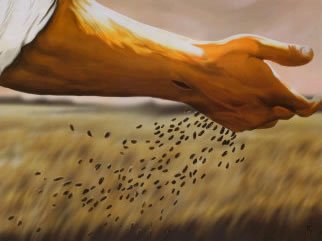
The parable of the sower in Matthew 13, Mark 4 and Luke 8 is an important one to understand (Mk 4:13).  Seeing our souls as a garden enclosed (Song 4:12) helps.  It is a very large garden capable of growing all sorts of trees and plants.  Just like any garden, if it is left untended it will grow weeds.  The best thing is to clear it, break it up (Hosea 10:12) and sow the word of God.

However there is a more general sense…

View original post 160 more words

He’s wild, you know. Not like a tame lion

C.S. Lewis describes Aslan in those terms to Lucy in one of his Narnia chronicles, The Lion, the Witch and the Wardrobe.

The concept of a three personal God is very precious to me.  I love the idea that He is not depending on us before He works miracles, not even on our faith.

Of course, without faith it is impossible to please Him (Hebrews 6:11).  Anyone that comes to Him must believe that He is and that He is a rewarder of those that seek Him.

But when it comes to doing miracles, God isn’t limited by our faith.  He is quite capable of doing His own thing.

John wrote his gospel after the others.  And one of the things he does in his gospel account is write about miracles that have nothing to do with anyone’s faith except that of Jesus Himself.

  • In Chapter 5 he heals a man that was 38 years beside a pool waiting to try and get in when it was stirred up.  All he asks is whether he wants to be healed or not.  To this the man replies in a manner that shows that he only believed that the stirred up pool could save him, not Jesus.  Nevertheless Jesus heals him.  Later the same man betrays Him to the Pharisees.
  • In Chapter 6 Jesus feeds the five thousand when the only response of anyone present to his command to feed the people  was “What are these among so many?”.
  • In Chapter 11 Jesus raises Lazarus from the dead.  We know Lazarus was incapable at the time of exercising faith(!).  But Martha who was capable showed significant unbelief despite earlier promising statements.  There is no sign anyone else had any faith that He would do this. (Go and read it).

There are times when people do exercise faith in John’s gospel.  In these cases Jesus says a very specific word, the person concerned obeys and the miracle occurs:

  • In Chapter 4 the royal official sees his son healed after doing what he was told.  But it was probable that Jesus healed his son before that anyway.
  • In Chapter 9 he heals a man born blind after he does what Jesus says.  Here is an example of a man hearing the Word of God in a specific way, being obedient to what he heard and then seeing – literally – the miracle occur.

If you want to see miracles the key is to be where Jesus is (John 12:26) which means definite and continuing obedience to what He says.  Now all I need to do is put this into practice a bit more myself!

Biblical Rejoicing

“Consider it all joy, my brethren, when you encounter various trials”

James 1:2

Biblical rejoicing has nothing to do with being happy or experiencing pleasure and everything to do with faith.

“In this you greatly rejoice, even though now for a little while, if necessary, you have been distressed by various trials, 7so that the proof of your faith, being more precious than gold which is perishable, even though tested by fire, may be found to result in praise and glory and honor at the revelation of Jesus Christ; 8and though you have not seen Him, you love Him, and though you do not see Him now, but believe in Him, you greatly rejoice with joy inexpressible and full of glory,”

1 Peter 1:6-8

We rejoice because we believe.  Our rejoicing in trial proves our faith.

Blessed are you when people insult you and persecute you, and falsely say all kinds of evil against you because of Me.12Rejoice and be glad, for your reward in heaven is great;

Matthew 5:11-12  (a beatitude from the Sermon on the Mount)

As an example of rejoicing in adversity consider this testimony of a brother of two of the Egyptian martyrs beheaded by ISIS in Libya a few weeks back.

I had a bit of a sore leg today and I was trying out the rejoicing from within that the Holy Spirit seems to always be doing in me, if I’d but listen.  Seemed to work.  I had this curious sense of experiencing the pain and considering it a joy though not enjoying the experience in any sensual way:

Not only that, but we rejoice in our sufferings, knowing that suffering produces endurance, and endurance produces character, and character produces hope, and hope does not put us to shame, because God’s love has been poured into our hearts through the Holy Spirit who has been given to us.

Romans 5:3-5

Rejoice always!

Finally my brethren rejoice!

The Word of God

I don’t know about you but I’ve been a long time around Christians and I’ve often found that the Word of God is used without distinction between the bible and Jesus Christ.  “In the beginning was the Word” according to John’s Gospel which confounds the two even further.

So what exactly is the Word of God?  Jesus Christ or the bible? Or some combination of both?

Why do biblical Christians emphasize the absolute authority of the Word of God?  And why do most biblical Christian churches say the bible is inspired, inerrant and infallible in its original writing?  It is only a book after all, or is it?

I was travelling down to one of our church’s connect groups last night.  I’d been asked to lead/ facilitate it.  And getting this clear in my mind was troubling me.  So then the Lord showed me a illustration which I think everyone at the meeting found helpful and which I share here because it may bless you the reader of this blog also.

Every born again believer alive on this earth is an eternal spirit, a soul being saved and a body that will be saved, i.e. replaced by an eternal one (see my previous blog on the Spirit, Soul and Body).

The Holy Spirit does not yet have a body to inhabit for eternity though the Bride, the Church is being made ready for that purpose.  So how does the Word of God (we are talking about a Triune God here) express Himself in this world?  Well, there are a few answers to that but one of them is most certainly the Bible.

So what is the Bible?  Like us it is a body.  This body is made up of the printed text, the written words, the versions of written words, the translation, the paper and the binding.  Each version of the bible represents a different type of body.  But crucially, the Bible is, like our bodies, a vessel containing the Spirit of God.

How important is this body?  Well without it there would be a lack in God’s ability to be the Word of God to us.  There would be one type of vessel less to carry His Word to us.  And there is an objectivity, inerrancy and authority that a book can bring that no human can on their own.  With the Man Jesus now seated in heaven, what better way for Him to make his Spirit known than through a book?

But let’s not get too hung up over the vessel.  Humans come in various types of vessels, male, female, African, Caucasian, Chinese, etc.  But when you or I are talking to them, the vessel is secondary as long as we can understand what they are saying.  What is important about every human is the spirit that inhabits them and how that has impacted their expression of themselves, their soul.  Similarly when I am reading a version of the Bible what I am listening out for is the Spirit of God’s Word, Jesus Christ and how that has impacted the words I am reading.  Sometimes I may know another language and that helps give another view but ultimately all I really want to know is the Word of God. And He is never wrong, nor does He ever let us down and everything He says is inspired.

So whether it is the King James Version, loved by so many, or The Message, I am not too hung up about that body that carries the Word of God.  But I am passionate about hearing what He has to say.

Is not fighting over versions something like racism or sexism?  Well it can be I think.  Lets not get too hung up about words (2 Tim. 2:14).

He Who Overcomes, Part 7: Two Resurrections?

Some years ago I remember being very struck by Paul’s admission in Philippians 3 that he hadn’t yet attained to the resurrection from the dead:

” I want to know Christ—yes, to know the power of his resurrection and participation in his sufferings, becoming like him in his death, 11 and so, somehow, attaining to the resurrection from the dead.

1Not that I have already obtained all this, or have already arrived at my goal,but I press on to take hold of that for which Christ Jesus took hold of me.13 Brothers and sisters, I do not consider myself yet to have taken hold of it. But one thing I do: Forgetting what is behind and straining toward what is ahead, 14 I press on toward the goal to win the prize for which God has called me heavenward in Christ Jesus.15 All of us, then, who are mature should take such a view of things. And if on some point you think differently, that too God will make clear to you.”

My first problem is with the idea of attaining to the resurrection of the dead.  I can understand attaining a better place in heaven or a greater closeness to God.  However, surely everyone is resurrected?  There is no choice there right?  And being resurrected has nothing to do with attaining anything, it is going to happen regardless of what you have attained:

“Do not marvel at this; for an hour is coming, in which all who are in the tombs will hear His voice, 29and will come forth; those who did the good deeds to a resurrection of life, those who committed the evil deeds to a resurrection of judgment.” (John 5:28,29)

Paul himself argues very strongly that there will be a resurrection in his first letter to the Corinthians (chapter 15) and there is no mention of having to attain to it there:

12But if it is preached that Christ has been raised from the dead, how can some of you say that there is no resurrection of the dead? 13If there is no resurrection of the dead, then not even Christ has been raised. 14And if Christ has not been raised, our preaching is useless and so is your faith. 15More than that, we are then found to be false witnesses about God, for we have testified about God that he raised Christ from the dead. But he did not raise him if in fact the dead are not raised. 16For if the dead are not raised, then Christ has not been raised either. 17And if Christ has not been raised, your faith is futile; you are still in your sins. 18Then those also who have fallen asleep in Christ are lost. 19If only for this life we have hope in Christ, we are of all people most to be pitied.

20But Christ has indeed been raised from the dead, the firstfruits of those who have fallen asleep. …..

29Now if there is no resurrection, what will those do who are baptized for the dead? If the dead are not raised at all, why are people baptized for them? 30And as for us, why do we endanger ourselves every hour?31I face death every day—yes, just as surely as I boast about you in Christ Jesus our Lord. 32If I fought wild beasts in Ephesus with no more than human hopes, what have I gained? If the dead are not raised,

“Let us eat and drink,

for tomorrow we die.”

My second problem was with Paul saying that he hadn’t yet attained to it.  If Paul hadn’t attained to the resurrection from the dead after planting churches and being called an apostle of Jesus Christ, what hope is there for the rest of us?

So I went digging a bit deeper and discovered that the word Paul uses for resurrection in Philippians 3:11 is different from when it is used elsewhere in the NT.  There is a preposition tacked onto the front of the word used for resurrection which means “out of” i.e. ανάστασις is the Greek word for resurrection used elsewhere in the bible but in this case it has the preposition ἐξ prepended to it:  ἐξανάστασις.  Greek scholars (I’m not one) will tell you not to read too much into this but I don’t think it is unreasonable to translate it as “resurrection out from among the dead”.

Of course, the most explicit reference to a first and subsequent resurrection is to be found in Revelation 20:

4I saw thrones on which were seated those who had been given authority to judge. And I saw the souls of those who had been beheaded because of their testimony about Jesus and because of the word of God. They had not worshiped the beast or its image and had not received its mark on their foreheads or their hands. They came to life and reigned with Christ a thousand years. 5(The rest of the dead did not come to life until the thousand years were ended.) This is the first resurrection. 6Blessed and holy are those who share in the first resurrection. The second death has no power over them, but they will be priests of God and of Christ and will reign with him for a thousand years.

I am not sure about the beheading bit but the rest of it seems clear enough.  When you add this to the promise to the overcomer in Rev. 2:11b: “He who overcomes will not be hurt by the second death.”  I think it is easy enough to see the connection.  It sure is hard to interpret it in another way.  What possible resurrection could Paul not have attained to if not this one?  Later in 2 Timothy 4:8, near the end of his life, he seems assured of having reached it.  He also talks in that verse of those who love His appearing attaining to the same crown.

There are other verses that make sense in the context of two resurrections.  Paul says in 1 Cor. 6:

2Or do you not know that the saints will judge the world? If the world is judged by you, are you not competent to constitute the smallest law courts? 3Do you not know that we will judge angels?”

Judging the world would seem very difficult if the judges are involved in the same judgement day in the same way as those being judged! Have a look at Rev. 20:4 above again.

So I believe it is clear that the saints that Paul refers to are the same as the overcomers that John refers to in Revelation.  At the judgement of the dead described in Revelation 20:11 – 15 these are the judges along with Christ the supreme judge who witness to the works of those being judged.  Matthew 25:31-46 refers to the same judgement.   I believe that when Jesus says to the sheep and goats: “Inasmuch as you did it to one of the least of these my brethren” that the brethren he is referring to are sitting on either side (or in front) of Him and are the judges also.

Let’s imagine the Judgement Day for a minute.  Here are billions of people being judged by, perhaps, millions of saints in the presence of the Supreme Judge.  Everyone is coming up to be separated into sheep and goats.  Ahead of you in the line you see people who you think should go to heaven but they end up in the lake of fire and others who you think should be in the lake of fire end up in heaven.  You weren’t faithful to death so you lost that assurance that comes from being in vital contact with the Father and you find yourself naked and confused and not knowing if you are a sheep or a goat. The terror of that is to taste of the second death.

There are other verses that make sense in the context of a first and second resurrection:

“…others were tortured, not accepting their release, so that they might obtain a better resurrection.”  Hebrews 11:35b

And the curious case of those who said that the resurrection was past even though they were obviously there to say it:

“Among them are Hymenaeus and Philetus, 18who have departed from the truth. They say that the resurrection has already taken place, and they destroy the faith of some.” (2 Timothy 2:17b, 18)

The resurrection that could have already taken place could be the first one.  Perhaps they were trying to get at Paul’s followers by pointing out that the first resurrection had already happened and Paul wasn’t in it.

Of course none of this is main stream, evangelical Christian theology and doubtless there are people who have studied the Scriptures all their lives as a full time profession who could make mincemeat of my arguments. But I’ve been saying these things to many people for over 15 years now and so far no one has come up with a better explanation of these verses.

If you who have read this far can come up with some good counter interpretations of these verses then please let me know them.  Otherwise, I would say: Go for the first resurrection. It mightn’t be easy but it will certainly be worthwhile.

He who Overcomes, Part 6: Smyrna and the Second Death

“He who overcomes shall not be hurt by the second death.”  Rev. 2:11

I don’t think there can be any controversy about what the second death is according to Scripture:

“This is the second death, the lake of fire.  And if anyone’s name was not found written in the book of life, he was thrown into the lake of fire.”  Rev. 20:14a, 15.

This is the place Jesus said that it would be better to lose an eye or a hand than to go there (Matt. 18:8-9).  It is hard to be a bible believing Christian and not believe in hell as some seem not to do.

However the great thing about being an overcomer –  someone coming over and over again to the Father through the action of the Holy Spirit on the ground of the redemption that is in Christ Jesus – is that you won’t be hurt by the second death at all. There is a similar promise in Rev. 20:6: “Blessed and holy is the one who has a part in the first resurrection; over these the second death has no power, …”

The book of life is mentioned again in Rev. 3:5 so we will deal with it there. However the topic of first and second resurrections is worth pursuing further I think and I will deal with it in the next blog.

The Word of God and the Salvation of our Spirit, Soul and Body

The Power of the Word of God

Jesus is the Word of God (John 1:1). It is His word that saves us (Matthew 8, Mark 4 and Luke 12) as it is sown into our lives by those who preach the gospel to us (Romans 10:14-17).  It is His DNA that is in His word so that when it is sown in our lives it grows up into Christ in us, our hope of glory (Col. 1:27).

The Tripartite Nature of Man

Like God, whom we are made in the image of (Gen. 1:27), we have three parts to our being: spirit, soul and body (1 Thess. 5:23).  Each of them is saved in a different way according to the Scriptures.  The salvation of all of them is brought about by the action of the Word of God in our lives.

The Salvation of the Spirit (Past)

We are born again by the Word of God (1 Peter 1:23-25).  That is, our spirit is made alive and we are a new creation (2 Cor. 5:17).  Our spirit is eternal and once united with the Spirit of God is imperishable or indestructible (1 Peter 1:23-25).  So our spirit is saved the moment God’s spirit, or the word of God, is conceived in us (John 3:7).  This is the sense in which Paul says we have been transferred from the kingdom of darkness into the kingdom of His Son (Col. 1:13).  Wherever it talks about salvation in an instant sense you can take it that the Scripture writers are referring to the salvation of the spirit of a person.  The spirit of a man is in the very centre of a man, in his heart.  Because our spirits are made alive when we are born again we can worship God in spirit and in truth (John 4:23-24) and truly eat His flesh and drink His blood (John 6:53, 63).  The salvation of our Spirit is the down payment or promise of the salvation of the rest of us (Eph. 1: 13-14).  To be saved you must be born again (or born from above, John 3:3,7).

The Salvation of the Soul (Present)

Whenever the scriptures speak of working out your salvation (Phil. 2:12) – or salvation being an ongoing work – they are referring to the work of the word of God growing through the soul.  The word of God is living and active and divides between the spirit and the soul so you can tell the difference (Heb. 4:12). The fact that our soul needs to be saved is evident in the struggle between the flesh and the spirit that goes on in it (Gal. 5:17, Rom. 8:5-13).  It is in the salvation of our soul that our decisions matter and this affects our eternal destiny. Being conformed to God’s image by beholding the glory of the Lord (2 Cor. 3:18) takes a definite turning to Him and refers to the salvation of the soul.  And there are many Scriptures like that.  In fact our whole life on this earth from the time we are born again until the time we “fall asleep” or, in other words, when this mortal flesh returns to dust, is taken up with the salvation of our soul.  We must work out our salvation with fear and trembling (Phil. 2:12).

The Salvation of the Body (Future)

Jesus is the first born from the dead (Col. 1:18), the first to have a bodily resurrection.  No one else has been raised bodily yet, we either have to physically die first or be able to look Him in the eye when He returns (1 John 3:2).  When that happens our bodies are transformed from this one of flesh and blood (where the perishable life is in the blood Deut. 12:23) to one of flesh and bone (where the eternal life is in the spirit). Jesus’ resurrected body had flesh and bone and he could eat (Luke 24:36-43) and so will we when our bodies are saved.  We live in hope of this though our outward man is decaying day by day (2 Cor. 4:16).  The whole process by which our bodies are saved is described in detail in 1 Cor. 15.

A Blessing

Now may the God of peace make you holy in every way, and may your whole spirit and soul and body be kept blameless until our Lord Jesus Christ comes again.

1 Thessalonians 5:23.