Tag Archives: faith

Desire

Watch over your heart with all diligence,
For from it are the springs of life.

Proverbs 4:23

It is a great secret to have the eyes of your heart opened so you know what is really going on down there. Paul prays that it might happen to us all: I pray that the eyes of your heart may be enlightened, (Ephesians 1:18).

It is so important to know what you really want in your heart. As I have written elsewhere, the first thing Jesus (the Incarnate Word) is recorded as saying in John’s gospel is “What are you seeking?” or loosely translated, what do you really want?

God has put eternity in our hearts (Eccles. 3:11) so therefore what we really want will always have an eternal component to it. Actually, the eternal reality is the basis of our earthly most heartfelt desires. We are all looking for something that will eternally satisfy.

Some people know in their hearts that renting a house is just not it, they must own it. What they are doing is agreeing with God’s desire to give them an eternal permanent place they can call their own (John 14:1-3). They are sharing in the same hope as those who were looking for an eternal city among the fathers of faith (Hebrews 11:13-16). The hope in God that He will give to each one of us this place of security and permanence is a heart’s desire that cannot be denied. For some this will be the assurance of it coming in the future. For others a lot of that satisfaction can be found in this age here on the earth. As David said: “I certainly believed that I would see the goodness of the Lord in the land of the living.” (Psalm 27:13). It becomes a tree of life to those who find that desire satisfied (Proverbs 13:12).

The same applies to any desire of the heart. They are all rooted in eternally valid and appropriate fulfillments.

So let the Spirit search you out and let you know what it is you really want. And don’t be afraid of the answer your heart gives.

Because the heart is the seat of the emotions, intellect and will (according to the bible) there are always strong feelings, intense and oft repeated thoughts and actions that arise out of the desires of our heart.

For all of us it could not be more obvious what we spend most of our time thinking of and doing. What is your most commonly watched TV program (is it “a house in the sun” for example)? Or is it a program containing a lot of human forms and relationships (“Love Island” anyone)?

What do you do to relax? What are you thinking of in your unguarded moments?

One way of looking at the Christian walk is that of capturing all those thoughts and bringing them to the Christ dwelling with you in your heart (2 Cor. 10:5). For Christ dwells in our hearts through faith:

…you have heard Him and have been taught in Him, just as truth is in Jesus, 22 that, in reference to your former way of life, you are to rid yourselves of the old self, which is being corrupted in accordance with the lusts of deceit, 23 and that you are to be renewed in the spirit of your minds, 24 and to put on the new self, which in the likeness of God has been created in righteousness and holiness of the truth. Ephesians 4:22-24.

The process of being renewed in the spirit of our minds includes the taking of every thought of our hearts captive to Christ and asking him what he thinks about it. Sometimes you might be surprised at his answers. We are very often not like him at all in the way we think (Isaiah 55:8) but we do have the mind of Christ (1 Cor. 2:16) to call on at all times if we choose to do so. Putting on the new man is to continuously walk in submission to the thoughts of Christ over our own thoughts.

Keep a constant watch over what your heart is thinking. Let God show you how your desires correspond to his. He put those desires in the heart of every child of God. He hasn’t made a mistake when he lets you reap the consequences of that sowing.

You don’t really understand the heart of God if you think he wouldn’t want you to both eat the cake in this life and also have it in the next. However, he does also know whether having just the eternal version of those two or both the eternal and temporal would be best for you.

Delight yourself in the Lord and He will give you the desires of your heart. Psalms 37:4.

A New Approach

And as He was going through, he saw a man blind from birth. His disciples asked him: “Rabbi, who sinned? This man or his parents that he was born blind?” Jesus answered: “Neither this man sinned nor his parents. This is in order that the works of God should be manifest in him. We must work the works of him who sent us while it is still day, night is coming when no one can work. While I am in the world, I am the light of the world.” When he had said this he spat on the ground and made clay out of the spittle and anointed his eyes and said to him: “Go now to the pool of Siloam” (which is translated Sent) “and wash.” The man then went away and washed and came back seeing.

John 9:1-7

Cause and effect is a usual way of thinking for us humans: Something happens and we seek a cause for it. In this case the disciples had been taught that the reason for illness is sin. The problem they had is that this man was born blind so there were only two possible explanations in their minds: either the man sinned while he was in the womb or his parents sinned and he felt the effects of that sin.

Jesus saw things differently. He knew that he was about to abolish sin on the cross (Ephesians 2:14-16, Colossians 1:13-14) and so change everything. 

Jesus didn’t come into the world to condemn the world but that the world might be saved through Him (John 3:17). Sin is dealt with, so He doesn’t concern Himself with that. Now every disease, sickness, infirmity, addiction is an opportunity for God to be glorified. In this case God is glorified by restoring the sight of the blind man.

Let’s see every weakness of the flesh as an opportunity for God to work instead of trying to work out why it has happened. People don’t need our assessments, they need our love and the power of God working through that.

The Word

In the beginning was the Word and the Word was with God and the Word was God. He was in the beginning with God. 

John 1:1-2

So why does the apostle John under the inspiration of the Holy Spirit call Jesus the Word?

God is Spirit and before anything else was, He is. 

We struggle to think of what was before God expressed the words recorded in Genesis and made things. There wasn’t even time so we can’t even say that that was then and this is now. All anyone can do is start with a beginning. In the beginning God created… In the beginning was the Word.

A word is a combination of symbols that express an idea. It can be either spoken or written. We need to understand the language or symbols if we are to consciously benefit from the words spoken or written.

The Word – Jesus – is God’s best idea, ever. He is the word. 

All ideas/ words ultimately have their origin in God. Even the ideas about what God is not, only exist because He is.

For any word to mean or do anything it needs to be expressed either in writing or speech. Jesus is God expressed – the Word (Hebrews 1:3).

This explains – I hope – why God has chosen to express Himself through symbols on a page that we read. The bible contains the ideas God wants to express in writing. It is Jesus become written for us. 

It is also a critical part of how we eat His flesh and drink His blood.

God created the idea of eating and drinking and made it an essential part of our being. We cannot live physically unless we eat and drink. When we eat and drink we assimilate animals and vegetables and convert them through the action of our blood into the substance of our flesh. 

In Chapter 6 of John’s gospel Jesus says we must eat His flesh and drink His blood. This is a picture of spiritual communion in which Jesus wants us to know how much he wants us to have his thinking, his ways of acting, his soul integrated and part of our soul.

We should really read the whole chapter. Here are some of the main points:

32 Jesus said to them, “Very truly I tell you, it is not Moses who has given you the bread from heaven, but it is my Father who gives you the true bread from heaven. 33 For the bread of God is the bread that comes down from heaven and gives life to the world.”

35 Then Jesus declared, “I am the bread of life. Whoever comes to me will never go hungry, and whoever believes in me will never be thirsty.

47 Very truly I tell you, the one who believes has eternal life. 48 I am the bread of life. 49 Your ancestors ate the manna in the wilderness, yet they died. 50 But here is the bread that comes down from heaven, which anyone may eat and not die. 51 I am the living bread that came down from heaven. Whoever eats this bread will live forever. This bread is my flesh, which I will give for the life of the world.”

53 Jesus said to them, “Very truly I tell you, unless you eat the flesh of the Son of Man and drink his blood, you have no life in you. 54 Whoever eats my flesh and drinks my blood has eternal life, and I will raise them up at the last day. 55 For my flesh is real food and my blood is real drink. 56 Whoever eats my flesh and drinks my blood remains in me, and I in them. 57 Just as the living Father sent me and I live because of the Father, so the one who feeds on me will live because of me. 58 This is the bread that came down from heaven. Your ancestors ate manna and died, but whoever feeds on this bread will live forever.” 

63 The Spirit gives life; the flesh counts for nothing. The words I have spoken to you—they are Spirit and life.

There can be no more intimate a picture of getting closer to someone than eating them. It’s not that Jesus simply wants us to eat with him. According to John, Jesus is saying he wants us to eat him. In fact we have to eat his flesh and drink his blood because that is how we have eternal life.

As verse 63 above clearly shows this is not about eating anything physical. There is a particular religion extensively observed in Ireland and elsewhere which majors on physical things. But to do that completely misses the point of what Jesus is saying here and what he wants.

In the beginning was the Word and now, throughout time, there is no other created thing that so accurately expresses God than His Word made flesh in Jesus as He is expressed in the bible.

We must eat His flesh and drink His blood spiritually if we are to live in eternity. Learn the bible. Think no other thoughts, be no other way. Eat and drink the thoughts, the Spirit, of God expressed – the Word- and so become like Him.

This is fundamental to what it means to be a disciple of Jesus.

He who believes in Me will have eternal life. John 3:15

Faith

“If we emphasize faith does that mean we can forget about the law?”  Paul asks at the end of Romans 3. And then he answers himself:  “Of course not!  In fact, only when we have faith do we truly fulfill the law.”

It seems to me that the first 4 chapters of Romans are primarily about sin, law and faith and the relationship between all three. And up to now we have learned that we all sin, that the law doesn’t help but instead just makes the sin more obvious and that faith is somehow the answer to it all. Paul has also introduced the concept of grace/ undeserved favour. In chapter 4 Paul tries to explain faith using Abraham as an example.

First of all it is as well to establish that Abraham was a sinner. He mistrusted God on at least two occasions we know of and put Sarah in a compromised position, he had a child by his wife’s servant – as well as several other liaisons. He also committed murder on several occasions – or at least he was involved in war – and would have killed his own son if God hadn’t stopped him (Genesis 22). By the way, it looks like Sarah had had enough after that incident since we don’t see her with him again until she is dead. You wouldn’t blame her for not wanting to stay with a man who said God told him to kill their son.

But the Scriptures tell us, “Abraham believed God, and God counted him as righteous because of his faith.” Romans 4:3). Abraham, just like us, needed a saviour – a God who forgives sinners. And it was the trusting relationship with God that enabled God to pass on that forgiveness to him. There was no way he could be with God, believing God, and not be forgiven since he couldn’t stand before God’s holiness except in a place of forgiveness.

“Oh what joy for those whose disobedience is forgiven, whose sins are put out of sight.  Yes, what joy for those whose record the Lord has cleared of sin!”  as David says (Psalm 32: 1-2 quoted in Romans 4:7.8).  Another man who needed a saviour.

The death of Jesus looks back as well as forward in its effects.

Faith comes by hearing the Word of God (Part 1)

A couple of blogs back I wrote about the conflation there is in our terminology when referring to the Word of God.  Jesus Christ is the Spirit behind the words, the Power in them and the Way, the Truth and the Life of them.  The words on the pages of the Bible without His presence in them are like a dead body – instead of giving life they produce death (John 6:63, 2 Cor. 3:6).

So we have to hear His Spirit speaking to us when we read His words.  And when we do what wonders can follow!

“For nothing is impossible with God” – Luke 1:37

“All things are possible to those who believe.” – Mark 9:23

“Everything that you ask, believing, you will receive.” – Matthew 21:22

“Is there anything too hard for God?” – Genesis 18:14

“If you ask anything in My name, I will give it to you.” – John 14:14

are just a few of the things that He says to us.

But what about something specific?  Is it possible to hear about that?  Well I believe it is and that it is essential we do hear specifically.

When David was going to fight against the Philistines, he clearly heard the tactics he was to use straight from the mouth of God (2 Sam 5:17-25):

17 Now when the Philistines heard that they had anointed David king over Israel, all the Philistines went up to search for David. And David heard of it and went down to the stronghold. 18 The Philistines also went and deployed themselves in the Valley of Rephaim. 19 So David inquired of the Lord, saying, “Shall I go up against the Philistines? Will You deliver them into my hand?”

And the Lord said to David, “Go up, for I will doubtless deliver the Philistines into your hand.”

20 So David went to Baal Perazim, and David defeated them there; and he said, “The Lord has broken through my enemies before me, like a breakthrough of water.” Therefore he called the name of that place Baal Perazim. 21 And they left their images there, and David and his men carried them away.

22 Then the Philistines went up once again and deployed themselves in the Valley of Rephaim. 23 Therefore David inquired of the Lord, and He said, “You shall not go up; circle around behind them, and come upon them in front of the mulberry trees. 24 And it shall be, when you hear the sound of marching in the tops of the mulberry trees, then you shall advance quickly. For then the Lord will go out before you to strike the camp of the Philistines.” 25 And David did so, as the Lord commanded him; and he drove back the Philistines from Geba as far as Gezer.

On two occasions he heard Him and the tactics were different in both cases (he went directly against them the first time and circled around them the second – v. 19, 23,24).

David was an example of someone depending on God on a daily basis and not just someone using a past method that succeeded to do something very similar again the same way.  Had David done the same thing twice, without waiting on God the second time, the results would have no doubt been different.  The first time He heard God, the second time he would have been presumptuous.

Faith comes by hearing the Word of God.  He is not limited to using the same formula time and again.  There is no relationship with God involved in taking a phrase like “By His stripes we are healed” (Isaiah 53:5, 1 Peter 2:24) and using it again and again like a mantra.  I’ve seen people do this and I don’t know of any situation where it achieved the results that they were expecting.  Unless someone hears Jesus say that word specifically in relation to a specific situation then no faith will come, just a kind of stubborn, desperate act of the will and flesh.

There is a school of doctrine that emerges in various places in the Christian churches from time to time. It says something along the line of “If you have enough faith then you can always see someone healed.”  I’d ask the question “Faith in what?”  If it is faith in a sentence plucked from the Scripture, even those I’ve quoted above, then I would ask “Did you hear the Holy Spirit say that to you about this situation or did you just take the words without the power in them?”  The truth is that if you have enough faith you will see someone healed or raised from the dead or whatever.  But faith only comes through hearing the Word of God.  We have to hear Him speak the words to us not just read them and think we can apply them like some kind of lotion.

However, I am still learning, there is much to learn about this area.  If I experienced more miracles of healing on a level that a disciple of Jesus should experience according to the gospels, I could speak with more authority.  I could be wrong.

For if anyone thinks himself to be something, when he is nothing, he deceives himself. But let each one examine his own work, and then he will have rejoicing in himself alone, and not in another. For each one shall bear his own load.

Galatians 6:3-5

In my next blog we’ll explore this topic further with some real life examples.

Abraham and Isaac

The post below is an attempt to imagine what both Abraham and Isaac were thinking as they went through the ordeal described in Genesis 22.  I also bring out the similarities between the story and that of the death of Jesus Christ at the hands of His Father.

It was a very long trudge up Mt. Moriah as Abraham went to sacrifice his son to his God.  He was thinking about it as he went along.  He knew that it was a common enough thing among the gods of the people’s around him for them to ask for such sacrifices.  But somehow he had hoped it would be different with his One.  And then there was the confusing thing about that promise that through Isaac all his descendants would be named.  If there was one thing certain about the God Abraham served, it was that He kept His promises. “I bet you He is going to raise Isaac from the dead!” thought Abraham to himself.  That encouraged him a bit…. until he thought again about raising that knife….

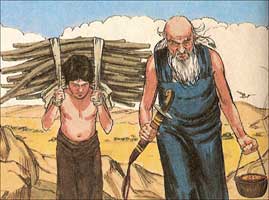
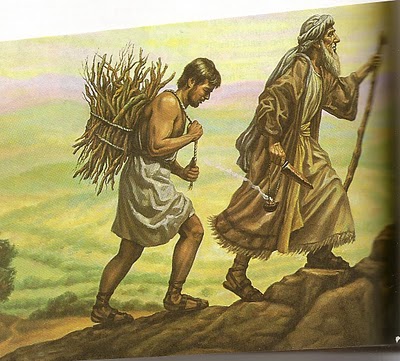
ImageTrudging along with Isaac beside him.  How was he going to explain this to Sarah?  Hopefully Isaac would come back in one piece and it would be easier.

Isaac was a good lad.  Humble, submitted, meek as a lamb going to the slaughter.  Abraham was an old man, why did he have to go through this?  All his hopes and dreams were tied up in Isaac.  There was no one else like him.  But he had learnt a long time ago not to give into self-pity.

Silent, confused, trusting still, trudging along with Isaac beside him.

________________________

ImageThe wood was heavy.  It was biting into his shoulder as he trudged up the hill. Only a few days earlier he had travelled on a donkey, a foal of a donkey in some style but now their followers had been left behind and it was just him and his father walking.  He saw the fire and the knife…

He asked the question but he knew the answer somehow fitted.  He was the lamb that was led to the slaughter, uncomplaining.  God had indeed provided.  So he submitted silent, still while the altar was prepared, the wood arranged a cross it and the knife was raised.

___________________________

 “Abraham! Abraham!”

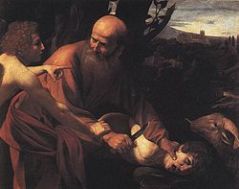
Image

Abraham looked down at his son who was in all his heart and all his mind and all his soul and all his strength –himself- and it had come to this!  The angel had said both their names.  So he thought and said: “Here I am”…  “My everything.  Ask me to sacrifice myself it would be easier!”

______________________________

God saw the transaction.  Yes, He had made man in His image so it was possible – the Father could slay His Son, this man had demonstrated that.  So infinitely difficult though, so distressing that He didn’t want a creature to have to endure what He as a Creator would, the loss of a son at His own hand.  He saw the intent, that was enough, now He would provide.  There had been times enough when fathers had lost their sons and there would be times again when it would happen, times without number.  He would do the best thing possible so that those who received the Gift would receive again their sons back from the dead, just as Abraham believed he would.