Category Archives: General Principles

Guidelines to how I view the cosmos

Loving the Greek…..

The New Testament was originally written in Greek since that was the “English” or “lingua Franca” of the the first century.  So I thought it would be a good idea to learn the NT or Koine Greek some years ago.  I must admit though that the vast range of English translations we have seem to capture most of the nuances of the Greek word meanings as far as I can tell.  But I am no expert.

There are a few things that the NT Greek does bring out:

1.  The simplicity of the language John uses compared with Paul.  It is really very easy to read John’s gospel and letters in the Greek especially in comparison to Paul’s.  It is a real and compelling miracle to see the depth of meaning and the deep subjects that John is able to explore with so few words.   I really don’t know anything equivalent in English.  However Revelation is no easier to read in Greek than it is in English which is one of the reasons many scholars believe that a different John wrote it.

2.  The Greek uses the continuous form of the verb “to be” far more than the English translations I have read do.  I am guessing that is because it would be being far more awkward to be reading.  But what the Greek brings out is a very important theological point or continuity rather:  You must keep on being saved to be saved.  There is no emphasis in the New Testament on point decisions or actions like the English translations seem to imply.  The examples are everywhere in the N.T. (Colossians 3:1 keep on seeking, Romans 8:1, 4 are not walking, etc., etc.).

3.  Of all the English translations I have read I have yet to come across one which brings out the distinctions in the Greek words for love in John 21:15-17. Knowing the differences significantly adds to the understanding of Jesus’ reinstatement of Peter and the qualifications for being a minister in God’s church.  Only the amplified version really brings it out but you can lose the significance in all the words.  Here is my version:

15 When they had eaten, Jesus said to Simon Peter, Simon, son of John, do you agape Me more than these? He said to Him, Yes, Lord, You know that I phileo You. He said to him, Feed My lambs.

16 Again He said to him the second time, Simon, son of John, do you agape Me? He said to Him, Yes, Lord, You know that I phileo You. He said to him, Shepherd My sheep.

17 He said to him the third time, Simon, son of John, do you phileo Me? Peter was grieved that He should ask him the third time, Do you phileo Me? And he said to Him, Lord, You know everything; You know that I phileo You! Jesus said to him, Feed My sheep.

Agape means love like Jesus’ love when He died for us on the Cross.  A supernatural love that comes straight from the Father.  Peter knew he didn’t love Jesus like that – not after his three denials on the night Jesus needed him most.  He wasn’t going to make the same mistake he had made before the crucifixion (John 13:37).

But he also knew that he had phileo –  a brotherly affection and natural love for Jesus.  So he had responded honestly.  He didn’t mind Jesus questioning his agape love but he was upset when he questioned even his phileo love.  He would have been devastated to discover that he didn’t even have that!

But actually Jesus was out to encourage him.  For each time He questioned Peter and each time Peter answered honestly and without pretense Jesus found in him someone He could trust.  Someone who could feed the young and tend to the needs of and even feed the more mature.

Some teachers would say that Pentecost (Acts 2: 1-4) added the agape to the phileo that Peter had.  And perhaps it did.  But for me I think I know what answer I would give to Jesus if I was asked the same questions, Pentecost or no Pentecost.

Only He knows really how qualified I am, or anyone is, to spiritually feed and tend His lambs or sheep.  But the qualifications are definitely not academic ones.  You don’t have to learn the Greek to love His people enough to feed them.

Fear

 “And I say to you, My friends, do not be afraid of those who kill the body, and after that have no more that they can do.But I will show you whom you should fear: Fear Him who, after He has killed, has power to cast into hell; yes, I say to you, fear Him!

“Are not five sparrows sold for two copper coins? And not one of them is forgotten before God. But the very hairs of your head are all numbered. Do not fear therefore; you are of more value than many sparrows.

Luke 12: 4-6. (Matthew: 10:28-31)

Fear and do not fear: one sentence after another.  First note that Jesus is speaking to His friends.  This is very important since Jesus says (in John 15:14) that you are His friends if you do what He commands you and it also presumes relationship with Him.

1.  Do not be afraid (v. 4 above).  That is do not be afraid of men. The original Greek word that was used  is the same one that we get our word for phobia from (e.g. arachnaphobia, technophobia, etc.).  If God is for us who can be against us? He who did not spare His own Son, but delivered Him up for us all, how shall He not with Him also freely give us all things? (Romans 8:31-32).  So don’t have phobias about what men can do.  They can only affect your body.

2.  Fear Him (v. 5).  It would be easier, perhaps nicer, if fear wasn’t the exact same word but it is, even in the Greek.  We do need to be afraid of God even if we are friends of Jesus because God can put both our body and soul in Hell after we die. And that is much worse than our body dying.

3.  Do not fear (v.6).  Same word again!  This time Jesus is assuring His friends that they don’t have to be afraid about being put into Hell.  Even though God can do it, He won’t do it to them because they are His friends.

The point is that we need to stay being His friends, i.e. in relationship with Jesus and obeying His commands. Otherwise why would Jesus tell us to fear Him?

On Eagle’s Wings

Dr. Loye Miller (1918) published the following account, as given to him by one of his students:

Last summer while my father and I were extracting honey at the apiary about a mile southeast of Thacher School, Ojai, California, we noticed a golden eagle teaching its young one to fly. It was about ten o’clock. The mother started from the nest in the crags, and roughly handling the young one, she allowed him to drop, I should say, about ninety feet, then she would swoop down under him, wings spread, and he would alight on her back. She would soar to the top of the range with him and repeat the process. One time she waited perhaps fifteen minutes between flights. I should say the farthest she let him fall was 150 feet.

My father and I watched this, spellbound, for over an hour. I do not know whether the young one gained confidence by this method or not. A few days later father and I rode to the cliff and out on Overhanging Rock. The eagle’s nest was empty. (Miss F.E. Shuman)

Deuteronomy 32:11-12 says this:

As an eagle stirs up its nest,
Hovers over its young,
Spreading out its wings, taking them up,
Carrying them on its wings,
12 So the Lord alone led him,
And there was no foreign god with him.

In Exodus 19:4 God says this:

‘You have seen what I did to the Egyptians, and how I bore you on eagles’ wings and brought you to Myself.’

Some other good commentary on the subject can be found here.

Changing God’s mind

From Acts 27 it is clear that you should always listen to someone who is in communion with God. But even if you don’t God can still be merciful if that godly man (or woman) intercedes on your behalf.

http://thebiblerevival.com/ This passage is one of the few in Scripture which shows an example of a man apparently changing God’s mind on something. In Acts 27:10 Paul predicts that their lives will be lost along with the cargo and ship whereas in v.22 he predicts that there will be no loss of life, which is how it turned out. In between v. 10 and v. 22 Paul had been praying and God had heard and answered his prayers and effectively had changed His mind.

The most famous example of this is when Moses interceded on behalf of the people of Israel in Exodus 32: 9-14. What both examples (and others) show is that we are not dealing with some immovable stone image or machine that churns out decisions from on high that cannot be changed. This is the opposite of determinism and causes no end of theological conundrums for anyone approaching God without knowing Him. We reach the limits of rational thought in this kind of thing.

Recently I was sharing with an engineer at work, a clever guy. He started the conversation by asking how I could logically think that the bible could be right about God. After some useful debate (which I must put in another blog) I ended up by saying that God reaches everyone not just the logical. And He does it by summing everything up in two promises: You shall love the Lord your God with all your heart and all your soul and all your mind and all your strength and your neighbour as yourself.

Thankfully we are not limited to being rational when dealing with God. Let’s be rational, but more than that, let’s be in love.

Abraham and Isaac

The post below is an attempt to imagine what both Abraham and Isaac were thinking as they went through the ordeal described in Genesis 22.  I also bring out the similarities between the story and that of the death of Jesus Christ at the hands of His Father.

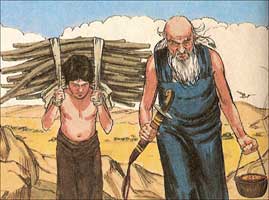
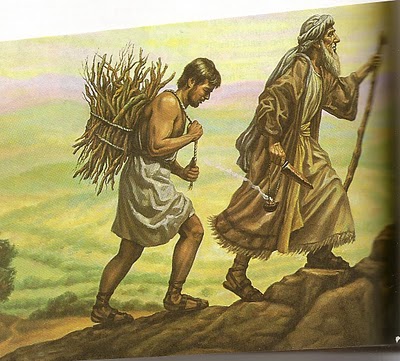
It was a very long trudge up Mt. Moriah as Abraham went to sacrifice his son to his God.  He was thinking about it as he went along.  He knew that it was a common enough thing among the gods of the people’s around him for them to ask for such sacrifices.  But somehow he had hoped it would be different with his One.  And then there was the confusing thing about that promise that through Isaac all his descendants would be named.  If there was one thing certain about the God Abraham served, it was that He kept His promises. “I bet you He is going to raise Isaac from the dead!” thought Abraham to himself.  That encouraged him a bit…. until he thought again about raising that knife….

ImageTrudging along with Isaac beside him.  How was he going to explain this to Sarah?  Hopefully Isaac would come back in one piece and it would be easier.

Isaac was a good lad.  Humble, submitted, meek as a lamb going to the slaughter.  Abraham was an old man, why did he have to go through this?  All his hopes and dreams were tied up in Isaac.  There was no one else like him.  But he had learnt a long time ago not to give into self-pity.

Silent, confused, trusting still, trudging along with Isaac beside him.

________________________

ImageThe wood was heavy.  It was biting into his shoulder as he trudged up the hill. Only a few days earlier he had travelled on a donkey, a foal of a donkey in some style but now their followers had been left behind and it was just him and his father walking.  He saw the fire and the knife…

He asked the question but he knew the answer somehow fitted.  He was the lamb that was led to the slaughter, uncomplaining.  God had indeed provided.  So he submitted silent, still while the altar was prepared, the wood arranged a cross it and the knife was raised.

___________________________

 “Abraham! Abraham!”

Image

Abraham looked down at his son who was in all his heart and all his mind and all his soul and all his strength –himself- and it had come to this!  The angel had said both their names.  So he thought and said: “Here I am”…  “My everything.  Ask me to sacrifice myself it would be easier!”

______________________________

God saw the transaction.  Yes, He had made man in His image so it was possible – the Father could slay His Son, this man had demonstrated that.  So infinitely difficult though, so distressing that He didn’t want a creature to have to endure what He as a Creator would, the loss of a son at His own hand.  He saw the intent, that was enough, now He would provide.  There had been times enough when fathers had lost their sons and there would be times again when it would happen, times without number.  He would do the best thing possible so that those who received the Gift would receive again their sons back from the dead, just as Abraham believed he would.

Disciples, Saints and Overcomers

Disciples is the term used in the four gospels and Acts, Saints is the term used in the letters and Overcomers is the term used in Revelation (chapters 2 & 3).  And I believe they all refer to the same thing – they mean Christians who are loving the Lord their God with all their hearts and all their minds and all their souls and all their strength and their neighbours as themselves (Matthew 22:37-40).

Disciples take up their cross daily and lose their lives so they may save them (Luke 14:26-27).  Saints live holy lives dedicated to their God and the fellowship of other saints.  Overcomers keep on coming over and over again to the Lord no matter what.  They all by faith and patient endurance take hold of the promises God has in store for those who love Him (Hebrews 6:11-12).

And the New Testament is written for them not for anyone else really.

Unless you are born again you cannot be a disciple and you cannot see the things they see (John 3:3 & 5). However being born again is not enough, you must also walk daily with Jesus if you want to gain the promises made to overcomers (Rev. 2:7, 11, 17, 26-28; 3:5, 12, 21) .

Three ways of looking at anything

Paul went into the third heaven (2 Cor. 12:2) and there are a number of other indicators in the Scriptures that there are three heavens as of now.

  1. The first one is the one we can see, the universe outside this earth that extends to 15 billion light years or so it seems. We don’t know too much about it but at least we can see some of it with our eyes and various forms of telescopes.
  2. The second one is mentioned in a few places such as Ephesians 6:12 and is the place where the devil reigns.
  3. The third one is described in Revelation. Moses made a copy of it in the Tabernacle (Hebrews 11:23,24). Paul was not the only human to go to the third heaven, Moses, John, Isaiah, Daniel and Ezekial all went there and probably a few others.

There is a hierarchy in the three heavens. God in the third rules over the other two and the second one rules over the first. Unless you are “in Christ” who is seated in the third heaven (Eph. 1:20) you are inevitably under the second heaven whether you know it or not. Or at least that is what the Scripture says. And we know who rules the second heaven.

So there are three ways of looking at everything:
1) From the third heaven: God’s viewpoint, totally in control, no surprises for Him and all He does is in love, justice, mercy and grace. As an example, God’s view of a faithful Christian’s death is that He called him/her home when He had decided they had accomplished all that they needed to accomplish and blessed all they could from down here. The “well done good and faithful servant” awaited him/her. This is the viewpoint of predestination.
2) The view from the second heaven. The devils and angels fight it out for the souls of men. Personally I don’t spend much time thinking of things from this point of view. Suffice to say you had better know what you are doing if you get involved in that conflict.
3) The view from the first heaven. This is the view of man where people make choices that determine their final destiny. The really important choices are all to do with accepting or rejecting God’s words. This is the Arminian viewing place for those familiar with those views.

If you want you can think of a faithful Christian’s death from the viewpoints of the other two heavens.  I think a lot of people do.  However, I for one am going to line my views up with God’s.  Ok, maybe I don’t know exactly what He is thinking of the brother /sister or all about why He called him/her home just now.  But imagining what He is thinking sure beats imagining how the devil or men are thinking about it.

What happens when we die?

A young saint’s spirit went home last week and her body died.   According to the bible, the body without the spirit is dead….James 2:26.

Despite being in contact with her husband during Friday, when I went into the specially convened prayer meeting at Open Arms that night I had no idea what to pray or what condition she was in except that it was serious.  So I prayed in the Spirit as follows: “Lord, forgive us for not understanding your ways and for our childish prayers.  We miss our sister and we know that her husband and child will be heartbroken.  So for those reasons we are asking for her back.”  I was in tears as I prayed this.  Then I got a vision from the Lord.  Jesus was in heaven hearing our prayers and pointing them out to our sister whose spirit was also there.  He seemed to be asking her if she wanted to go back.  To which she seemed to reply: “No way!”

Now it is not that she doesn’t care about her husband and son or us for that matter.  It’s just that, from the viewpoint of heaven and eternity, their remaining time seems shorter, eternity seems longer and God’s care for them more obvious.  Its a perspective we all need to have.

On Sunday, shortly after we heard the news that the life support machines had been stopped, a group of us were meeting and discussed what death is about for a born again, committed disciple of Jesus Christ – what the bible calls a “saint”.

The bible speaks a lot about what happens to “saints” when they die (it is much less clear on what happens to people who are not saints).  In fact all the letters of the New Testament and Revelation are written for the saints (a.k.a. disciples or overcomers)  and don’t make much sense unless that is understood.

So there are several verses that we can use to describe our current status and what happens when we die. First of all we should be clear that the earthly body we are in is a vessel for something more important:  2 Cor. 4:6-7a says:

For it is the God who commanded light to shine out of darkness, who has shone in our hearts to give the light of the knowledge of the glory of God in the face of Jesus Christ.

But we have this treasure in earthen vessels,

Jesus said (John 11:25,26):

“I am the resurrection and the life. He who believes in Me, though he may die, he shall live. 26 And whoever lives and believes in Me shall never die. Do you believe this?”

Well do you?  Martha didn’t for when the test came she showed it by her response in John 11:39:

Jesus said, “Take away the stone.”

Martha, the sister of him who was dead, said to Him, “Lord, by this time there is a stench, for he has been dead four days.”

In Lazarus’ case (and in the case of the widow’s son at Nain) Jesus raised both the body and the spirit, thus restoring the soul as well to Lazarus.

(I believe the Scripture says the Spirit interacting with the body is what creates the soul – without both the soul doesn’t exist – but I could be wrong about that).

But in the saint’s case, when we die our bodies normally decay to the dust from whence they came and our spirits go to heaven.  Our souls are not fully saved until our spirits are reunited with our bodies on the day the Lord returns and gives us new ones.

So the old body has served its purpose, it won’t be used again and it really doesn’t matter what you do with it. Cremation is probably one of the more eco friendly options.

The fact that the saints will be resurrected in a new body is dealt with extensively by Paul in 1 Cor. 15.  In v.20 and v.23 he calls Christ the first fruits of the resurrection.  A first fruits means there is more of the same coming afterwards:

20 But Christ has indeed been raised from the dead, the firstfruits of those who have fallen asleep. 21 For since death came through a man, the resurrection of the dead comes also through a man. 22 For as in Adam all die, so in Christ all will be made alive. 23 But each in turn: Christ, the firstfruits; then, when he comes, those who belong to him. 

When Luke wrote his gospel he went to great lengths to ensure that we understood that Jesus’ resurrection was a bodily one:

36 Now as they said these things, Jesus Himself stood in the midst of them, and said to them, “Peace to you.” 37 But they were terrified and frightened, and supposed they had seen a spirit. 38 And He said to them, “Why are you troubled? And why do doubts arise in your hearts? 39 Behold My hands and My feet, that it is I Myself. Handle Me and see, for a spirit does not have flesh and bones as you see I have.”

40 When He had said this, He showed them His hands and His feet. 41 But while they still did not believe for joy, and marveled, He said to them, “Have you any food here?” 42 So they gave Him a piece of a broiled fish and some honeycomb. 43 And He took it and ate in their presence.

Luke 24:36-43

But so far Jesus is the only one who has resurrected in that way.  His resurrection was also different from what our bodily resurrection will be like in that His old body never decayed.  In fact God wanted to show something very specific through Jesus’ resurrection.

In the Old Testament it says this about the life of flesh:

Leviticus 17:11
For the life of the flesh is in the blood, and I have given it to you upon the altar to make atonement for your souls; for it is the blood that makes atonement for the soul.’

There has been an increase of understanding these days through scientific enquiry and we know now that the life of this flesh is most certainly in the blood.  96,500 km (enough to circle the world more than twice) of capillaries, veins and arteries carry blood laden with life giving oxygen and minerals to every living cell in our bodies.  Only the dead skin cells we shed, parts of our hair and nails are lifeless.

And we know that Jesus shed His blood.    Then He was buried, His body did not decay and so He rises with flesh and bone.  Henceforth His Spirit sustains Him so that life is in the Spirit not the blood in His new body. Likewise for us, since He is the first fruits, so our new bodies will be kept alive by the spirit, not blood.  Note that Jesus ate and had flesh and bones, there is nothing insubstantial about the new bodies we will inherit.

So the saint is in heaven awaiting the Lord’s return so that she and all the other “spirits of just men (includes women) made perfect” (Hebrews 12:23) can enter their new bodies and live with Jesus in His new kingdom.

So in summary:

1) A saint who dies is in heaven with Jesus now in the spirit.

2) Jesus is the only one in heaven with a new flesh and bone body

3) Jesus will return one day and when He does He will bring the saints with Him and give them new bodies like His own.

Think about these things, they will encourage you!

The Abortion Debate

From what I have read, what seems to make Ireland a pro-life country is the legal view that a child’s life is equivalent to a mother’s from the point of conception.  This leads to a whole different way of treating difficult pre-natal situations from a country where the legal position is that the child is not a child but something less than human (often called a foetus) until some arbitrary stage in the pregnancy.

Well I am not a lawyer but that is how it reads to me.

If that is the case then I am all in favour of it staying that way.

Again from what I have heard and read however that doesn’t mean there won’t be some difficult legal situations that will arise.  When you have an adult or even a child threatening the life of another person it is difficult but the courts can deal with it and there are precedents.  A child would normally be considered as having diminished responsibilities as compared with an adult.  However a child in the womb can  have no responsibility at all for threatening the life of the mother and that is very difficult to legislate for.  So we seem to have buried our heads in the sand about this for some time now. Yes it is a difficult issue and perhaps the only way to deal with it is to have a judge nearby who can rule in each case as to what the best thing to do is.  In our pro-life environment we can be sure that any judgement made by doctors or specially assigned judges will be those that try to preserve the lives of both.  But unfortunately there are cases arising in this State in which that horrible decision has to be made.  They may be very few but they do arise.

The current approach is to avoid the situation or pass it over to another jurisdiction to deal with it.  I don’t believe that is the right approach.


Hidden

The  Word was made flesh and dwelt among us and we beheld His glory (John 1:14).

We are creatures variously described in the bible as an earthen vessel (2 Cor. 4:7); a branch (John 15:4), a member of His body (1 Cor. 12:27) but even in those descriptions there is something more than just a creature described.  We contain God Himself in some way, just like the body of Mary did and the earthly body of Jesus did and now the heavenly body of Jesus does also.  When you are born again a connection occurs with God that is beyond a simple creature/ creator relationship.  Its the relationship of a family.

So if that is the case then why are we not all Supermen?  Surely we should be imbued with astonishing, miraculous powers and be able to conquer the world, etc.

I think that some of us will be in positions of power in the ages to come if we are found worthy of that.  The way we are found worthy is by continuing to abide in the crucified Christ for crucified is the way He has chosen to live through us in this age (Gal. 2:20, 6:14).

God is regularly misunderstood, spat at, despised and dishonoured in this world for so He has chosen that it should be.  His aim is to have a remnant that love Him not because they have to, or because there is anything to gain in this life by doing so or even just because we will have a great position in His kingdom to come but because He loves us and is lovely.  Its the great romance at the heart of a lot of films.  We are being wooed by Him who appears to us in pauper’s clothes but is in fact the prince of the realm.  He asks us to join Him and be like He is, with the glory hidden in a jar of clay for a time (2 Cor. 4:7).

For you have died and your life is hidden with Christ in God.  When Christ, who is our life, is revealed then you also will be revealed with Him in glory.  

Colossians 3:3,4.

He is worth waiting for and He thinks you are too.