Category Archives: church

Includes what it means to be a saint. Material for a lesson in the His Story module of Life College.

Family Values

Dr. Carle Zimmerman, a Harvard sociologist who examined the rise and fall of empires through the centuries, paid close attention to the correlation between family life and national life. His book Family and Civilization concludes that deteriorating civilizations follow a reasonably definable pattern and that “atomistic families” dominate the social landscape in decaying cultures. When civilizations began to unravel, they had five characteristics in common.

  1. Marriage lost its sacredness, divorce became commonplace, and alternative forms of marriage were accepted.
  2. Feminist movements undermined complementary and cooperating roles as women lost interest in mothering and pursued personal power.
  3. Parenting became increasingly difficult, public disrespect for parents and authority increased, and delinquency and promiscuity became more commonplace.
  4. Adultery was celebrated, not punished; people who broke their marriage vow were admired.
  5. There was increased tolerance for incestuous and homosexual sex, with an increase in sex-related crime.

Carle C. Zimmerman, Family and Civilization (Wilmington, DE: Intercollegiate Studies Institute, 2008)

Zimmerman’s conclusions are so current, they’re frightening. He appears to have observed the United States in the twenty-first century and then summarized his findings. In fact, he wrote them in 1947.

The whole above passage is copied from Charles Swindoll’s book: “Abraham: One Nomad’s Amazing Journey of Faith” (Kindle Locations 2229-2239). Tyndale House Publishers, Inc.. Kindle Edition.
Sodom and Gomorrah

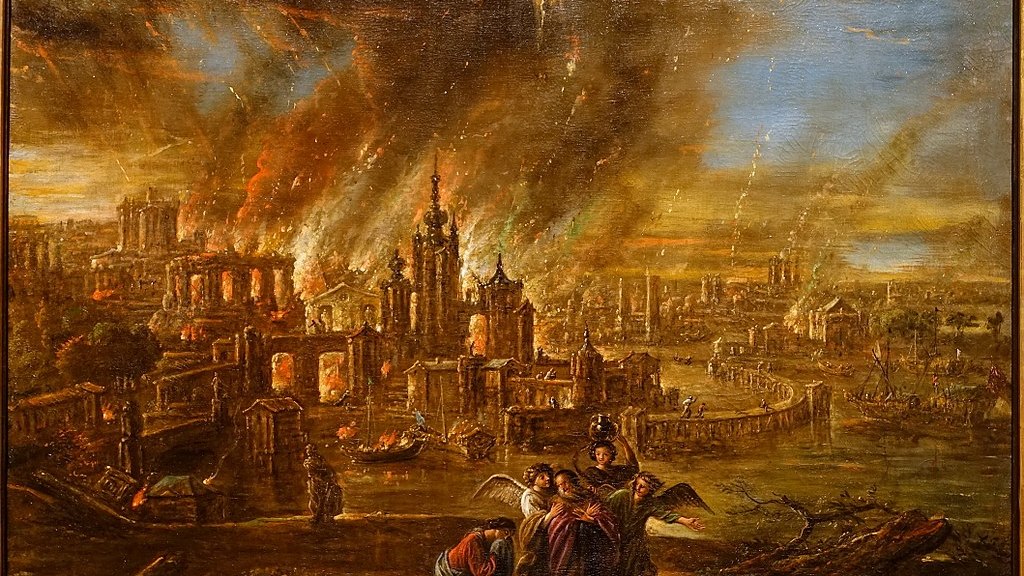
I am reading a book by Charles Swindoll called: “Abraham: One Nomad’s Amazing Journey of Faith.”  In it Charles includes a very convicting chapter on Genesis 19 and the destruction of Sodom & Gomorrah.  It is a word for today’s church.

I am a firm believer that things are improving in many ways but I don’t think anyone could say that things have been improving over my lifetime morally.  There has been more concern for social justice expressed among the richer young people, more eradication of absolute poverty, more education, better living standards for nearly everyone and a less polluted environment in many places.  All these things are good and can in large part be ascribed to charitable impulses arising from Christians who have been reading their bibles, listening to God and making changes to their lives and the lives of those around them accordingly, often empowered by the Holy Spirit.  It is good to see accounts of people like Desmond Doss in the Mel Gibson film “Hacksaw Ridge”, and Abraham Lincoln in “Lincoln”.  There are good men & women out there, we know many who are giving their lives selflessly in many places around the world, some at great cost to themselves.

However it is also impossible to deny that many forms of immorality are on the increase.  Things that my ancestors would have thought gross immorality are now lauded as virtues by the peers of my descendents.  The continuous and unrelenting destruction of innocent life by the hands of their mothers and colluding medical staff – if you had told someone at the beginning of the 20th Century that such behaviour was going to be protected by the law at the wishes of the majority of the people, very few would have believed you.  If you had also told my ancestors that we would have a openly homosexual Taoiseach and an openly practicing lesbian (and witch) as our Minister for Children – well no one would believe you 100 years ago.  Or even 50 years ago.  Most young people would laugh at the idea that having sex before marriage was somehow wrong and they don’t know what fornication means.  Adultery is so common no one remarks on it much.

The inevitable consequence of our continuing tolerance of this downward slide among our people here in Ireland and across the western world is judgement.  It cannot be otherwise.  Somewhere along the line God is going to say “Enough” and end it all.  He did it at the Flood, at Babel, at Sodom & Gomorrah and He will do it again.  Most likely in the next 20 years or so He will usher in a new age during which He will rule the nations with a rod of iron (Psalm 2:9, Rev. 2:27, 19:15).  You won’t want to be on the wrong end of that rod when it comes.

On our part we need to be sure we are not becoming like Lot, desensitized, perverted and too fond of the comforts that the improvements are bringing about to want to lift our heads above the parapet and call a spade, a spade.

Why would anyone believe the Pope is the Anti-Christ!?!

People believe all sorts of things for all sorts of reasons.  Many people believe everything they read on the Internet, others believe everything Trump says.  A lot of people believe the Bible literally including when it says the world was created in 6 x 24 hour days.

So it should come as no surprise that for hundreds of years, millions of people believed the Pope was the Anti-Christ.  These people were called Protestants or Reformers and from the 16th to the beginning of the 19th Century they all agreed on this one thing while disagreeing on many other things.  Many well known names agreed that the Pope is the Anti-Christ, people like Luther, Calvin, Zwingli and the Wesley brothers.  In fact it wasn’t until the beginning of the 19th century that any significant branch of Protestantism began to dispute this position.  J.N. Darby of the Brethren movement was among the first.

Of course now hardly any Protestants believe that the Pope is the Anti-Christ except a few die-hard Ulster Unionists from the DUP and other cranks on the Internet with small readership.  It is not exactly a popular position among Evangelicals or Pentecostals either.  A lot of people would take the view, understandably, that there is little value in adopting such a position.

Be that as it may I still think it is worthwhile looking at why this position was so universally held by so many significant people for so long.

One obvious reason was they were normally in countries that were at war with countries that allied themselves with the Pope or they were in countries where their lives were in danger because they had a bible.  They had plenty of historical precedent to know they were up against a mortal enemy.  One of the Crusades was sent against a group of people in the South of France whose only crime was to not submit to the Pope. There had been many martyrs before Luther pinned up his famous 95 theses.

The Biblical basis for their beliefs about the Pope and the Roman Catholic Church were also well thought out and convincing.  Apart from several passages in Revelation the main passages in the Bible that talk explicitly about the Anti-Christ can be found in 2 Thessalonians Chapter 2:

  1. In verse 3 the writer (Paul, Silas or Timothy) says that the “man of lawlessness .. will oppose and will exalt himself over everything that is called God or is worshiped, so that he sets himself up in God’s temple, proclaiming himself to be God.”  In the other letters they saw that Paul was very consistent in calling the body of believers corporately (i.e. the Church) God’s temple.  So they understood that the Anti-Christ was going to be someone sitting in the middle of the Church, calling himself God (Vicar of Christ is one of the Pope’s titles which means “in place of Christ”).
  2. In verses 5-8 the writer says this: “Don’t you remember that when I was with you I used to tell you these things? And now you know what is holding him back, so that he may be revealed at the proper time. For the secret power of lawlessness is already at work; but the one who now holds it back will continue to do so till he is taken out of the way.”  The common understanding of these verses during Reformation times was that the power that was restraining the Anti-Christ at the time of the first century (when the letter was written) was the Roman Emperor.  Their reasoning went that the Anti-Christ could not achieve world dominion or the secular power that he had during the centuries before and during the Reformation if Christianity was being persecuted and kept underground.  They could also look back on history and note something that was a very striking fulfilment of the verses.  When Constantine became the first Christian Emperor of Rome in the middle of the 4th century he did the most unusual thing.  He moved the capital of the Roman Empire a thousand miles away from Rome to a new city called Constantinople (now Istanbul) on the Bosphorus Straits in present day Turkey.  Once he was moved out of the way, the stage was set for the government of the City of Rome to be taken over by another.  Since there was no separation of Church and State that person was the first Pope.  They also used to say that the reason the writer did not come out and explicitly say that the restrainer was the Emperor was so as not to get people receiving the letter in more trouble than they already were with that power.

There are lots of other verses and passages the Reformers used to back up their position which I will explore in further blogs.

Of course they could have been wrong.

The Innocence of Children

Everyone somehow knows how special young children are.  Jesus said not to look down on them for their angels always behold the face of His Father in heaven (Matt. 18:10).  But we also know that while they are growing up they lose this innocence.  Paul describes the process in Romans Chapter 1.  It starts off in this way in Romans 1:21-22:  “For even though they knew God, they did not honor Him as God or give thanks, but they became futile in their speculations, and their foolish heart was darkened. Professing to be wise they became fools.”

So if you want to retain that innocence for as long as possible teach your children to give thanks to God for everything at every opportunity.

The school system is set up to undermine this mainly through peer ridicule. Children can be merciless to each other in the playground.

The other reasons the school system undermines childlike faith is because of godless, cynical teachers and a curriculum informed by secular values that, especially in Ireland, largely ignores God.

It is no wonder then that teenagers end up exchanging the glory of God for images of the Kardashians and other YouTube gods & goddesses.  The inevitable next stage of that exchange – as Paul points out in Romans 1: 23-25 – is impurity and the dishonouring of their bodies among themselves.  By the time they get to college sex before marriage has become the norm.  Paul then goes on to point out how things continue to deteriorate until all forms of perversion and evil are accepted.  As people grow older the realisation that these things are wrong doesn’t go away but, nevertheless, they cheer each other on (Romans 1:26-32).

Jesus took away the barrier between us and God on the Cross and young children somehow seem to know this.  When we live with very young children you can see something in them that reflects the fact that their angels are looking at the face of God.  This “innocence” is so prized, every parent wishes that somehow it could be retained.  If we are honest, it is impossible to think that any young child that dies could somehow not be going to heaven.

So how do we encourage our children and ourselves to keep that childlike understanding that Jesus says we must have if we are to enter the kingdom of God (Matt. 18:3)?  Paul has told us how already in Romans 1:16: “For I am not ashamed of the gospel, because it is the power of God that brings salvation to everyone who believes”.  The gospel (or good news) is that Jesus died for your sins on the cross and rose again to prove his power to bring you to heaven to be with Him when you die.

Tell that good news to your children from a young age and if they go from faith to faith, believing more strongly in this truth and talking to God (starting with giving thanks) every day they will retain their innocence.

Working with Integrity

Can you be trusted?

A man of integrity engenders trust among those he works for, with and to.

His bosses trust him to deliver and let him get on with it. The manager doesn’t have to continually look over his shoulder and call him to account for he knows that he will do a good job and work hard without having to be micro-managed. When they ask him to do something he delivers on time and on budget.  He doesn’t rob his employer, he does a good day’s work as unto Christ not man and is content with his pay.

Those he works with confide in him and call on him when they want something done for they know he will deliver.  When he needs them to do something for him they will re-prioritise their work schedule to help him if at all possible.  As the years go by and circumstances change he will be there for them and them for him.

Those who work for him are confident that he has their back.  They are motivated to work hard for him since they know that when he asks them to do something he isn’t just thinking about the boss and the share holders but he is thinking about their long term careers as well.  He retains their loyalty and they will leave other bosses to work for him.

One of the main reasons all these people trust him is because they know what he believes and his life is consistent with his beliefs.  He isn’t telling them about Jesus and eternal life on the one hand and acting deceitfully or with malice on the other.  Where there are inconsistencies – for no one is perfect – he is transparent about them and rectifies them even to his own cost.  For he sees the reward, his hope is in the next life, not this one.

Ungodly, unscrupulous men whose god is mammon and whose hope is in this world will exploit such a man but his God is on his side and no weapon formed against him will prosper.

He may not be rich in this life but he will have love, peace and joy and the hope of eternal rewards.  His family will be blessed.  His reputation with the church and outsiders is untarnished.

On that last day he will hear the words: “Well done, good and faithful servant, enter into the joy of your master!”

Three Pillars

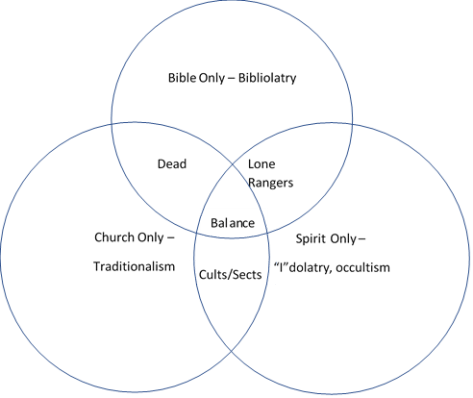
Three Pillars Venn Diagram

The above diagram is a way of looking at what happens if an individual or church adopts one or two of the three pillars.  A balanced Christian or church includes all three.

Recently I spent a couple of hours with someone I hadn’t met in years.  As we spoke together it became obvious that he was struggling with his faith.  He is a bright guy and had spent a long time researching the nature of Christ as part of trying to allay his doubts.  He did what many intellectuals do, that is, he put too much emphasis on a logical analysis of the Bible only.

As someone in relationship with God the Father through Jesus Christ I know the Holy Spirit uses the 66 books of the Bible to speak the truth to me.  It is part of what Jesus promises the Holy Spirit will do in John 16:13.

But that is the point I made to my friend.  Approaching the Bible without the leading of the Holy Spirit is a waste of time.  We cannot by our intellects alone know or find God.  It is up to Him to reveal Himself to us.

Standing on one foot is hard.  You will eventually fall over if all that is holding you up is one of the three pillars that God has given us.  An objective understanding of Scripture is one of those pillars.  If you know the Bible off by heart and can quote any part of it then you have a strong leg to stand on but that is not enough on its own.  You must be born again and continue in the relationship that God initiates with you spiritually from that time forward.  Intimate, experiential relationship with God the Father through Jesus Christ in the Holy Spirit is essential if you are to interpret the Bible correctly and if it is to become a living word not just a deadly letter (2 Cor. 3:6).  This is the second pillar.

The third pillar is the Church.  When we are born again we are part of the body of Christ (1 Cor. 12) and it is foolish not to meet together with those who are your brothers and sisters in Christ (Hebrews 10:25).  I believe firmly in the priesthood of all believers (1 Peter 2:9) and that no one needs to teach you anything if you are born again (Hebrews 8:11, 1 John 2:20).  However it would be arrogant of anyone to think that they can live in this sin and devil filled world in a way that is pleasing to God without the other members of the body supporting and feeding into them.

So read the Scripture and understand it as well as you can but don’t do that on your own, let the Holy Spirit guide you into all truth and let others who love you in Christ encourage you.  We all need encouragement.  Relationship is at the heart of knowing God.

Fellowship with the Saints

The words “fellowship” and “saints” are old-fashioned and rarely encountered in modern Evangelical/ Pentecostal circles.

JRR Tolkein’s first book in the Lord of the Rings trilogy is called “The Fellowship of the Ring”.  Fellowship in that context, and generally, speaks of a group of people united in a common purpose.  The purpose is greater than the individuals and calls for self-sacrifice and submission.

The word “saint” means sanctified one.  In the context of Scripture, Paul writes to the saints at various places as members of the local churches there.  Saints in the biblical context are those who have an ongoing, personal relationship with God in the context of the local church.

Put the two words “Fellowship” and “Saints” together and you have a group of people united in glorifying God through their lives together.

Disciples, Saints and Overcomers

According to the bible, God’s eternal destiny for you is communion with Him and fellowship with the church.  Communion and fellowship starts from when you are born from above (John 3:8) and continues for eternity.  Evangelism, by contrast, just lasts for this life.  After God ushers in the new heaven and earth (Rev. 21) there is no more opportunity for people to transition from the kingdom of darkness to the kingdom of life.  This makes evangelism critically important and if you did nothing else but tell people the good news of Jesus’ death for our sins and resurrection, you will not have wasted your time on this earth.

However, the bible includes a lot about communion with God and fellowship with His people.  As examples, Jesus tells people about the narrow way in Matthew 7, Paul quotes a number of old testament scriptures on the subject of being God’s sons and daughters at the end of 2 Corinthians chapter 6 and John records Jesus’ words on abiding in John 15.  But there are many more examples, in fact, depending on how you read it, you could say the whole New Testament is mainly about these two things:  communion with God and fellowship with His church.

In fact I believe that when God inspired the Scriptures (particularly the New Testament) he inspired them with mainly one class of people in mind.  Jesus called these people “disciples”, Paul went on to describe them as “saints” and John wraps up the New Testament by calling them “overcomers”.   The three words are not synonyms but they are closely related and they also have a sense of progression in them.  Being a disciple/ saint/ overcomer is God’s ordained way of having communion with him and fellowship with the church.

According to the New Testament, if you want communion with God and fellowship with the church then you must be born again, be a follower of Jesus (a disciple), be made holy (a saint) and persevere to the end (an overcomer).

Evangelism, Communion and Fellowship

Jesus spelt out the way of connecting people to God when He told Nicodemus that “You must be born again”.  You can find an account of His conversation with Nicodemus if you read John’s gospel, chapter 3.

According to the bible, the aim of church should be to tell as many people as possible about the good news that God through Jesus Christ has reconciled the world to Himself (2 Corinthians 5:9).  Jesus is the only way to eternal life or heaven (see John 14:6).  Unless you are born again you cannot even see the kingdom of God, never mind enter it and live for ever (John 3:3).

So you must be born again (John 3:5).

There is a very good case for leaving it at that.  If us Christians all just spent our time bringing everyone we knew to the place where they were born again – or at least presented with that possibility – we would have spent our lives very profitably.  This approach to life is called evangelistic and some people who meet God are called to it almost exclusively and everyone who calls themselves a bible believing Christian is called to it to at least some extent.

However the bible has a lot more to say about what it means to be a follower of Jesus after that initial, critical, connection has been made.  If you have been born again God wants you to have two things that he talks a lot about in the bible: Communion with Him and fellowship with others who have been born again (i.e. with His Church).  The Scriptures spend a lot of time dealing with this.

Communion and fellowship are eternal (see, for example, John 17).  Once you are born again and transferred from the kingdom of darkness into the kingdom of life (Colossians 1:13), communion and fellowship is your eternal destiny.  It is where God wants you to be now and forever.

Possibly Impossible

There are a lot of tensions in Scripture:

  1. Predestination v. Free Will
  2. Deity and Humanity of Christ
  3. Old and New Testaments
  4. Law v. Grace
  5. Holiness v. Grace
  6. etc.

We’ve only been to a few churches and we have usually spent a long time at each.  The last church I attended for 18 years and my wife was there for longer.  This current one we have been at for over 11 years now.

The two churches in many ways could not be more unalike.  There are many differences but the one difference I want to look at today was their approach to the character of Christians/ God.  Holiness v. Grace.

One church very strongly emphasized something that I believe is true from Scripture:  It is possible to be “perfect as your Heavenly Father is perfect” as Jesus commands us to be in the Sermon on the Mount (Matthew 5:20, 48).  In fact the Scriptures tell us how.  First be born again (otherwise you can’t even see the Kingdom of God), second consecrate yourself to do the will of God only, third walk in the Spirit, or as John puts it, abide in Him (John 15).  And, despite doing this, if you do sin, and everyone sins, then confess your sins and you will be cleansed and can start afresh (1 John 1). Simple really.

The other church very strongly emphasizes something else that I believe is true from Scripture:  Jesus died for the sins of the whole world for all time so you can stand before God unconditionally unashamed.  It is by believing in your heart that Christ died for you and confessing with your mouth that you are saved (Romans 10:9-10). This is typical evangelical doctrine and, inevitably, there will be a proclamation of that simple Gospel at every service so that people have a chance to encounter God.  The hope is that the encounter will then change everything for the person who has it – and very often it does.

Emphasis is the main difference here.  An over emphasis on walking in the Spirit or your behaviour as in the first case, can lead to that being the criteria that you are assessed by.  The danger is that on entering that church you would first have to behave in a certain way and then show the right beliefs before you (might) be accepted.

However the emphasis in the second church also has its problems.  In this case you are accepted no matter what your behaviour is like with the hope that you will believe and then God will then work with you to change your behaviour.  However you can be left wondering what difference there is between those going to the church and those who don’t.  In some cases their behaviour can seem indistinguishable.  It is very messy.

Personally I think the second emphasis is better than the first.  But then who wouldn’t prefer grace to holiness?

Is it even possible to get the balance right?