Category Archives: Life College

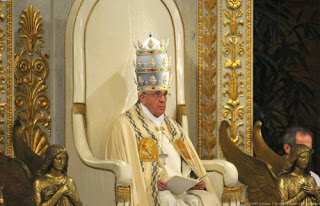
Why would anyone believe the Pope is the Anti-Christ!?!

People believe all sorts of things for all sorts of reasons.  Many people believe everything they read on the Internet, others believe everything Trump says.  A lot of people believe the Bible literally including when it says the world was created in 6 x 24 hour days.

So it should come as no surprise that for hundreds of years, millions of people believed the Pope was the Anti-Christ.  These people were called Protestants or Reformers and from the 16th to the beginning of the 19th Century they all agreed on this one thing while disagreeing on many other things.  Many well known names agreed that the Pope is the Anti-Christ, people like Luther, Calvin, Zwingli and the Wesley brothers.  In fact it wasn’t until the beginning of the 19th century that any significant branch of Protestantism began to dispute this position.  J.N. Darby of the Brethren movement was among the first.

Of course now hardly any Protestants believe that the Pope is the Anti-Christ except a few die-hard Ulster Unionists from the DUP and other cranks on the Internet with small readership.  It is not exactly a popular position among Evangelicals or Pentecostals either.  A lot of people would take the view, understandably, that there is little value in adopting such a position.

Be that as it may I still think it is worthwhile looking at why this position was so universally held by so many significant people for so long.

One obvious reason was they were normally in countries that were at war with countries that allied themselves with the Pope or they were in countries where their lives were in danger because they had a bible.  They had plenty of historical precedent to know they were up against a mortal enemy.  One of the Crusades was sent against a group of people in the South of France whose only crime was to not submit to the Pope. There had been many martyrs before Luther pinned up his famous 95 theses.

The Biblical basis for their beliefs about the Pope and the Roman Catholic Church were also well thought out and convincing.  Apart from several passages in Revelation the main passages in the Bible that talk explicitly about the Anti-Christ can be found in 2 Thessalonians Chapter 2:

  1. In verse 3 the writer (Paul, Silas or Timothy) says that the “man of lawlessness .. will oppose and will exalt himself over everything that is called God or is worshiped, so that he sets himself up in God’s temple, proclaiming himself to be God.”  In the other letters they saw that Paul was very consistent in calling the body of believers corporately (i.e. the Church) God’s temple.  So they understood that the Anti-Christ was going to be someone sitting in the middle of the Church, calling himself God (Vicar of Christ is one of the Pope’s titles which means “in place of Christ”).
  2. In verses 5-8 the writer says this: “Don’t you remember that when I was with you I used to tell you these things? And now you know what is holding him back, so that he may be revealed at the proper time. For the secret power of lawlessness is already at work; but the one who now holds it back will continue to do so till he is taken out of the way.”  The common understanding of these verses during Reformation times was that the power that was restraining the Anti-Christ at the time of the first century (when the letter was written) was the Roman Emperor.  Their reasoning went that the Anti-Christ could not achieve world dominion or the secular power that he had during the centuries before and during the Reformation if Christianity was being persecuted and kept underground.  They could also look back on history and note something that was a very striking fulfilment of the verses.  When Constantine became the first Christian Emperor of Rome in the middle of the 4th century he did the most unusual thing.  He moved the capital of the Roman Empire a thousand miles away from Rome to a new city called Constantinople (now Istanbul) on the Bosphorus Straits in present day Turkey.  Once he was moved out of the way, the stage was set for the government of the City of Rome to be taken over by another.  Since there was no separation of Church and State that person was the first Pope.  They also used to say that the reason the writer did not come out and explicitly say that the restrainer was the Emperor was so as not to get people receiving the letter in more trouble than they already were with that power.

There are lots of other verses and passages the Reformers used to back up their position which I will explore in further blogs.

Of course they could have been wrong.

Historical Eschatology

Eschatology is the fancy name for the study of the end times.  There are quite a few theories out there about how things are going to work out usually involving a rapture, a great tribulation, a millennium and an Anti-Christ.  One of the popular theories includes a significant tribulation to come at the end lasting 7 years out of which the Christian church will be raptured, usually before the great tribulation starts (conveniently).  There was even a film called “Left Behind” starring Nicholas Cage produced recently based on this particular view of the end times.

However, had you been born into a Protestant family anytime in the 3 hundred years following the start of the Reformation in 1518 your ideas of the end times would have followed a different tack, one that is not at all popular these days.  In those days the Anti-Christ and the great tribulation were in your face and unmistakable.  A pre-tribulation rapture was not even a consideration.  Your country was possibly in a war with the forces of the Anti-Christ.  If not you were quite possibly struggling to survive in a country under his control.  In those countries the Bible was a banned book and if you were found with one you could be imprisoned or killed.  These are times that many Protestants today seem eager to forget.

But pick up a King James Version of the Bible today from your shelf and you will read these words in the preface:  “…by writing in defence of the Truth, (which hath given such a blow unto that man of sin, as will not be healed,)”

The man of sin referred to here was the pope of the time.  There was very little disagreement among the reformers as to who the Scripture said the Anti-Christ was, i.e. the popes of Rome since about the 4th Century.  They had ample evidence in front of them to come to that conclusion and there are several Scriptures which support this assertion.

The Reformation was an amazing move of God affecting hundreds of millions of people which changed the course of history.  One of the expectations of the Reformers (as mentioned in the KJV preface) was that the Reformation would prove to be a fatal blow to the Anti-Christ but this didn’t happen.  In fact, the papacy has somehow survived that fatal blow (see Revelation 13:3) and spread even further abroad afterwards.  However, it has been much weakened by the Truth that the Reformation and the accompanying printing press made abundantly available through the Bible. It has not the civil power it used to be able to wield but its nature hasn’t changed.

There are several places in the Scripture to which the reformers would refer when it came to explaining the mystery of the Anti-Christ to their listeners.  Here is an institution – the Roman Catholic church with the pope at its head – which ran the lives of the people from birth (baptism) to death (final unction) and all stages in between.  It took their money, ran their schools and hospitals, determined who their kings were and, if required, would withdraw all or any of these services in response to an order from their hierarchical heads based in Rome.

Their adherents considered Canon Law (as laid down by the pope) of greater authority than the civil law (as laid down by their parliaments and kings) and used it to justify the most immoral behaviour.  And if you think that was for then and not now just remember what the Bishop of Cloyne John Magee did when he covered up for paedophile priests in the Diocese of Cloyne during the early part of this century.

And, if you can, read a few good books on the subject.  Here are a couple of my favourites:

  1. D’Aubigne’s History of the Reformation (try and get an unedited and unabridged version) originally written in French with lots of Latin in the notes.  This is a massive work (thankfully available on Amazon) which has been translated into English by Henry Beveridge.  If you are from a Roman Catholic background like me or just need to get a good understanding of what happened during the Reformation from a believer’s standpoint these volumes are the best reading I know of out there.
  2. His Waiting Bride by Edgar F. Parkyns (out of print but there are a few copies available on Amazon).
  3. The Pilgrim Church by F.F. Bruce.

Bound

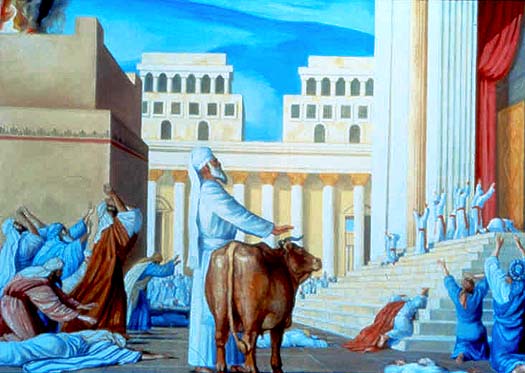
The story below is about a hypothetical old testament character bringing a bullock to the temple to be sacrificed as a whole burnt offering. I go on to draw the conclusion that our flesh is just like that bullock, substantial, costly and unwilling to go to the slaughter.

bullock

Bucking and pulling, the bullock refused to stay still.

“Come on, I guess you know you are going to be slaughtered.  Pity you can’t be like a lamb and just go quietly.”  Jacob managed to tie another rope around the bullocks head while he thought that.

It was their prize bullock, the first fruits, the tithe, that they had brought to Jerusalem to be slaughtered.  It was a big beast and not that stupid that it didn’t sense what was coming.

“Just two more ropes should do it.” Jacob looked over at his father straining to tie the ropes around the horns of the altar.  They were the strongest parts of it and once there were four ropes, one on each corner, they could begin to draw the bullock in.

Jacob knew his father loved Yahweh and was drawing on these ropes motivated by that love.  He remembered what he had been taught about the prophets Jeremiah’s and Hosea’s writings*, how God had drawn His people out of Egypt and brought them with similar cords of love during all their years in the wilderness and afterwards. The picture of a bucking and rebellious people reluctantly being led was clear as he watched this bullock’s antics.

Jacob also knew that this bullock was worth a lot and represented a significant sacrifice on the part of his dad but he also knew his dad didn’t think of it that way.  He just wanted to give his best to the God who had loved him and prospered him all his days with finances, family and peace.

The bullock was more subdued now.  The priest stuck the knife in and drained the blood from the beast.  The life of the beast was in the blood and as it was poured out so the life left the beast and only a carcass remained.

This was a whole burnt offering.  The smoke went up in billows and spread a pungent odour around the temple area.


Many years later a man with a mission called Paul wrote to some Romans and said that they should offer themselves as a living sacrifice (Romans 12:2) or, in reality, we all should.  The flesh represented by the bullock is strong and not rational.  It doesn’t want to die.  The cords of love that cause us to bring our sinful natures to the altar are strong.  They are the bindings of a God who loves us.  Like a moth to a flame we cannot help but be drawn to the death of our old ways by the look in His eyes.

“I died for you, will you not trust Me?” Jesus asks.

“My Father loves you and has only the best plans for you.  Will you not trust Him?”

*Jeremiah 31:3, Hosea 11:4.

Faith and Heart Attitude

How do you get into heaven?

Jesus says you have to be a certain way.  He sums up this way in the beatitudes:

“Blessed are the poor in spirit for theirs is the kingdom of the heavens.” (Matt. 5:3)

Alternatively, you can suffer and qualify that way:

“Blessed are those who are persecuted for the sake of righteousness for theirs is the kingdom of the heavens.” (Matt. 5:12)

On the other hand Paul is also quite clear:

“But now apart from the law the righteousness of God has been made known, to which the Law and the Prophets testify. 22 This righteousness is given through faith in Jesus Christ to all who believe. There is no difference between Jew and Gentile, 23 for all have sinned and fall short of the glory of God, 24 and all are justified freely by his grace through the redemption that came by Christ Jesus. 25 God presented Christ as a sacrifice of atonement,through the shedding of his blood—to be received by faith. He did this to demonstrate his righteousness, because in his forbearance he had left the sins committed beforehand unpunished— 26 he did it to demonstrate his righteousness at the present time, so as to be just and the one who justifies those who have faith in Jesus.

27 Where, then, is boasting? It is excluded. Because of what law? The law that requires works? No, because of the law that requires faith. 28 For we maintain that a person is justified by faith apart from the works of the law.”  Romans 3:21-28.

The classic protestant understanding of the gospel – justification by faith apart from works – is summed up in the above passage from Romans and backed up by many other passages from the New Testament.

So how does that fit with what Jesus says to people in the sermon on the mount?  I believe the key is in heart attitude.

There are so many people in this world that won’t ever read Paul’s writings.  There are a huge amount of them – billions – who, even if they did read it won’t understand it intellectually.  In general, people are not cerebral.  However, even the smallest baby knows how to trust.  God has made our hearts trusting, we have to be taught not to believe in Him.  In that way, the intelligent and those with the leisure and money to spend time reading up all sorts of things on the Internet  are handicapped.  We believe clever false teachings about life so easily.  The humble poor however simply believe and trust God will look after them.  To them Jesus speaks and says: “Yours is the kingdom of heaven.”

Those who follow their unspoiled conscience and find themselves persecuted for persevering in doing the right thing are also showing that they believe in their hearts in God.  Paul talks about them in Romans 2:

God “will repay each person according to what they have done.” To those who by persistence in doing good seek glory, honor and immortality, he will give eternal life.But for those who are self-seeking and who reject the truth and follow evil, there will be wrath and anger. There will be trouble and distress for every human being who does evil: first for the Jew, then for the Gentile; 10 but glory, honor and peace for everyone who does good: first for the Jew, then for the Gentile. 11 For God does not show favoritism.

12 All who sin apart from the law will also perish apart from the law, and all who sin under the law will be judged by the law. 13 For it is not those who hear the law who are righteous in God’s sight, but it is those who obey the law who will be declared righteous. 14 (Indeed, when Gentiles, who do not have the law, do by nature things required by the law, they are a law for themselves, even though they do not have the law. 15 They show that the requirements of the law are written on their hearts, their consciences also bearing witness, and their thoughts sometimes accusing them and at other times even defending them.) 16 This will take place on the day when God judges people’s secrets through Jesus Christ, as my gospel declares.  Romans 2: 6-16.

Some of those who are poor in spirit will have been discouraged by now and not have read this far.  Others will have read to this point and not understood it.  Some will have read and understood and to those I hope this is helpful.

But you don’t have to understand Paul’s writings to be saved.  You don’t even have to consciously understand the Good News to believe.  Jesus died for your sins so you don’t have to and rose again so He can bring you with Him to His place when you die.  That isn’t complicated.

If you don’t think you are much and feel you can’t keep up with the intellectual demands of our technically complicated society don’t worry.  It will all be burnt up in the end and your soul will be with the One you trust in.  Just keep going.

Coherence

“What is the difference between a bird and a car?” I heard the Holy Spirit saying to me in my thoughts this morning.

Don’t mock, God is quite capable of speaking to you too in plain English.

A wagtail had just mounted my car outside and flitted about in its inherent freedom.

A bird is so much part of God’s creation, it is coherent in it I thought in reply.  It has that peculiar thing called life about it, autonomy, awareness of its environment, capable of responding dynamically to things.  When it dies it will decay quickly and be recycled.

A car has to have an artificial man made environment created so it can function in it.  It needs roads, petrol stations, parking lots.  It is dead, hardly aware of its surroundings, capable of little or no autonomous action, has little capability of responding to dynamically changing surroundings.  It needs to be driven. When it breaks down it will have to be scrapped and the parts recycled with difficulty.  It moves through God’s creation but doesn’t really cohere to it or fit in very well.  The quest to create autonomous cars still won’t give the things life.  We haven’t understood what does that properly yet in our education system.

I had been asking God about inventions.  He was pointing out to me that an element of invention that He values greatly is how it might cohere or fit into His creation.

Later on today my daughter was going over her biology homework with me.  She needed to learn about the carbon cycle and the nitrogen cycle.  In a similar way to the way water is recycled (Eccl. 1:7) God wastes nothing.  Paradoxically, when things can be recycled efficiently then it is possible to introduce huge amounts of waste without damaging the environment.  Hence the fact that God allows trees and plants to produce a super abundance of seeds, most of which never become trees or plants like their parents.  Waste is not waste when it is recycled.

A narrow view of the Gospel would have us ignore or play down care for the environment.  Climate change and dealing with plastics are the realm of the liberal, ungodly left  in popular evangelical teaching.

However I believe God cares a lot about these things and He wants His followers to do the same.

The Innocence of Children

Everyone somehow knows how special young children are.  Jesus said not to look down on them for their angels always behold the face of His Father in heaven (Matt. 18:10).  But we also know that while they are growing up they lose this innocence.  Paul describes the process in Romans Chapter 1.  It starts off in this way in Romans 1:21-22:  “For even though they knew God, they did not honor Him as God or give thanks, but they became futile in their speculations, and their foolish heart was darkened. Professing to be wise they became fools.”

So if you want to retain that innocence for as long as possible teach your children to give thanks to God for everything at every opportunity.

The school system is set up to undermine this mainly through peer ridicule. Children can be merciless to each other in the playground.

The other reasons the school system undermines childlike faith is because of godless, cynical teachers and a curriculum informed by secular values that, especially in Ireland, largely ignores God.

It is no wonder then that teenagers end up exchanging the glory of God for images of the Kardashians and other YouTube gods & goddesses.  The inevitable next stage of that exchange – as Paul points out in Romans 1: 23-25 – is impurity and the dishonouring of their bodies among themselves.  By the time they get to college sex before marriage has become the norm.  Paul then goes on to point out how things continue to deteriorate until all forms of perversion and evil are accepted.  As people grow older the realisation that these things are wrong doesn’t go away but, nevertheless, they cheer each other on (Romans 1:26-32).

Jesus took away the barrier between us and God on the Cross and young children somehow seem to know this.  When we live with very young children you can see something in them that reflects the fact that their angels are looking at the face of God.  This “innocence” is so prized, every parent wishes that somehow it could be retained.  If we are honest, it is impossible to think that any young child that dies could somehow not be going to heaven.

So how do we encourage our children and ourselves to keep that childlike understanding that Jesus says we must have if we are to enter the kingdom of God (Matt. 18:3)?  Paul has told us how already in Romans 1:16: “For I am not ashamed of the gospel, because it is the power of God that brings salvation to everyone who believes”.  The gospel (or good news) is that Jesus died for your sins on the cross and rose again to prove his power to bring you to heaven to be with Him when you die.

Tell that good news to your children from a young age and if they go from faith to faith, believing more strongly in this truth and talking to God (starting with giving thanks) every day they will retain their innocence.

The Gospel Truth – This Happened!

There is a reason Jesus and Paul were able to say to us all that there is good news for everyone.  There is!  Jesus, the Son of God, died for your sins and then rose again.

Let me now remind you, dear brothers and sisters, of the Good News I preached to you before. You welcomed it then, and you still stand firm in it. It is this Good News that saves you if you continue to believe the message I told you—unless, of course, you believed something that was never true in the first place.

I passed on to you what was most important and what had also been passed on to me. Christ died for our sins, just as the Scriptures said.He was buried, and he was raised from the dead on the third day, just as the Scriptures said. He was seen by Peter and then by the Twelve.After that, he was seen by more than 500 of his followers at one time, most of whom are still alive, though some have died. Then he was seen by James and later by all the apostles. Last of all, as though I had been born at the wrong time, I also saw him.

(1 Cor. 15:1-8 NLT).

Repent of your sins and believe the Good News! (Mark 1:15)


The Book of Life

According to an understanding of the Scriptures by many people (e.g. C.S. Lewis) everyone’s name is in the Book of Life because of what Jesus did on the Cross.  But are you living in such a way that God will have to blot you out of it?

So Moses went back to the Lord and said, “Oh, what a great sin these people have committed! They have made themselves gods of gold. But now, please forgive their sin—but if not, then blot me out of the book you have written.”  The Lord replied to Moses, “Whoever has sinned against me I will blot out of my book. Exodus 32:31-33

May they be blotted out of the book of life and not be listed with the righteous. Psalm 69:28

The one who is victorious will, like them, be dressed in white. I will never blot out the name of that person from the book of life, but will acknowledge that name before my Father and his angels. Rev. 3:5

Anyone whose name was not found written in the Book of Life was thrown into the Lake of Fire. Rev. 20:15.

Nothing impure will ever enter it, nor will anyone who does what is shameful or deceitful, but only those whose names are written in the Lamb’s book of life. Rev. 21:27

According to the bible, Jesus’ death on the cross and His resurrection is not a partial means of salvation for the sins of the world.  Jesus is called the Lamb of God who was slain to take away the sins of the world – all its sins for all time, not just some of them:

But when this priest had offered for all time one sacrifice for sins, he sat down at the right hand of God. Hebrews 10:12

For our sake he made him to be sin who knew no sin, so that in him we might become the righteousness of God. 2 Cor. 5:21

As a result, many theologians over the centuries have come to the conclusion that the default position of everyone born into the world is that they start off with a clean slate and are written into the Lamb’s book of life.  This means, for example, that every innocent aborted child is in heaven.

The consequence of this way of thinking is that God has to – reluctantly – blot people out of the Book of Life when they consistently choose the devil and his ways over God and His ways.  John mentions this possibility in 1 John 5:16-17 (NASV):

16 If anyone sees his brother committing a sin not leading to death, he shall ask and God will for him give life to those who commit sin not leading to death. There is a sin leading to death; I do not say that he should make request for this. 17 All unrighteousness is sin, and there is a sin not leading to death.

So this understanding means everyone is saved (in the sense of not going to hell or the lake of fire when they die) but it is possible to lose that salvation by persistently sinning in destructive ways.  Sadly, many, people do persist in sinning in that way, they are children of Adam after all.

By contrast, other evangelical theologians would say that no one is in the Book of Life to start with and that you have to consciously believe in Jesus – have faith – to be written into it.  Since faith comes by hearing and hearing by the word of God (Romans 10 – read the whole chapter), the consequence of that way of thinking is that unless you preach the gospel to every creature they are all going to hell, innocent children included.

This position is based on verses such as these in John 3:

Jesus answered and said to him, “Truly, truly, I say to you, unless one is born again he cannot see the kingdom of God.”

Jesus answered, “Truly, truly, I say to you, unless one is born of water and the Spirit he cannot enter into the kingdom of God. That which is born of the flesh is flesh, and that which is born of the Spirit is spirit. Do not be amazed that I said to you, ‘You must be born again.’

And, of course, the following verses are very significant when it comes to understanding why many people sincerely believe that only those who are born again are going to be saved (i.e. be admitted to heaven when they die physically):

16 “For God so loved the world, that He gave His only begotten Son, that whoever believes in Him shall not perish, but have eternal life. 17 For God did not send the Son into the world to judge the world, but that the world might be saved through Him. 18 He who believes in Him is not judged; he who does not believe has been judged already, because he has not believed in the name of the only begotten Son of God. 19 This is the judgment, that the Light has come into the world, and men loved the darkness rather than the Light, for their deeds were evil. 20 For everyone who does evil hates the Light, and does not come to the Light for fear that his deeds will be exposed. 21 But he who practices the truth comes to the Light, so that his deeds may be manifested as having been wrought in God.”

Taking this position explains the emphasis found in evangelical churches on simply telling as many people as possible the good news and not speaking a lot about the other things the bible says – because none of them are as important as this.  People who sincerely believe this position have to say that anyone who hasn’t heard the gospel and believed in Jesus is going to hell but it is possible to avoid that fate if we can only tell people the gospel soon enough and give them a chance to believe.

It is not an easy subject.

Personally, my position is that people have to make consistent choices to walk away from God before he, reluctantly, removes their names from the Book of Life –  I follow the reasoning of the first group above which includes people like C.S. Lewis.  Having studied the subject for many years I think it is more consistent with Scripture.

The reason we preach the gospel then is so that people will fall in love with the One who has saved them. This salvation (i.e. going to heaven when you die) does not depend in any way upon anything you do (by grace you are saved) but it does depend on you not deliberately turning away from God and ending up hating what is good.

So we tell people this so they know why they should continue to persevere in doing right and, by having a relationship with God through the Holy Spirit, receive the power to do so.  Otherwise we do have an inbuilt tendency – inherited from Adam – to walk away,   the history of the human race as shown in the Scriptures makes this clear.

It also means that we have to say that being born again and thus being able to see and enter the Kingdom of God is not the same thing as being in the Book of Life.  This means there are different levels or places in heaven where people are.  Those who are born again and persevere to the end are going to be in a different place and experience from those who simply are saved because of Jesus’ death on the cross.

This is a big subject and an important one.  Much more has and could be said about it.  It affects all our relationships and how we treat people.

Are they for us and Christ or against us and Christ?

30 He who is not with Me is against Me; and he who does not gather with Me scatters. – Matthew 12:30

40 For he who is not against us is for us. 41 For whoever gives you a cup of water to drink because of your name as followers of Christ, truly I say to you, he will not lose his reward. – Mark 9:40-41

That last verse is particularly useful since it shows clearly the difference between two types of people, disciples and others who support them, both of whom are going to heaven.

Working with Integrity

Can you be trusted?

A man of integrity engenders trust among those he works for, with and to.

His bosses trust him to deliver and let him get on with it. The manager doesn’t have to continually look over his shoulder and call him to account for he knows that he will do a good job and work hard without having to be micro-managed. When they ask him to do something he delivers on time and on budget.  He doesn’t rob his employer, he does a good day’s work as unto Christ not man and is content with his pay.

Those he works with confide in him and call on him when they want something done for they know he will deliver.  When he needs them to do something for him they will re-prioritise their work schedule to help him if at all possible.  As the years go by and circumstances change he will be there for them and them for him.

Those who work for him are confident that he has their back.  They are motivated to work hard for him since they know that when he asks them to do something he isn’t just thinking about the boss and the share holders but he is thinking about their long term careers as well.  He retains their loyalty and they will leave other bosses to work for him.

One of the main reasons all these people trust him is because they know what he believes and his life is consistent with his beliefs.  He isn’t telling them about Jesus and eternal life on the one hand and acting deceitfully or with malice on the other.  Where there are inconsistencies – for no one is perfect – he is transparent about them and rectifies them even to his own cost.  For he sees the reward, his hope is in the next life, not this one.

Ungodly, unscrupulous men whose god is mammon and whose hope is in this world will exploit such a man but his God is on his side and no weapon formed against him will prosper.

He may not be rich in this life but he will have love, peace and joy and the hope of eternal rewards.  His family will be blessed.  His reputation with the church and outsiders is untarnished.

On that last day he will hear the words: “Well done, good and faithful servant, enter into the joy of your master!”

Not in your control

When you were born you had no choice about it nor anything connected with it.  Your parents were not your choice.  Your skin colour, the colour of your eyes and hair, what kind of body frame you have have nothing to do with your free will.  When you were born and where were not your choice.  Most of the significant events of your early childhood were also outside your control.  You probably didn’t have any say in the kindergarten you went to nor your primary school and probably not even your secondary school.  Your relatives were not your choice.  Where you lived growing up and the places you moved to were also probably not your choice.  Whether your parents stayed together or divorced was also outside your control.

Likewise when you die what will happen to you will be completely outside your control.  You cannot prevent the dissolution of your body, soul and spirit into the dust and soul state that is coming at your death.  Whether, and how, you are resurrected is also totally outside your control.  What happens after you are resurrected is…… actually, according to the bible, you can have a say in that.

Jesus said: “Make peace with your adversary while you are on the way to the judge lest, when you arrive there, the judge throws you into jail.  You won’t get out until you have paid the last penny.”  (Matt. 5:25; Luke 12:58, 59).

He also says: “Do not fear those who, after they have destroyed your body, have nothing else they can do to you.  Fear Him, who after you have been destroyed can cast both your body and soul into Hell.  Yes, I tell you, fear Him!” (Matt. 10:28; Luke 12:4,5).

The Holy Spirit, Jesus and the Father want you to be with them forever.  Jesus said to His followers/ friends:

“Do not let your heart be troubled.  You believe in God, believe also in Me.  In My Father’s house are many dwelling places.  If it were not so would I have said to you that I go to prepare a place for you?  And if I go, I will also receive you to myself, so that where I am, you and I can also be.”

John 14: 1-4

Make peace with God through Jesus Christ by believing in His death for your failures on the cross.  He paid the price so you don’t have to (2 Cor. 5:21).  When you believe He will give you assurance in your heart that He loves you (Eph. 1:13, 14; 2 Cor. 1:22).

He will then take care of your body, soul and spirit on that day when you will have no control over your final destiny: the day after your death.