Three ways of looking at anything

Paul went into the third heaven (2 Cor. 12:2) and there are a number of other indicators in the Scriptures that there are three heavens as of now.

  1. The first one is the one we can see, the universe outside this earth that extends to 15 billion light years or so it seems. We don’t know too much about it but at least we can see some of it with our eyes and various forms of telescopes.
  2. The second one is mentioned in a few places such as Ephesians 6:12 and is the place where the devil reigns.
  3. The third one is described in Revelation. Moses made a copy of it in the Tabernacle (Hebrews 11:23,24). Paul was not the only human to go to the third heaven, Moses, John, Isaiah, Daniel and Ezekial all went there and probably a few others.

There is a hierarchy in the three heavens. God in the third rules over the other two and the second one rules over the first. Unless you are “in Christ” who is seated in the third heaven (Eph. 1:20) you are inevitably under the second heaven whether you know it or not. Or at least that is what the Scripture says. And we know who rules the second heaven.

So there are three ways of looking at everything:
1) From the third heaven: God’s viewpoint, totally in control, no surprises for Him and all He does is in love, justice, mercy and grace. As an example, God’s view of a faithful Christian’s death is that He called him/her home when He had decided they had accomplished all that they needed to accomplish and blessed all they could from down here. The “well done good and faithful servant” awaited him/her. This is the viewpoint of predestination.
2) The view from the second heaven. The devils and angels fight it out for the souls of men. Personally I don’t spend much time thinking of things from this point of view. Suffice to say you had better know what you are doing if you get involved in that conflict.
3) The view from the first heaven. This is the view of man where people make choices that determine their final destiny. The really important choices are all to do with accepting or rejecting God’s words. This is the Arminian viewing place for those familiar with those views.

If you want you can think of a faithful Christian’s death from the viewpoints of the other two heavens.  I think a lot of people do.  However, I for one am going to line my views up with God’s.  Ok, maybe I don’t know exactly what He is thinking of the brother /sister or all about why He called him/her home just now.  But imagining what He is thinking sure beats imagining how the devil or men are thinking about it.

What happens when we die?

A young saint’s spirit went home last week and her body died.   According to the bible, the body without the spirit is dead….James 2:26.

Despite being in contact with her husband during Friday, when I went into the specially convened prayer meeting at Open Arms that night I had no idea what to pray or what condition she was in except that it was serious.  So I prayed in the Spirit as follows: “Lord, forgive us for not understanding your ways and for our childish prayers.  We miss our sister and we know that her husband and child will be heartbroken.  So for those reasons we are asking for her back.”  I was in tears as I prayed this.  Then I got a vision from the Lord.  Jesus was in heaven hearing our prayers and pointing them out to our sister whose spirit was also there.  He seemed to be asking her if she wanted to go back.  To which she seemed to reply: “No way!”

Now it is not that she doesn’t care about her husband and son or us for that matter.  It’s just that, from the viewpoint of heaven and eternity, their remaining time seems shorter, eternity seems longer and God’s care for them more obvious.  Its a perspective we all need to have.

On Sunday, shortly after we heard the news that the life support machines had been stopped, a group of us were meeting and discussed what death is about for a born again, committed disciple of Jesus Christ – what the bible calls a “saint”.

The bible speaks a lot about what happens to “saints” when they die (it is much less clear on what happens to people who are not saints).  In fact all the letters of the New Testament and Revelation are written for the saints (a.k.a. disciples or overcomers)  and don’t make much sense unless that is understood.

So there are several verses that we can use to describe our current status and what happens when we die. First of all we should be clear that the earthly body we are in is a vessel for something more important:  2 Cor. 4:6-7a says:

For it is the God who commanded light to shine out of darkness, who has shone in our hearts to give the light of the knowledge of the glory of God in the face of Jesus Christ.

But we have this treasure in earthen vessels,

Jesus said (John 11:25,26):

“I am the resurrection and the life. He who believes in Me, though he may die, he shall live. 26 And whoever lives and believes in Me shall never die. Do you believe this?”

Well do you?  Martha didn’t for when the test came she showed it by her response in John 11:39:

Jesus said, “Take away the stone.”

Martha, the sister of him who was dead, said to Him, “Lord, by this time there is a stench, for he has been dead four days.”

In Lazarus’ case (and in the case of the widow’s son at Nain) Jesus raised both the body and the spirit, thus restoring the soul as well to Lazarus.

(I believe the Scripture says the Spirit interacting with the body is what creates the soul – without both the soul doesn’t exist – but I could be wrong about that).

But in the saint’s case, when we die our bodies normally decay to the dust from whence they came and our spirits go to heaven.  Our souls are not fully saved until our spirits are reunited with our bodies on the day the Lord returns and gives us new ones.

So the old body has served its purpose, it won’t be used again and it really doesn’t matter what you do with it. Cremation is probably one of the more eco friendly options.

The fact that the saints will be resurrected in a new body is dealt with extensively by Paul in 1 Cor. 15.  In v.20 and v.23 he calls Christ the first fruits of the resurrection.  A first fruits means there is more of the same coming afterwards:

20 But Christ has indeed been raised from the dead, the firstfruits of those who have fallen asleep. 21 For since death came through a man, the resurrection of the dead comes also through a man. 22 For as in Adam all die, so in Christ all will be made alive. 23 But each in turn: Christ, the firstfruits; then, when he comes, those who belong to him. 

When Luke wrote his gospel he went to great lengths to ensure that we understood that Jesus’ resurrection was a bodily one:

36 Now as they said these things, Jesus Himself stood in the midst of them, and said to them, “Peace to you.” 37 But they were terrified and frightened, and supposed they had seen a spirit. 38 And He said to them, “Why are you troubled? And why do doubts arise in your hearts? 39 Behold My hands and My feet, that it is I Myself. Handle Me and see, for a spirit does not have flesh and bones as you see I have.”

40 When He had said this, He showed them His hands and His feet. 41 But while they still did not believe for joy, and marveled, He said to them, “Have you any food here?” 42 So they gave Him a piece of a broiled fish and some honeycomb. 43 And He took it and ate in their presence.

Luke 24:36-43

But so far Jesus is the only one who has resurrected in that way.  His resurrection was also different from what our bodily resurrection will be like in that His old body never decayed.  In fact God wanted to show something very specific through Jesus’ resurrection.

In the Old Testament it says this about the life of flesh:

Leviticus 17:11
For the life of the flesh is in the blood, and I have given it to you upon the altar to make atonement for your souls; for it is the blood that makes atonement for the soul.’

There has been an increase of understanding these days through scientific enquiry and we know now that the life of this flesh is most certainly in the blood.  96,500 km (enough to circle the world more than twice) of capillaries, veins and arteries carry blood laden with life giving oxygen and minerals to every living cell in our bodies.  Only the dead skin cells we shed, parts of our hair and nails are lifeless.

And we know that Jesus shed His blood.    Then He was buried, His body did not decay and so He rises with flesh and bone.  Henceforth His Spirit sustains Him so that life is in the Spirit not the blood in His new body. Likewise for us, since He is the first fruits, so our new bodies will be kept alive by the spirit, not blood.  Note that Jesus ate and had flesh and bones, there is nothing insubstantial about the new bodies we will inherit.

So the saint is in heaven awaiting the Lord’s return so that she and all the other “spirits of just men (includes women) made perfect” (Hebrews 12:23) can enter their new bodies and live with Jesus in His new kingdom.

So in summary:

1) A saint who dies is in heaven with Jesus now in the spirit.

2) Jesus is the only one in heaven with a new flesh and bone body

3) Jesus will return one day and when He does He will bring the saints with Him and give them new bodies like His own.

Think about these things, they will encourage you!

The Abortion Debate

From what I have read, what seems to make Ireland a pro-life country is the legal view that a child’s life is equivalent to a mother’s from the point of conception.  This leads to a whole different way of treating difficult pre-natal situations from a country where the legal position is that the child is not a child but something less than human (often called a foetus) until some arbitrary stage in the pregnancy.

Well I am not a lawyer but that is how it reads to me.

If that is the case then I am all in favour of it staying that way.

Again from what I have heard and read however that doesn’t mean there won’t be some difficult legal situations that will arise.  When you have an adult or even a child threatening the life of another person it is difficult but the courts can deal with it and there are precedents.  A child would normally be considered as having diminished responsibilities as compared with an adult.  However a child in the womb can  have no responsibility at all for threatening the life of the mother and that is very difficult to legislate for.  So we seem to have buried our heads in the sand about this for some time now. Yes it is a difficult issue and perhaps the only way to deal with it is to have a judge nearby who can rule in each case as to what the best thing to do is.  In our pro-life environment we can be sure that any judgement made by doctors or specially assigned judges will be those that try to preserve the lives of both.  But unfortunately there are cases arising in this State in which that horrible decision has to be made.  They may be very few but they do arise.

The current approach is to avoid the situation or pass it over to another jurisdiction to deal with it.  I don’t believe that is the right approach.


Notes from a Cardiac Unit

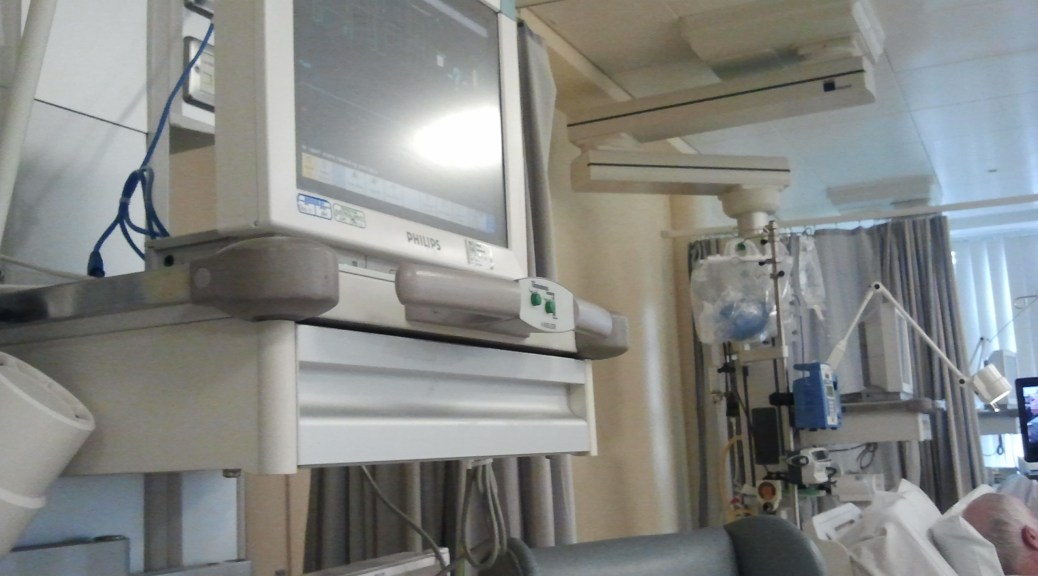
So I went to the doctor with a pulled muscle, got an ECG and ended up in the cardiac unit of Naas Hospital.  I have atrial fibrillation which, although a bit unusual at my age, is not particularly life threatening.  Thinking back I’ve probably had it for months.  They will thin my blood over the next six weeks to remove any clots and then restart my heart.  Just like computers, restarting seems to solve a lot of problems.  It should go back to a normal rhythm then, if not well they will have to try some more drugs.

During the middle of last night I got up to go to the loo and began to feel very weak.  Of course this has happened before but now I knew it was my heart it changed my perception of what was happening.  I really thought that perhaps I could die and was not particularly happy about that.  My youngest is nine and I think she would find it hard, as indeed so would the others.  There was also a level of fear and no sense of the Lord’s presence.  So it was a challenge to pull my mind around to the idea that I had to face that portal some day anyway and if today was the day…  I’m not sure I passed that test very well.  The next time though I should be better prepared.  I learnt how much I depend on feelings.  It is a clear and lovely thing to depend on the truth alone and to press on through the feelings.

The cardiac unit is a place where death is ever possible probably more intensely so than in many other parts of the hospital.  Death can be sudden though none of the people here have yet suffered a heart attack in the time I have been here.  A. from Newbridge suffered a heart attack at the weekend.  It was a life changing experience for him and he wants to change his life henceforth, stop wasting time.  It was great to be able to give him the Purpose Driven Life to read.  He knows others in Open Arms and will come along on a Sunday he says.  Perhaps he is the main reason I am here.  He is only 46.

Ellen has dementia, she is in a room on her own off the main ward.  She makes everyone wonder what they would be like if their brain was affected that way.  Her most common phrase is:  “I want a cup of tea. Are you deaf?” To which the very patient nurses reply either “How are you Ellen?” or “I gave you a cup of tea already but you did not drink it.”  She normally replies with unprintable expletives.  She can also scream at the top of her voice if they come near her to change her or bathe her.  This is a bit disconcerting.  There is probably nothing more challenging than brain disease since it can change your personality so much and it is not clear why.  It strikes at the heart of our identity as people.  Whenever I indulge in thoughts I shouldn’t (and that happens) I remind myself that these could embed and show up at some later stage of dementia or Alzheimer’s should I get that.  Somehow the idea that everything will be shouted from the housetops in heaven is not as much of a deterrent as the possibility of me doing that myself to all and sundry in my old age.

The other two inmates are older.  I don’t think I want to end up in here in my old age.  Old age…. remember your Creator while you are young….before the days come when you say I have no pleasure in them.

As I said to a bunch of medical students on the first day I was here:  “We are all going to die, it’s just a question of timing.”  Unless the Lord comes for us before then of course.

The Safeguards of the Christian Faith

Faith is a gift – or so the Bible says in Ephesians 2:8 – and faith is substance and assurance (Hebrews 11:1). So those with faith might not require much else. They believe in Jesus having, like me, that assurance in their hearts where they can hear and feel the Holy Spirit. The other side of that though is that they can be deceived. So God has put in place two other things to help, the Scripture and the Church. So we have three things which keep us on the straight and narrow so to speak.

Here is a check for the church or group you are in:

Do they honour the personal in dwelling Spirit of God in you (1 John 4:2) and do they honour the Scripture ?

Some big groups do not: churches with a clergy say you cannot know God safely unless you are guided by clergy.  Some would rather you did not read the Scripture at all but let it be read and interpreted to you through the same clergy.

Sound familiar? So they remove two safeguards and leave you with only one. And what if that turns out to be corrupt?

The Sea

Many years ago a preacher pointed out the curious statement at the beginning of Revelation 21:  

“And I saw a new heaven and a new earth, for the first heaven and the first earth had passed away.  Also there was no more sea.”

I’ve been thinking about that ever since (among other things).

Now I am going to make some bold statements about it all and back it up with some Scriptures.

  • The sea that is referred to is the one before the throne in the “old” heaven, i.e. the heaven that is there now (Rev. 4, 5).
  • This heaven is also known as the third heaven (2 Cor. 12:2) and is the place where God’s throne currently is.
  • The sea (Rev. 4:6) is the way time and events on earth look like to an observer in the third heaven (Dan. 7:2,3; Rev. 13:1).  Spirits (winds) blow upon it and things are stirred up and come up out of the sea before the throne.  However the most wonderful sight is that of the spirits of men worshipping God (Hebrews 12:22-24; Rev. 15:2).

So why is there no more sea when the new heaven comes along?

Well there is no more time nor difference between the spirit and the flesh in the new heaven.  In this life the life of this mortal body is in the blood (Gen. 9:4; Lev. 17:11,14), in the new heaven the life of the immortal body will be in the spirit (Luke 24:39; 1 Cor. 15:44).  When we are seen in the existing heaven it is our spirits that are seen.  However in the new heaven we will be body and soul with the Lord forever.

There is also a very clear picture about being born again here.  What happens when we are born again?  Well, a baby moves from a place of breathing and living in water to breathing and living in air.  So we too, according to this picture of rising above the surface of the sea in heaven, move from death beneath the waves to life in the spirit above them.  The first time we do this is when we are raised together with Christ from death to life when we are born again.  I believe that walking in the spirit means walking on water (on the sea) which explains one of the main points of that miracle (Matthew 14:22-33; John 6:19).

So if it helps you, the next time you are worshipping God either on your own or at church imagine that your spirit is rising up out of the sea before God’s throne in the third heaven.  Because that may very well be what is actually happening (cf. Hebrews 4:16).

A way of looking at the descriptions in the book of Revelation

Some people say Revelation is purely symbolic.  Some people say it is literal. Personally I consider all of Revelation open to a literal interpretation, i.e. it was literally what events on earth looked like from the vantage point of heaven to a human transported there (i.e. John).

John is in eternity looking down at events on earth occurring in time. That being the case there is bound, even for this reason alone, to be considerable differences between what he saw of the same events in comparison to someone viewing from earth in time.  Add to that that he was also more than likely looking at the spiritual rather than the corporeal bodies of each participant and the imagery in Revelation is more easily understood (perhaps).

Here are some thoughts:

Revelation is the spiritual view of events on earth through the second heaven – c.f. Daniel 7.

Animals represent creatures, corporations with no relationship with God, humans represent creatures or corporations capable of a relationship with God.  Corporations in this sense are collectives of people with one spirit, e.g. nations, empires, companies, etc.

Does that help?

The consequences of communion

  or   

Paul’s observations on what happened when people didn’t discern the body of Christ during the breaking of bread or Lord’s supper or communion as it is sometimes known (1 Cor. 11:30) can be better understood if we look at the historical understanding of disease at the time and now.  Now we understand the concept of germs and contagious diseases but then such things were not understood at all.

However Paul was able to observe something happen and come to conclusions.  Communion meant sharing a common cup and bread (1 Cor. 10:16,17) then.  Nowadays we don’t normally do that, at least in large congregations.  The reason we don’t  is because we know that is how germs are spread.  But at a time when that was not understood, the connection between falling ill (or sometimes dying) and sharing a common cup would not have been so understood.  However Paul observed this happening in some churches.  And it would seem it was churches like Corinth who seemed most lax about how they observed the Lord’s supper that this happened in the most.

Now let’s take this argument one (admittedly controversial) stage further.  He says that believers in some cases were ill after communion because they did not observe the Lord’s body (1 Cor. 11:29).  In general believers will not be leading a promiscuous lifestyle.  Contagious diseases in particular are picked up by a promiscuous lifestyle.  So if the body is discerned and those who are outside the body in general are convicted enough by the self examination not to partake in the breaking of bread then that reduces the risk of the spread of contagious disease through sharing a common cup.

Of course there is not a one to one correlation between not having contagious disease and being a Christian – most everyone gets a cold at some time – but you can see how this might work out in practice even at a simply natural level.  Then if you take into account God’s divine intervention on behalf of His people …

Lessons in Maturity: Separating knowledge from the Knower

In 2011 I worked for a company of consultants.  One of the tasks I was given during that time was to come up with a way of handling knowledge.

Knowledge comes in two main forms: implicit and explicit.

Implicit knowledge is information or data or skills that people know without realising they do or, at least, without articulating it well.   Implicit knowledge can be very hard to document or explain to someone else. Explicit knowledge is the opposite, it is knowledge that is easily documented and understood in text or diagrams.  In the past and in some places today, civilisations and organisations dealt with the problem of passing on implicit knowledge by using an apprentice and master approach. This approach has gone out of favour in the West generally.

In my research I came across this paper. Its a typical Ph.D. paper with loads of big words, months of research and lots of references. But basically it says you can’t separate knowledge out from the knower and make it useful for people who are in the senior consultant category (mature if you like). The senior consultant will always need to talk to the knowledge originator to get the things (help, implicit knowledge, advice, experience, contacts, etc.) that only a conversation or interaction with the person will provide. Explicit, extracted knowledge only has limited use really only for those who are inexperienced or new to a company.

Likewise reading the Bible on its own without being a disciple of its Author is of limited use and can be quite frustrating.

Lessons in Maturity: Lactose intolerance

Here is an offbeat observation of real life imitating Scripture at a physical level: Lactose intolerance is standard as people mature unless it is removed by adverse conditions.

In Northern Europe over many generations the gene that normally activates lactose intolerance was removed by natural selection due to the dependence on cow’s milk in the colder climates. Hence the fact that all major races except Caucasians (and some East Africans) are lactose intolerant after breastfeeding age.

So it is natural to mature beyond milk at least in the physical.

Is the western dependence on spiritual milk among Christians with years of a Christian walk likewise evolved and unnatural?

A Christian in a relationship