All posts by faithfulwon

Perfect Love

John mentions perfect love in 1 John 4:18 in a way that seems to indicate – taken along with the rest of his writings – that he had first hand experience of it.  I’m not sure I have now because I experienced a level of love I have never had before both mentally and emotionally last night and it has left me realising that I have a lot more to know.

It wasn’t a mushy thing nor a cold, crucified kind of love.  It reminded me more of the kind of love that Paul talks about in Ephesians 3:17 – a rooted and grounded kind of love.  Like all God things ultimately it is a revelation.  It sounds simple when you describe it but the experience is profound, moving and revealing all at once.

I fancy myself as a bit of a mystic.  My mind is on heavenly things a lot.  The truth is that it is probably on earthy things more often but, as I said, I like to think in mystic ways.  I’m partial to Akiane Kramarik’s way of thinking about things and I would have a lot of time for the ideas explored in the various Star Trek series and movies.  Thankfully as someone impacted by Jesus in an experiential and life changing way I don’t have time to explore that kind of mysticism much.  As Paul says (in 1 Corinthians 8: 5) there are many gods and many lords and they are all more powerful than me without Christ – or at least most of them are I guess.  I’m better off ensuring I know the Lord of lords and God of gods first and it will take me a lifetime to do that.

But that kind of mystical tendency has left me floating a few inches above the ground most of the time I think.  Or at least that is what it seemed like when God showed me His love for me in a fresh new way last night.  Being rooted and grounded in love is to be totally in touch with the here and now.  God showed me last night that in the here and now He has done nothing but protect, love and esteem me for the last 35 years.  It is just in my imaginations that I have been fearful, imagining what suffering together with Christ might mean.

Victor Hugo and the French Worldview

Victor Hugo is best known outside France for two novels he wrote, Les Miserables and The Hunchback of Notre Dame. I recently tried to read an unabridged version of the former and I may have read abridged versions of the latter as a child. The latest film version/ musical of Les Miserables is a powerful work which captures the main story line of the novel very well. However when I read the book, the level of detail (“God is in the details” according to the translator) was difficult to wade through. The book had about 1500 pages and I gave up around page 1000. Maybe I will complete it some day.

France and the UK have always stood poles apart – especially during the 19th Century. This is mainly because France had a bloody revolution at the end of the 18th Century and the UK didn’t. Victor Hugo was an apologist for the revolution. He argues extensively in Les Miserables that it was a great thing for France and for the world that it happened. On that point I could not agree. Charles Dickens’ novel “A Tale of Two Cities” which I did complete not too long ago brings out the contrast between London and Paris at the time. Dickens is distinctly not apologetic for the French Revolution. In fact you would be hard pressed to find many Englishmen who are or were.

Being Irish I understand the power of blood sacrifice in nationalist revolution. I came to live in Ireland at 12 having been schooled and reared in England until that time. I can still remember the shock of the Irish view of revolution and what it meant to the Irish. Everything in the Irish worldview is coloured by 1916 and 1922 as well as the history of revolutions extending back through 1798 and before. Around where I live there are 3 plaques and a monument within a 2 km radius commemorating battles and deaths that happened in the local area during the revolution of 1798.

Blood sacrifices have power. As Christians we should know this only too well.

The rising up of the ordinary people was praised throughout Les Miserables. Victor Hugo helped lay a foundation in French thinking that makes it perfectly acceptable for a large amount of people working in a particular industry to hold the rest of the country to ransom. He also had a wife and a mistress, another pattern of French public life he reinforced.

“Victor Hugo’s death from pneumonia on 22 May 1885, at the age of 83, generated intense national mourning. He was not only revered as a towering figure in literature, he was a statesman who shaped the Third Republic and democracy in France. More than two million people joined his funeral procession in Paris from the Arc de Triomphe to the Panthéon, where he was buried. He shares a crypt within the Panthéon with Alexandre Dumas and Émile Zola. Most large French towns and cities have a street named after him.” (Wikipedia)

15 Minutes

Whether it is because our lives are too busy, or because our attention spans have dropped away due to social media, but for whatever reason it seems increasingly difficult to find time to do anything – at least if you mean by the word “time” anything greater than about 15 minutes.

We can all usually find 15 minutes:

  • 15 minute coffee break
  • 15 minutes on Facebook (normally turns into 30 though)
  • 15 minutes over a meal (which should be at least 30 but often isn’t)
  • 15 minutes power napping

So recently I’ve been trying 15 minutes praying (having been prompted about this in a number of ways). First thing in the morning before doing anything else, sitting on the edge of my bed. When I get home in the evening from work. Last thing at night. Seems to work. You should try it.

Now it has taken me 15 minutes to write this blog (including time being distracted by someone’s birthday on Facebook) which is enough time. Anymore and you will probably not read it.

Next 15 minutes of exercise. Hopefully I’ll also get 15 minutes of teaching myself the electric organ before the day is out.

Isn’t it amazing what you can do with 15 minutes?

Peace and Rest

There are many places in Scripture where God tries to tell us just how important he considers it that His people should be walking in peace.

In the New Testament we are commanded to strive to enter the rest that the Israelites failed to enter because of disobedience (Hebrews 3: 12 – 4:11).

In the Old Testament God enshrined rest in the fourth commandment (Exodus 20:8-11). He considered it so important that the penalty for violating that commandment was death (as shown in Numbers 15:32-36).

Despite being told the penalty for breaking the Sabbath, when faced with the violation (Exodus 31:14) they hesitated before carrying out the punishment -understandably. Of all the various death penalties meted out to the Israelites under the Law this one seems most harsh.

Thankfully we are not under the Law. Nevertheless there are sins that lead to (spiritual) death (1 John 5:16) and for us as Christians it would appear that consistently not being in rest is one of them.

Jesus emphasized again the importance of resting in Him in John 15: 1-7 where he mentions some quite shocking consequences of not abiding in Him. We can be cast out of His body that way.

From my own experience I have noticed both in myself and others that if I am not in rest it is usually because I am not trusting in God – I am anxious or worried –  or I am proud and rising up in myself, full of myself. Neither of these states is pleasing to God and, if continued in, they will inevitably result in separation from God.

Actually, spiritual death is worse than physical. So let’s strive to enter that rest.

And remember, there is always hope in Christ. All you have to do is come to Him. No matter where you’ve been – or how often you have been out of rest – you will find a welcome there every time you turn to him (the old fashioned word is “repent”). His death on the cross has made that possible.

“Come to Me, all who are weary and heavy-laden, and I will give you rest. 29“Take My yoke upon you and learn from Me, for I am gentle and humble in heart, and YOU WILL FIND REST FOR YOUR SOULS. 30“For My yoke is easy and My burden is light.”

Matthew 11: 28-30 (NASB).

Chosen Part 2: A Strange Flight

I was sitting on the third bus on the Dusseldorf Airport apron and it was going nowhere.

Next, someone is calling my name. I see an official on the apron with my bag in front of him. He explained to me that 121 people had been booked into the plane when in fact there was only 119 seats on it. He apologised for the inconvenience but they had been asking for volunteers and only one person had come forward. They then chose me from the other 120 passengers! They would compensate me for missing the plane by giving me free accommodation, a meal, a flight back the next day (Saturday) and £150 (which was quite a lot in 1996). And they hoped that was OK. No explanation as to why they chose me.

I stood forlornly on the apron waving goodbye to the other 119 passengers and joined my fellow detainee for the meal back at the airport hotel. I can’t remember much about the meal. My fellow inmate explained that he had volunteered to come off the plane partly because of the £150 but mainly because his fellow passenger was his boss from the Dept. of Transport who was in a foul humour at being messed about so much by Aer Lingus.

I rang Olive again, and again, and again. Some things don’t change much over the years and my wife’s tendency is still to either not have her mobile phone or to have it on silent or buried in her handbag where she can’t hear it. Bless her. Anyway, she could have saved herself a trip to the airport if she had decided to turn it on before she reached there. When she did eventually reach the airport she rang me with rather a strange opening line: “Hi love, I see your flight has been cancelled…” I was about to say: “No, I’m just not on it.” but that didn’t make sense so I checked with her again. It had definitely been cancelled.

I looked up at my fellow prisoner and told him. By this stage we had been about 2 hours at our meal and the cooks had gone home. So we wandered up to the hotel reception and sure enough, there were the other 119 passengers and the crew coming in the door. They had spent 3 hours on the tarmac only to discover that there was a technical fault with the airplane.

Sadly for those who weren’t chosen, a technical fault is not one that Aer Lingus compensated passengers for at the time. So the next day I got home on an earlier flight than they did and happily took my £150 compensation.

120 to one. Not bad, Dad.

Chosen Part 1: A Strange Airport

This is a true story.  Sometime in mid 1996 I was in Kiel, Germany at a GSM standards meeting. It was Friday evening and I was on my way home, looking forward to the weekend.

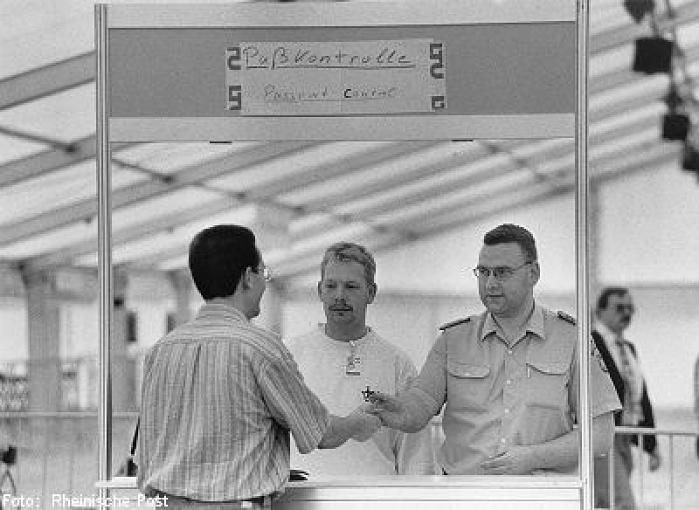
The first leg of the journey was by train from Kiel to Hamburg Airport where I took a plane to Dusseldorf. It was then that things began to become a bit surreal. When I got off the plane I got onto a bus which brought us to a tent/ marquee. Everyone got off the bus and calmly walked into the marquee as if there was nothing unusual about using a tent to receive passengers from an airplane in a first world country. I was wondering was there a special wedding being planned or something.

Things got even more surreal after I entered the tent. The first thing I saw was a conveyor belt with luggage on it. The thing that was different about this conveyor belt was that it wasn’t a loop – if you didn’t get your luggage off it, it fell into an ever increasing pile at the end of the belt! I watched this for a while a bit bemused. I could see the airport employee loading the belt from behind a tent flap. He saw me looking at him with my bag. The dream like nature of the whole experience was reinforced when he pointed at the bag and signed that it was going straight to Dublin, which it was….

I walked on. At this stage it had begun to rain. Water was dripping down between the joints in the marquees. I walked from the arrivals marquee towards a check-in marquee. There was a long line of what looked like hot dog stands stretched out the length of the tent with queues of people at each one.
I walked along the line looking for my flight number. These were written on sheets of paper in thick black felt marker and tacked to the top of each stand. I queued up with some others at the stand with my flight number on it. At the side of each stand was what looked like a bathroom weighing scales with a couple of wires out of it. People were putting their luggage on the scales.

Dusseldorf Airport Passport hotdog stand The girl behind the stand looked a bit flustered. She almost seemed to be crying when I asked her what happened: “Oh” she said, “we only got the franchise to manage the Aer Lingus luggage two weeks before the airport burnt down!”
I had been out of the country and had missed the news about the airport burning down. On the 11th April 1996, a fire broke out inside the passenger terminal at Dusseldorf Airport and 17 people were killed. I arrived a couple of weeks later.

Things made a bit more sense now. After getting my tickets I walked on to the X-ray machines which were sitting on pallets on the grass and towards the duty free tent. I pointed at what I wanted for Olive and the woman behind the counter entered the value into a handheld calculator and put my money in a grey petty cash box. I don’t think I got a receipt but then nothing was surprising me much any more. I walked over to the departures tent, found departure flap number 11 and sat down on a wooden form at the back of the area.

Much and all as I wanted to get home I was in no rush to get on the plane so I let the first and second bus leave and got on the third one.

That bus sat on the apron outside the tent and went nowhere. I could see a man remonstrating with an Aer Lingus official further along the apron.  I didn’t know it but things were about to get even more surreal…. (to be continued)

The sower sows the word

faithfulwon's avatarfaithfulwon

This was the first blog that I posted almost exactly 4 years ago.  It addresses a theme – the Word of God – that comes up many times in subsequent blogs.

Luke 8:11 explains that when the Scripture talks about seed it  is referring to the word of God.  Its one of those key verses like Rev. 1:20 which explains an object picture that God uses to describe something spiritual.

The parable of the sower in Matthew 13, Mark 4 and Luke 8 is an important one to understand (Mk 4:13).  Seeing our souls as a garden enclosed (Song 4:12) helps.  It is a very large garden capable of growing all sorts of trees and plants.  Just like any garden, if it is left untended it will grow weeds.  The best thing is to clear it, break it up (Hosea 10:12) and sow the word of God.

However there is a more general sense…

View original post 160 more words

He’s wild, you know. Not like a tame lion

C.S. Lewis describes Aslan in those terms to Lucy in one of his Narnia chronicles, The Lion, the Witch and the Wardrobe.

The concept of a three personal God is very precious to me.  I love the idea that He is not depending on us before He works miracles, not even on our faith.

Of course, without faith it is impossible to please Him (Hebrews 6:11).  Anyone that comes to Him must believe that He is and that He is a rewarder of those that seek Him.

But when it comes to doing miracles, God isn’t limited by our faith.  He is quite capable of doing His own thing.

John wrote his gospel after the others.  And one of the things he does in his gospel account is write about miracles that have nothing to do with anyone’s faith except that of Jesus Himself.

  • In Chapter 5 he heals a man that was 38 years beside a pool waiting to try and get in when it was stirred up.  All he asks is whether he wants to be healed or not.  To this the man replies in a manner that shows that he only believed that the stirred up pool could save him, not Jesus.  Nevertheless Jesus heals him.  Later the same man betrays Him to the Pharisees.
  • In Chapter 6 Jesus feeds the five thousand when the only response of anyone present to his command to feed the people  was “What are these among so many?”.
  • In Chapter 11 Jesus raises Lazarus from the dead.  We know Lazarus was incapable at the time of exercising faith(!).  But Martha who was capable showed significant unbelief despite earlier promising statements.  There is no sign anyone else had any faith that He would do this. (Go and read it).

There are times when people do exercise faith in John’s gospel.  In these cases Jesus says a very specific word, the person concerned obeys and the miracle occurs:

  • In Chapter 4 the royal official sees his son healed after doing what he was told.  But it was probable that Jesus healed his son before that anyway.
  • In Chapter 9 he heals a man born blind after he does what Jesus says.  Here is an example of a man hearing the Word of God in a specific way, being obedient to what he heard and then seeing – literally – the miracle occur.

If you want to see miracles the key is to be where Jesus is (John 12:26) which means definite and continuing obedience to what He says.  Now all I need to do is put this into practice a bit more myself!

Faith comes by hearing the Word of God (Part 2)

I was sharing my last blog with my family the other night and my eldest daughter (14) challenged me to sum it up in one sentence.  So here goes:

Faith comes by hearing Jesus Christ speaking by the Holy Spirit the Word of God into your heart and mind and not just by seeing words on a page or hearing them from someone else.

So here are a few first hand examples:

I know a man (as Paul might have said in 2 Cor 12:2) who was in a middle eastern country some years ago living in a rented accommodation with his wife.  The landlady lived on the top floor of the same apartment with her brother and sister. When the man went up to pay his rent for the first time he was asked about why he and his wife were there.  So he explained that they were there primarily to help Christians in the country.  At her sister’s prompting the landlady then asked if the man could pray for her since she had a continuous head ache/ migraine that she could not get rid of by any medicine or doctors.  So the man prayed and God showed him clearly the reason she had the headache.  She had the headache because there was someone who had done something in the past to her that she had never forgiven him for (a word of knowledge 1 Cor. 12:8).  After the man had got up the courage to say this to the landlady, her sister immediately piped up and said, “Yes, you know so-and-so that did such-and-such to you 13 years ago!”  So the landlady prayed forgiveness for the person and was healed of her headache.  A few weeks later she was still thanking God for the healing and telling others.  That could have been the start of a series of healings except that the man through whom the healing had come said to the first of the cousins that came with sick children that they could pray themselves, they didn’t need him to pray for them.  However the problem was that these people didn’t know how to hear God speak to them.  He often wondered what would have happened if the selfishness and false humility hadn’t kicked in just then, over 25 years ago now.

The above is an example of where the word of God in response to a prayer was “yes”.  Not long after that we were involved in another situation where the answer to many prayers that looked for the answer “please heal” was “no”.

In the mission organisation we were involved in, one of the wives of a missionary in North Africa was seriously ill.  The leaders of the movement and many others started praying and fasting for her.  At that time the idea that “if you have enough faith you can see her healed” was prevalent among them.  So they tried to work up the faith, quoting the usual Scriptures and speaking forth healing in Jesus name as many do.  Thankfully there were others who were also trying to find out what God wanted.  After a few weeks, there was no sign of the woman improving, she was in fact getting worse.  Everyone then met at a leader’s meeting to seek the Lord further and we were invited along to wash the dishes and generally serve the leaders (something we were delighted to do since we would also be able to attend the prayer times which, with that group, were always powerful and exciting).  The Lord’s presence was palpable and we all knew He was with us.  One of the main leaders then got up and explained how he and his wife had believed for weeks that Ann* was going to be healed but that still it hadn’t happened.  He now thought that actually God wanted them to let her go (he heard the Word of God).  After waiting on the Lord we then all felt as if her spirit had gone to be with the Lord.  We later found out that she had indeed passed on at about the same time.

*Not her real name.

Faith comes by hearing the Word of God (Part 1)

A couple of blogs back I wrote about the conflation there is in our terminology when referring to the Word of God.  Jesus Christ is the Spirit behind the words, the Power in them and the Way, the Truth and the Life of them.  The words on the pages of the Bible without His presence in them are like a dead body – instead of giving life they produce death (John 6:63, 2 Cor. 3:6).

So we have to hear His Spirit speaking to us when we read His words.  And when we do what wonders can follow!

“For nothing is impossible with God” – Luke 1:37

“All things are possible to those who believe.” – Mark 9:23

“Everything that you ask, believing, you will receive.” – Matthew 21:22

“Is there anything too hard for God?” – Genesis 18:14

“If you ask anything in My name, I will give it to you.” – John 14:14

are just a few of the things that He says to us.

But what about something specific?  Is it possible to hear about that?  Well I believe it is and that it is essential we do hear specifically.

When David was going to fight against the Philistines, he clearly heard the tactics he was to use straight from the mouth of God (2 Sam 5:17-25):

17 Now when the Philistines heard that they had anointed David king over Israel, all the Philistines went up to search for David. And David heard of it and went down to the stronghold. 18 The Philistines also went and deployed themselves in the Valley of Rephaim. 19 So David inquired of the Lord, saying, “Shall I go up against the Philistines? Will You deliver them into my hand?”

And the Lord said to David, “Go up, for I will doubtless deliver the Philistines into your hand.”

20 So David went to Baal Perazim, and David defeated them there; and he said, “The Lord has broken through my enemies before me, like a breakthrough of water.” Therefore he called the name of that place Baal Perazim. 21 And they left their images there, and David and his men carried them away.

22 Then the Philistines went up once again and deployed themselves in the Valley of Rephaim. 23 Therefore David inquired of the Lord, and He said, “You shall not go up; circle around behind them, and come upon them in front of the mulberry trees. 24 And it shall be, when you hear the sound of marching in the tops of the mulberry trees, then you shall advance quickly. For then the Lord will go out before you to strike the camp of the Philistines.” 25 And David did so, as the Lord commanded him; and he drove back the Philistines from Geba as far as Gezer.

On two occasions he heard Him and the tactics were different in both cases (he went directly against them the first time and circled around them the second – v. 19, 23,24).

David was an example of someone depending on God on a daily basis and not just someone using a past method that succeeded to do something very similar again the same way.  Had David done the same thing twice, without waiting on God the second time, the results would have no doubt been different.  The first time He heard God, the second time he would have been presumptuous.

Faith comes by hearing the Word of God.  He is not limited to using the same formula time and again.  There is no relationship with God involved in taking a phrase like “By His stripes we are healed” (Isaiah 53:5, 1 Peter 2:24) and using it again and again like a mantra.  I’ve seen people do this and I don’t know of any situation where it achieved the results that they were expecting.  Unless someone hears Jesus say that word specifically in relation to a specific situation then no faith will come, just a kind of stubborn, desperate act of the will and flesh.

There is a school of doctrine that emerges in various places in the Christian churches from time to time. It says something along the line of “If you have enough faith then you can always see someone healed.”  I’d ask the question “Faith in what?”  If it is faith in a sentence plucked from the Scripture, even those I’ve quoted above, then I would ask “Did you hear the Holy Spirit say that to you about this situation or did you just take the words without the power in them?”  The truth is that if you have enough faith you will see someone healed or raised from the dead or whatever.  But faith only comes through hearing the Word of God.  We have to hear Him speak the words to us not just read them and think we can apply them like some kind of lotion.

However, I am still learning, there is much to learn about this area.  If I experienced more miracles of healing on a level that a disciple of Jesus should experience according to the gospels, I could speak with more authority.  I could be wrong.

For if anyone thinks himself to be something, when he is nothing, he deceives himself. But let each one examine his own work, and then he will have rejoicing in himself alone, and not in another. For each one shall bear his own load.

Galatians 6:3-5

In my next blog we’ll explore this topic further with some real life examples.