Category Archives: good news

Also includes what it means to be a disciple. Materials for a lesson in the His Story Module.

Being thankful for what Christianity has brought to our societies

Back in 2013 I did a course in biblical interpretation at the IBI and this came up during it.  I thought I’d post it here for others to see also.  All comments are welcome.

We have access to the results of generations of the Lord’s people operating in the abundance of His grace that has been given to us as a result of the death of Christ.  Their (and our) faith in Him has resulted in many blessings being released into the world.

As a result of the prayers of the saints and the gracious action of God in our societies here in the West (and elsewhere) we experience innumerable blessings:

  • good governmental systems;
  • justice systems based on a good moral basis[1];
  • freedom from slavery;
  • law enforcement;
  • business in an environment of trust[2];
  • access to hospitals, nursing, doctors;
  • education
  • a legacy of Christian inspired classical music, literature, art, etc. for nearly everyone in our societies if they want it.

Resulting from the Christian understanding of a rational God we have

  • technologies that our ancestors couldn’t even have conceived of impacting the military, medical, communications, computing, transport and other areas.
  • We enjoy a lifestyle of luxury arising from free trade and corporate business cooperation that even their kings in their wildest imaginations had no idea could be had;
  • We enjoy the exotic produce of the land and sea from all over the world delivered to our door if we want it[3]

our material comforts are in another league to our ancestors.

Our understanding of the world and its astonishing variety and our exposure to knowledge about it and the universe through personal travel, education and TV, means that – if we had eyes to see it – we have been exposed to many of the miracles of God.

Here in the west we know little or nothing about persecution to the point of death.

That is not to say that every advance in Western society is directly attributable to Christians but I believe many are directly attributable to a Christian worldview – or on a more fundamental level – to God.  He is working through the revelation of His truth in the Scriptures to provide the basis for everyone’s thinking in Christian societies.  You only have to learn about the development of a society where some other basis is at work (e.g. animism, Buddhism, Islam or Hinduism) to see the difference. Not that many of those have been left untouched by the Christian worldview since the 19th century.


[1] At least originally – nowadays they are inclined to move to precedence but there is still an underlying Christian basis to the constitutions of the world’s major democracies which in turn determines the principles of justice used (e.g. innocent until proven guilty).

[2] That mightn’t seem to be the case but you only have to experience the difference between operating in a society where there is much less or no trust to see how important this is and how much we take it for granted.  Transparency International clearly show the relationship between trust (i.e. lack of corruption) in society and its prosperity.

[3] Tesco deliver to your door for just €5 more in nearly every part of Ireland.

Submission

When Jesus was 12 He went up to Jerusalem with His parents.  When they went home He stayed behind, beginning the work His Father had called Him to do.  But they didn’t understand that when He told them.  So He went back with them and stayed in submission to them until the Jewish age of majority which was 30 in those days.  You can read about it in Luke 2:41-52.

I would hope I would recognise when my 12 or 13 year old was being called by God to do a work.  But I still think I would find it hard if they stayed behind without telling me when we had all gone somewhere together!  They would want to have a good reason!

Being subject to His parents for a further 18 years when they didn’t understand what His life’s calling was must have been hard.  If you find yourself in a similar situation think of that.


Loving the Greek…..

The New Testament was originally written in Greek since that was the “English” or “lingua Franca” of the the first century.  So I thought it would be a good idea to learn the NT or Koine Greek some years ago.  I must admit though that the vast range of English translations we have seem to capture most of the nuances of the Greek word meanings as far as I can tell.  But I am no expert.

There are a few things that the NT Greek does bring out:

1.  The simplicity of the language John uses compared with Paul.  It is really very easy to read John’s gospel and letters in the Greek especially in comparison to Paul’s.  It is a real and compelling miracle to see the depth of meaning and the deep subjects that John is able to explore with so few words.   I really don’t know anything equivalent in English.  However Revelation is no easier to read in Greek than it is in English which is one of the reasons many scholars believe that a different John wrote it.

2.  The Greek uses the continuous form of the verb “to be” far more than the English translations I have read do.  I am guessing that is because it would be being far more awkward to be reading.  But what the Greek brings out is a very important theological point or continuity rather:  You must keep on being saved to be saved.  There is no emphasis in the New Testament on point decisions or actions like the English translations seem to imply.  The examples are everywhere in the N.T. (Colossians 3:1 keep on seeking, Romans 8:1, 4 are not walking, etc., etc.).

3.  Of all the English translations I have read I have yet to come across one which brings out the distinctions in the Greek words for love in John 21:15-17. Knowing the differences significantly adds to the understanding of Jesus’ reinstatement of Peter and the qualifications for being a minister in God’s church.  Only the amplified version really brings it out but you can lose the significance in all the words.  Here is my version:

15 When they had eaten, Jesus said to Simon Peter, Simon, son of John, do you agape Me more than these? He said to Him, Yes, Lord, You know that I phileo You. He said to him, Feed My lambs.

16 Again He said to him the second time, Simon, son of John, do you agape Me? He said to Him, Yes, Lord, You know that I phileo You. He said to him, Shepherd My sheep.

17 He said to him the third time, Simon, son of John, do you phileo Me? Peter was grieved that He should ask him the third time, Do you phileo Me? And he said to Him, Lord, You know everything; You know that I phileo You! Jesus said to him, Feed My sheep.

Agape means love like Jesus’ love when He died for us on the Cross.  A supernatural love that comes straight from the Father.  Peter knew he didn’t love Jesus like that – not after his three denials on the night Jesus needed him most.  He wasn’t going to make the same mistake he had made before the crucifixion (John 13:37).

But he also knew that he had phileo –  a brotherly affection and natural love for Jesus.  So he had responded honestly.  He didn’t mind Jesus questioning his agape love but he was upset when he questioned even his phileo love.  He would have been devastated to discover that he didn’t even have that!

But actually Jesus was out to encourage him.  For each time He questioned Peter and each time Peter answered honestly and without pretense Jesus found in him someone He could trust.  Someone who could feed the young and tend to the needs of and even feed the more mature.

Some teachers would say that Pentecost (Acts 2: 1-4) added the agape to the phileo that Peter had.  And perhaps it did.  But for me I think I know what answer I would give to Jesus if I was asked the same questions, Pentecost or no Pentecost.

Only He knows really how qualified I am, or anyone is, to spiritually feed and tend His lambs or sheep.  But the qualifications are definitely not academic ones.  You don’t have to learn the Greek to love His people enough to feed them.

Fear

 “And I say to you, My friends, do not be afraid of those who kill the body, and after that have no more that they can do.But I will show you whom you should fear: Fear Him who, after He has killed, has power to cast into hell; yes, I say to you, fear Him!

“Are not five sparrows sold for two copper coins? And not one of them is forgotten before God. But the very hairs of your head are all numbered. Do not fear therefore; you are of more value than many sparrows.

Luke 12: 4-6. (Matthew: 10:28-31)

Fear and do not fear: one sentence after another.  First note that Jesus is speaking to His friends.  This is very important since Jesus says (in John 15:14) that you are His friends if you do what He commands you and it also presumes relationship with Him.

1.  Do not be afraid (v. 4 above).  That is do not be afraid of men. The original Greek word that was used  is the same one that we get our word for phobia from (e.g. arachnaphobia, technophobia, etc.).  If God is for us who can be against us? He who did not spare His own Son, but delivered Him up for us all, how shall He not with Him also freely give us all things? (Romans 8:31-32).  So don’t have phobias about what men can do.  They can only affect your body.

2.  Fear Him (v. 5).  It would be easier, perhaps nicer, if fear wasn’t the exact same word but it is, even in the Greek.  We do need to be afraid of God even if we are friends of Jesus because God can put both our body and soul in Hell after we die. And that is much worse than our body dying.

3.  Do not fear (v.6).  Same word again!  This time Jesus is assuring His friends that they don’t have to be afraid about being put into Hell.  Even though God can do it, He won’t do it to them because they are His friends.

The point is that we need to stay being His friends, i.e. in relationship with Jesus and obeying His commands. Otherwise why would Jesus tell us to fear Him?

On Eagle’s Wings

Dr. Loye Miller (1918) published the following account, as given to him by one of his students:

Last summer while my father and I were extracting honey at the apiary about a mile southeast of Thacher School, Ojai, California, we noticed a golden eagle teaching its young one to fly. It was about ten o’clock. The mother started from the nest in the crags, and roughly handling the young one, she allowed him to drop, I should say, about ninety feet, then she would swoop down under him, wings spread, and he would alight on her back. She would soar to the top of the range with him and repeat the process. One time she waited perhaps fifteen minutes between flights. I should say the farthest she let him fall was 150 feet.

My father and I watched this, spellbound, for over an hour. I do not know whether the young one gained confidence by this method or not. A few days later father and I rode to the cliff and out on Overhanging Rock. The eagle’s nest was empty. (Miss F.E. Shuman)

Deuteronomy 32:11-12 says this:

As an eagle stirs up its nest,
Hovers over its young,
Spreading out its wings, taking them up,
Carrying them on its wings,
12 So the Lord alone led him,
And there was no foreign god with him.

In Exodus 19:4 God says this:

‘You have seen what I did to the Egyptians, and how I bore you on eagles’ wings and brought you to Myself.’

Some other good commentary on the subject can be found here.

Abraham and Isaac

The post below is an attempt to imagine what both Abraham and Isaac were thinking as they went through the ordeal described in Genesis 22.  I also bring out the similarities between the story and that of the death of Jesus Christ at the hands of His Father.

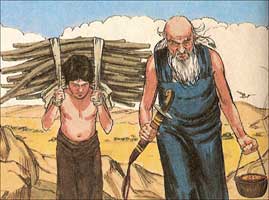
It was a very long trudge up Mt. Moriah as Abraham went to sacrifice his son to his God.  He was thinking about it as he went along.  He knew that it was a common enough thing among the gods of the people’s around him for them to ask for such sacrifices.  But somehow he had hoped it would be different with his One.  And then there was the confusing thing about that promise that through Isaac all his descendants would be named.  If there was one thing certain about the God Abraham served, it was that He kept His promises. “I bet you He is going to raise Isaac from the dead!” thought Abraham to himself.  That encouraged him a bit…. until he thought again about raising that knife….

ImageTrudging along with Isaac beside him.  How was he going to explain this to Sarah?  Hopefully Isaac would come back in one piece and it would be easier.

Isaac was a good lad.  Humble, submitted, meek as a lamb going to the slaughter.  Abraham was an old man, why did he have to go through this?  All his hopes and dreams were tied up in Isaac.  There was no one else like him.  But he had learnt a long time ago not to give into self-pity.

Silent, confused, trusting still, trudging along with Isaac beside him.

________________________

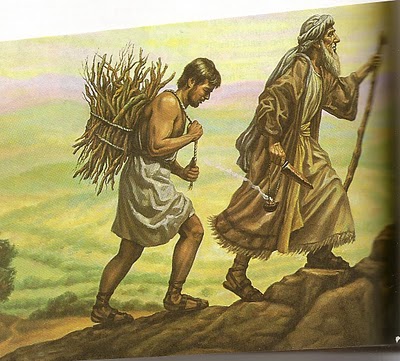
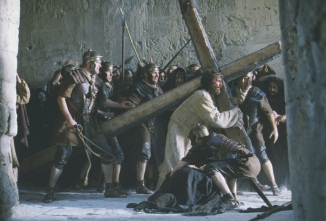
ImageThe wood was heavy.  It was biting into his shoulder as he trudged up the hill. Only a few days earlier he had travelled on a donkey, a foal of a donkey in some style but now their followers had been left behind and it was just him and his father walking.  He saw the fire and the knife…

He asked the question but he knew the answer somehow fitted.  He was the lamb that was led to the slaughter, uncomplaining.  God had indeed provided.  So he submitted silent, still while the altar was prepared, the wood arranged a cross it and the knife was raised.

___________________________

 “Abraham! Abraham!”

Image

Abraham looked down at his son who was in all his heart and all his mind and all his soul and all his strength –himself- and it had come to this!  The angel had said both their names.  So he thought and said: “Here I am”…  “My everything.  Ask me to sacrifice myself it would be easier!”

______________________________

God saw the transaction.  Yes, He had made man in His image so it was possible – the Father could slay His Son, this man had demonstrated that.  So infinitely difficult though, so distressing that He didn’t want a creature to have to endure what He as a Creator would, the loss of a son at His own hand.  He saw the intent, that was enough, now He would provide.  There had been times enough when fathers had lost their sons and there would be times again when it would happen, times without number.  He would do the best thing possible so that those who received the Gift would receive again their sons back from the dead, just as Abraham believed he would.

Disciples, Saints and Overcomers

Disciples is the term used in the four gospels and Acts, Saints is the term used in the letters and Overcomers is the term used in Revelation (chapters 2 & 3).  And I believe they all refer to the same thing – they mean Christians who are loving the Lord their God with all their hearts and all their minds and all their souls and all their strength and their neighbours as themselves (Matthew 22:37-40).

Disciples take up their cross daily and lose their lives so they may save them (Luke 14:26-27).  Saints live holy lives dedicated to their God and the fellowship of other saints.  Overcomers keep on coming over and over again to the Lord no matter what.  They all by faith and patient endurance take hold of the promises God has in store for those who love Him (Hebrews 6:11-12).

And the New Testament is written for them not for anyone else really.

Unless you are born again you cannot be a disciple and you cannot see the things they see (John 3:3 & 5). However being born again is not enough, you must also walk daily with Jesus if you want to gain the promises made to overcomers (Rev. 2:7, 11, 17, 26-28; 3:5, 12, 21) .

Forgiveness

From chapters 9 – 11 of Romans, Paul wrestles with the mysteries of pre-destination.  Finally at the end he seems almost to throw his hands up in the air and admit he can’t explain it.  This reaction seems triggered by the remarkable conclusion he comes to in Romans 11:32:

“For God has committed them all to disobedience, that He might have mercy on all.”

I was listening to Luke 7 in the car on the way to work and struck again by the words Jesus spoke to Simon the Pharisee:

“..to whom little is forgiven, the same loves little.” (Luke 7:47)

I believe now that the reason Jesus gave the Pharisees such a hard time was to make them realise, if at all possible, that they were just as bad as any prostitute.  Only by realising this could they be forgiven much and so love much.  In the light of the infinite holiness of God, we are all sinners to the same degree.  It is just that some of us have a hard time realising it.

Blessed is the man or woman who is forgiven much (Psalm 32:1).

The sower sows the word

Luke 8:11 explains that when the Scripture talks about seed it  is referring to the word of God.  Its one of those key verses like Rev. 1:20 which explains an object picture that God uses to describe something spiritual.

The parable of the sower in Matthew 13, Mark 4 and Luke 8 is an important one to understand (Mk 4:13).  Seeing our souls as a garden enclosed (Song 4:12) helps.  It is a very large garden capable of growing all sorts of trees and plants.  Just like any garden, if it is left untended it will grow weeds.  The best thing is to clear it, break it up (Hosea 10:12) and sow the word of God.

However there is a more general sense to the parable of the sower.  If we are sowing the word by preaching it (Romans 10:14,17) then we can probably expect 4 types of hearts upon which it will land:  hard ones, stony ones, congested ones and noble ones.  If we look at the parable of the sower in isolation then it would appear that only about a quarter of the people who hear the word produce fruit.

But Jeremiah 23:28-29 gives us some idea of the power of that word and some hope to those who may think their heart is hard, stony or clogged up with the cares of this life:

“Is not My word like a fire?” says the Lord, “and like a hammer that breaks the rock in pieces?”

The fire burns up the thorns and the hammer breaks up the path and stones.  A seed can have tremendous power in even the most adverse conditions.  God’s word is even more effective in the heart.