Tag Archives: bible

Comfort

Praise be to the God and Father of our Lord Jesus Christ, the Father of compassion and the God of all comfort, who comforts us in all our troubles, so that we can comfort those in any trouble with the comfort we ourselves receive from God. For just as we share abundantly in the sufferings of Christ, so also our comfort abounds through Christ. 2 Cor. 1:3-5

Perhaps its because of my age or heart condition but I find that unless I feel, very tangibly, the internal comfort of the Holy Spirit and some ease of pain or discomfort, I’m pretty well good for nothing.

The story of Jonah is one of God using discomfort to direct and teach Jonah and other men. In chapter 1, the extreme discomfort of a storm leads men to do something they wouldn’t do if the discomfort wasn’t there. In Chapter 2 Jonah knows comfort in the extremity of being deep underwater in the belly of a fish. In Chapter 3, the people of Nineveh make themselves discomfited in response to the Prophet’s word. 

But in Chapter 4 the impact of personal discomfort on our actions, thoughts and responses to God is shown most clearly:

Jonah had gone out and sat down at a place east of the city. There he made himself a shelter, sat in its shade and waited to see what would happen to the city. Then the Lord God provided a leafy plant and made it grow up over Jonah to give shade for his head to ease his discomfort, and Jonah was very happy about the plant. But at dawn the next day God provided a worm, which chewed the plant so that it withered. When the sun rose, God provided a scorching east wind, and the sun blazed on Jonah’s head so that he grew faint. He wanted to die, and said, ‘It would be better for me to die than to live.’

But God said to Jonah, ‘Is it right for you to be angry about the plant?’

‘It is,’ he said. ‘And I’m so angry I wish I were dead.’

10 But the Lord said, ‘You have been concerned about this plant, though you did not tend it or make it grow. It sprang up overnight and died overnight. 11 And should I not have concern for the great city of Nineveh, in which there are more than a hundred and twenty thousand people who cannot tell their right hand from their left – and also many animals?’

Jonah 4:5-10

It would be easy for us to judge Jonah but I for one can fully identify with his position. The sufferings of the people of Ukraine, Gaza or even those much closer to home are irrelevant to me when all I feel is pain or discomfort.

Which is why it is so good and important that God does comfort us. As Paul says: “Praise God.. who comforts us in all our troubles.”

It is clear that God wanted to teach Jonah and us all a lesson about the relative importance of things in this chapter. There can be no comparison between my sluggishness and tiredness in the morning and the appalling loss of home, possessions and loved ones that is happening everyday in Ukraine and Gaza.

But still He does actually comfort me. He cares so much about me that I am comforted internally and know regular relief from pain and tiredness as well. Why am I so blessed and others have to suffer so much?

I cannot tell. Grace I guess.

Empty Space?

As the KJV of the bible quaintly puts it (in 1 Corinthians 13), when it comes to heavenly things “we see as in a glass darkly”. Or as the NLT puts it more clearly (pun intended): “we see things imperfectly, like puzzling reflections in a mirror”.

I wonder, though, which unseen world we see more clearly, this physical one or the heavenly spiritual one?

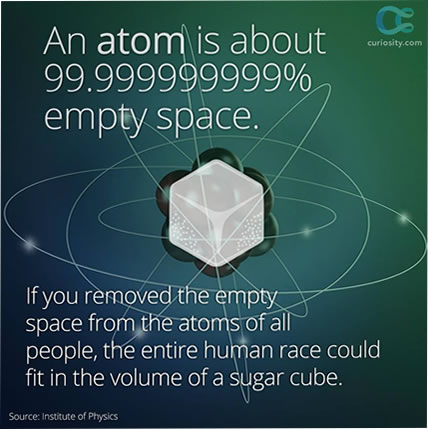
The reason I ask is because scientists tell us that the world is mainly empty space.

Even the most solid of things contain more emptiness than substance. The main guy to find this out was Ernest Rutherford. We can probably trust him and the others who have observed and proved this for many years now

The bible says that God fills all in all.

So what are you seeing? The world as it is, filled with God’s Spirit and not much else?

Or just the really, really insubstantial physical things around you?

And what are you trusting in? The evidence of your eyes or the Truth?

Jesus said:  “I am the Truth…” (John 14:6)

Jesus’ life better than Adam’s sin

In Romans 5 Paul states something a bit obvious – Jesus life is more powerful than Adam’s sin in its effects.

12 When Adam sinned, sin entered the world. Adam’s sin brought death, so death spread to everyone, for everyone sinned.  Yes, people sinned even before the law was given. But it was not counted as sin because there was not yet any law to break. 14 Still, everyone died—from the time of Adam to the time of Moses—even those who did not disobey an explicit commandment of God, as Adam did.

Bad news, it only took one man’s sin for death to enter the world and for everyone to die. We see that around us all the time. The inevitability of physical death stares every man in the face no matter how good they are.

17 For the sin of this one man, Adam, caused death to rule over many. But even greater is God’s wonderful grace and his gift of righteousness, for all who receive it will live in triumph over sin and death through this one man, Jesus Christ.

18 Yes, Adam’s one sin brings condemnation for everyone, but Christ’s one act of righteousness brings a right relationship with God and new life for everyone.19 Because one person disobeyed God, many became sinners. But because one other person obeyed God, many will be made righteous.

I find it difficult to understand how the free gift of new life for everyone can be greater than Adam’s sin if, in fact, it doesn’t apply to everyone. What I mean is, death applies to everyone so therefore life must also apply to everyone for it to be greater. That seems obvious enough.

So I would argue from this and from Scriptures concerning the Book of Life, that the default position of every man is that they are written in the Lamb’s Book of Life because of Jesus’ death on the Cross. You have to have your name erased from the Book of Life to lose that life. Only Overcomers are guaranteed that that won’t happen to them (see Exodus 32:32 and Rev. 3:5).

However if you want to appropriate and see the effects of that life in this world then you need to receive it now. Actually, if you are reading this don’t take the risk and presume you are there. Make sure you are experiencing the reality of the love of Christ in your life now. The only people who can really be assured they are in the Book of Life now are those who can hear God the Father’s whisper in their heart to which they respond: “Abba, Father”. No amount of thinking it can give that assurance.

But let God be gracious in your heart, He is not willing that any should perish (2 Peter 3:9). Who knows, perhaps the exclusive evangelical doctrine which says that every man must believe the way we do to be saved is not quite right after all?

Let us not think that everyone around us is going to hell just because they don’t go to our church. God knows their hearts, very often we don’t.

Faith

“If we emphasize faith does that mean we can forget about the law?”  Paul asks at the end of Romans 3. And then he answers himself:  “Of course not!  In fact, only when we have faith do we truly fulfill the law.”

It seems to me that the first 4 chapters of Romans are primarily about sin, law and faith and the relationship between all three. And up to now we have learned that we all sin, that the law doesn’t help but instead just makes the sin more obvious and that faith is somehow the answer to it all. Paul has also introduced the concept of grace/ undeserved favour. In chapter 4 Paul tries to explain faith using Abraham as an example.

First of all it is as well to establish that Abraham was a sinner. He mistrusted God on at least two occasions we know of and put Sarah in a compromised position, he had a child by his wife’s servant – as well as several other liaisons. He also committed murder on several occasions – or at least he was involved in war – and would have killed his own son if God hadn’t stopped him (Genesis 22). By the way, it looks like Sarah had had enough after that incident since we don’t see her with him again until she is dead. You wouldn’t blame her for not wanting to stay with a man who said God told him to kill their son.

But the Scriptures tell us, “Abraham believed God, and God counted him as righteous because of his faith.” Romans 4:3). Abraham, just like us, needed a saviour – a God who forgives sinners. And it was the trusting relationship with God that enabled God to pass on that forgiveness to him. There was no way he could be with God, believing God, and not be forgiven since he couldn’t stand before God’s holiness except in a place of forgiveness.

“Oh what joy for those whose disobedience is forgiven, whose sins are put out of sight.  Yes, what joy for those whose record the Lord has cleared of sin!”  as David says (Psalm 32: 1-2 quoted in Romans 4:7.8).  Another man who needed a saviour.

The death of Jesus looks back as well as forward in its effects.

None of us

“No one is righteous – not even one.

No one is truly wise;

No one is seeking God.

All have turned away; all have become useless.

No one does good, not a single one.”

For no one can ever be made right with God by doing what the law commands.  The law simply shows us how sinful we are.

But now God has shown us a way to be made right with him without keeping the requirements of the law.

We are made right with God by placing our faith in Jesus Christ.  And this is true for everyone who believes no matter who we are.

For everyone has sinned; we all fall short of God’s glorious standard.  Yet God, with undeserved kindness, declares that we are righteous.  He did this through Christ Jesus when He freed us from the penalty for our sins.  For God presented Jesus as the sacrifice for sin.  People are made right with God when they believe that Jesus sacrificed His life, shedding His blood.”

The above is extracted from Romans 3 (NLT in case you didn’t recognize it). It seems Paul wrote the first two chapters of Romans to make sure that he set the standard of God’s requirements out of reach for both the irreligious and the religious alike. As he says later on: “For God has imprisoned everyone in disobedience so he could have mercy on everyone.” (Romans 11:32 NLT). Which must surely be one of the most mind boggling statements in the Bible. No wonder Paul goes on to say: “How impossible it is for us to understand His decisions and His ways!”

But understanding it all is not where it is at. Believing and trusting in Him is.

Having said that Paul gives understanding its best shot in Romans. I personally like that.

The Descent of Man

It is several decades now since the popular BBC documentary series called “The Ascent of Man” was aired. Not for the first time it shows evolutionary ideas at odds with the Scripture.

Romans 1:18-32 speaks about the descent of man. Man starts by knowing God but then starts the descent. First of all men suppress the knowledge of God, they do not worship Him and do not even give Him thanks. Then their minds become dark and confused as they begin to think up foolish ideas of what God is like. They traded the truth of God for a lie and they worship idols and created things rather than the creator.

As a result God abandons them over to their heart’s desires.  So they do vile and degrading things with each other’s bodies including homosexuality.  Then comes a long list including: greed, envy, quarreling, deception, gossip, disobeying parents, refusing to understand and breaking promises.  God’s justice requires that those who do these things deserve to die.

18 For the wrath of God is revealed from heaven against all ungodliness and unrighteousness of men, who suppress the truth in unrighteousness, 19 because what may be known of God is manifest in them, for God has shown it to them. 20 For since the creation of the world His invisible attributes are clearly seen, being understood by the things that are made, even His eternal power and Godhead, so that they are without excuse, 21 because, although they knew God, they did not glorify Him as God, nor were thankful, but became futile in their thoughts, and their foolish hearts were darkened. 22 Professing to be wise, they became fools, 23 and changed the glory of the incorruptible God into an image made like corruptible man—and birds and four-footed animals and creeping things.

24 Therefore God also gave them up to uncleanness, in the lusts of their hearts, to dishonor their bodies among themselves, 25 who exchanged the truth of God for the lie, and worshiped and served the creature rather than the Creator, who is blessed forever. Amen.

26 For this reason God gave them up to vile passions. For even their women exchanged the natural use for what is against nature. 27 Likewise also the men, leaving the natural use of the woman, burned in their lust for one another, men with men committing what is shameful, and receiving in themselves the penalty of their error which was due.

28 And even as they did not like to retain God in their knowledge, God gave them over to a debased mind, to do those things which are not fitting; 29 being filled with all unrighteousness, sexual immorality, wickedness, covetousness, maliciousness; full of envy, murder, strife, deceit, evil-mindedness; they are whisperers, 30 backbiters, haters of God, violent, proud, boasters, inventors of evil things, disobedient to parents, 31 undiscerning, untrustworthy, unloving, unforgiving, unmerciful; 32 who, knowing the righteous judgment of God, that those who practice such things are deserving of death, not only do the same but also approve of those who practice them.

Romans 1:18-31

So count me in, I too deserve to die.

Thanks be to Jesus it doesn’t end there.

Biblical Rejoicing

“Consider it all joy, my brethren, when you encounter various trials”

James 1:2

Biblical rejoicing has nothing to do with being happy or experiencing pleasure and everything to do with faith.

“In this you greatly rejoice, even though now for a little while, if necessary, you have been distressed by various trials, 7so that the proof of your faith, being more precious than gold which is perishable, even though tested by fire, may be found to result in praise and glory and honor at the revelation of Jesus Christ; 8and though you have not seen Him, you love Him, and though you do not see Him now, but believe in Him, you greatly rejoice with joy inexpressible and full of glory,”

1 Peter 1:6-8

We rejoice because we believe.  Our rejoicing in trial proves our faith.

Blessed are you when people insult you and persecute you, and falsely say all kinds of evil against you because of Me.12Rejoice and be glad, for your reward in heaven is great;

Matthew 5:11-12  (a beatitude from the Sermon on the Mount)

As an example of rejoicing in adversity consider this testimony of a brother of two of the Egyptian martyrs beheaded by ISIS in Libya a few weeks back.

I had a bit of a sore leg today and I was trying out the rejoicing from within that the Holy Spirit seems to always be doing in me, if I’d but listen.  Seemed to work.  I had this curious sense of experiencing the pain and considering it a joy though not enjoying the experience in any sensual way:

Not only that, but we rejoice in our sufferings, knowing that suffering produces endurance, and endurance produces character, and character produces hope, and hope does not put us to shame, because God’s love has been poured into our hearts through the Holy Spirit who has been given to us.

Romans 5:3-5

Rejoice always!

Finally my brethren rejoice!

He who Overcomes Part 1: Heaven is for Real

There is no point in me talking about the promises to overcomers unless you also share my understanding of what the Scriptures say about heaven. Overcomers are at the end of their sometimes long, and always testing, journey with the Lord and are looking forward to rewards. A lot of these rewards are related to the next life so it is good to know a bit more about that. Scripture is full of revelations about heaven.

First let us draw a (biblical) distinction between the heaven and earth that now exists (2 Peter 3:5-7) and that which is to come, i.e. the new heaven and new earth:

Then I saw “a new heaven and a new earth,” for the first heaven and the first earth had passed away, and there was no longer any sea. 

Rev. 21:1.

(I’ve written in an another article about the significance of the mention of a sea in this verse.)

Everyone who lives on it is familiar with this old earth and the heaven we can see in all its glory around us on a starry night. Most people also vaguely think about heaven in terms of where they might go when they die. Very few think about the distinctions between the old and new heaven and even fewer think about the implications of there being a new earth to come.

nature_clouds_heaven_019281_

Heaven Now.

Paul says in 2 Cor. 12:2-4 that he knew someone (evidently himself) that was caught up to the third heaven or paradise. This implies that there are three heavens. The rest of Scripture would lead one to believe that the first one is the heavens we see around us physically (Psalm 8:3), the second is where the prince of the power of the air and other various spirits rule (Ephesians 6:12). The third is where God, Christ (and us in Christ) are seated. There is a hierarchy to these heavens, the third rules over the second and first, and the second rules over the first.

There is also a connection between each of these heavens and predestination and free will. From the view point of the third heaven everything is predestined – we ought to live in that as much as possible (Hebrews 4:14-16, 10:19-25) – the devil looks up from the second heaven and knows his time is short and manipulates all he can in the first. The first is all most people see and they think from there that their choices determine everything – as indeed they do.

Do you believe in predestination or free will? The answer is yes.

Of course only God can make all three views true at the same time. Equally, because all three viewpoints are true we quickly reach the inadequacy of intellectual comprehension and rational thought to describe it all. I don’t have a problem with that. I’ll continue to use my mind anyway whilst knowing its limits.

As far as the third heaven is concerned there are others who have gone into it and returned. Jesus of course came from it and returned to it. The others went to it and returned from it like Paul. Moses looked into it when he went to the top of Mount Sinai and copied what he saw when he made the tabernacle (Exodus 24 – 31 and Hebrews 5:5). Daniel saw Jesus presenting His blood to the Father on the mercy seat after His resurrection (Daniel 7:13-14, Hebrews 9:16 – 10:22), Isaiah saw the throne room and got his sins forgiven there (Isaiah 6:1-7) and Ezekial saw the motorised version of the Lord’s throne (Ezekial 1). Zechariah saw Jesus there (Jesus in Greek = Joshua in Hebrew) (Zechariah 3-4). Stephen looked into it when he was being stoned (Acts 7:55, 56). However the person who gives us the most detailed description of what it looks like is John in Revelation. As homework, look up each of the passages above and note down all the similarities between what each of them saw. I think  you will find that the same place is being described in each case.

[I’m quite convinced that others have gone to the third heaven and returned since like Colton Burpo (of Heaven is for Real) but, while interesting, I don’t think we need to go outside Scriptural examples to prove the point.]

picture-for-heaven-blog-post

The new heaven is not of this creation. In the sequence of events detailed in Revelation 20-22, the old heaven and earth are done away with, the great white throne judgement occurs and then the new heaven and earth are ushered in. There is a three fold aspect to this new heaven also. The new heaven exists on the new earth, the new earth holds the third heaven (or inner sanctum) which is the heavenly Jerusalem. Which of these heavens we can enter into can be deduced from the messages to the overcomers as well as other Scriptures which I shall deal with later in this series.

And of course there is the lake of fire also. We’ll deal with that a bit too.

I’m going to write this disclaimer at the end of the rest of this series: Always remember, I could be wrong about anything I write here (1 Cor. 8:2).  Let the Holy Spirit instruct you and not me (Hebrews 8:11). And ask your pastor or whoever you trust in this kind of thing if you need to.

He Who Overcomes Part 3: What is an Overcomer?

Everyone who loves the Lord is called by Him to be a disciple, next they are called to become a saint and then an overcomer. There is progression but there are also so many similarities between these terms that they could be thought of as similes. A disciple is a follower of Jesus, a saint is in fellowship with the Church and an overcomer keeps on coming over and over again to the Lord, s/he perseveres.word_of_god_jesus1

The Scriptures are only really written for disciples/ saints/ overcomers. It is unlikely that you will read them consistently, over and over again unless you are one. Only those who love the Lord will continue to receive from Him the freshness of His speaking through them. Saints don’t have to read the Scripture but they will probably want to. It has a way of getting in on you when you love Him. But like anything else it would be a mistake to be prescriptive about these things. A disciple doesn’t have to read the Scripture to be in a living and ongoing relationship with Jesus. But if you can read it you probably will if you are an overcomer.

So as you read through the New Testament note the progression and similarities between disciples, saints and overcomers. An overcomer comes last in the progression. As you persevere in being a disciple and a saint you become entitled to be called an overcomer – or at least you do if you persevere to the end, until the day you die in Christ.  As we explore the promises to overcomers we will see why that is important.

For those interested in this kind of thing, the word for overcomer in the Greek has the same root as nike – the brand that took its inspiration from the Greek god of victory. There is a finality to it which is very fitting.

To be continued …

He Who Overcomes, Part 2: A way to interpret Revelation

Some people say Revelation is purely symbolic.

Some people say it is literal.

Personally I consider most of the images of Revelation open to a literal interpretation, i.e. it was literally what events on earth looked like from the vantage point of heaven to a human transported there (i.e. John).

John is in the third heaven where Paul went, the same place Moses saw from the mountain and others like Daniel and Isaiah also saw.  He is in eternity looking down at events on earth occurring in time.  There is bound, even for this reason alone, to be considerable differences between what he saw of the same events in comparison to someone viewing them from an earthly viewpoint and in time.

I also believe that he was looking at the spiritual rather than the physical bodies of each participant.

This should make the imagery in Revelation more easily understood (perhaps ….).

Here are some thoughts:
The sea is how time looks and it also gives a spiritual view of events on earth – c.f. Rev. 13, Daniel 7:2.

All the images in Revelation to do with this earth and time arise from the Sea.

In Chapter 13:1 we see a spiritual being (the dragon or Satan) standing on the shore of the Sea.  Jesus is of course enthroned above the Sea, seated at the right hand of the Father.

Animals represent creatures/ corporations with no relationship with God.

Humans represent creatures/ corporations capable of a relationship with God.

Corporations in this sense are collectives of people with one spirit, e.g. nations, empires, etc.

When Revelation speaks of life and death it is normally spiritual life and death that is meant. Of course, this is far more important than physical life and death (see Matt. 5:29-30).

Revelation can be very hard to understand. John was in the spirit in eternity. Does Revelation make more sense if what John saw and describes are actually the spirits of nations, empires and kings and not physical views of those things? What if the sequence of events recorded in Revelation is not in time (where it is linear) but in eternity (the events happen more like a disk)?

In particular take note of Rev. 15:2 – those who can be seen rising up and standing on the Sea and praising God, I believe this is us the Church worshiping here and now:

And I saw something like a sea of glass mingled with fire, and those who have the victory over the beast, over his image and over his mark and over the number of his name, standing on the sea of glass, having harps of God. They sing the song of Moses, the servant of God, and the song of the Lamb, saying:

“Great and marvelous are Your works,
Lord God Almighty!
Just and true are Your ways,
O King of the saints!
Who shall not fear You, O Lord, and glorify Your name?
For You alone are holy.
For all nations shall come and worship before You,
For Your judgments have been manifested.”

Revelation 15:2-4