Category Archives: His Story

A Cosmological World View based on Holy Scripture
A module in Life College

Expert Witness

A major part of my work these days involves being an expert witness at court trials. Expert witnesses are highly prized in court for their ability to explain the truth about various technical matters in a way that an untrained jury can understand. Or at least they should do that. Expert witnesses are normally completely immune from prosecution. In the UK there has only ever been one successful case taken against an expert witness which went to the supreme court there. In Ireland there hasn’t been any.

I usually give evidence in criminal prosecutions and normally on the side of the DPP (State). It actually doesn’t matter to me which side I am on since the truth will always work on the side of the innocent and against the guilty. Jesus explains this very well in John 3: 19 – 21:

“19 And this is the condemnation, that the light has come into the world, and men loved darkness rather than light, because their deeds were evil. 20 For everyone practicing evil hates the light and does not come to the light, lest his deeds should be exposed. 21 But he who does the truth comes to the light, that his deeds may be clearly seen, that they have been done in God.”

On a number of occasions recently I have said to the prosecuting barristers the following: “Surely if the defendant is innocent he would be delighted with this evidence since he would point to it and say: “See I told you, this evidence backs my story up.” But if he is guilty then he would try and discredit the evidence and say “it is not good evidence”. ”

I’ve observed exactly that happen on a number of occasions recently. Once the defending barrister took so long cross examining me that I had the opportunity to say something similar in the witness stand. Several members of the jury looked at me and nodded their heads or smiled. I suppose it was no surprise then that the defendant was convicted.

Something very similar happens when I share the Gospel. Very often people will try and say that that is not good evidence when it is presented, despite the obvious truth of it. The Bible would stand up in court as expert witness material any day. As Jesus says: “the word that I have spoken will judge him in the last day.” (John 12:48).

More evidence that demands a verdict can be found at www.Bethlehemstar.net. Even if the Bible itself was not evidence enough for Jesus being the Son of God the astronomical evidence about the Star of Bethlehem alone would be enough to prove it in court. And what about any detailed study of creation? See www.Creation.com for example.

But as I said to one of the engineers at work recently who, of all people, depend on the truth about creation to do their work (it won’t work unless they are aware of how God has made things whether they acknowledge Him or not): “Even with this evidence people still will not believe.”

But what will they do in the end?

The Book of Isaiah

When I was first born again (on the back of a bus travelling from Mullingar to Galway, Ireland – May 7th, 1980) one of the things that helped establish my faith at the time was the amazing prophecies and writings of the Book of Isaiah.

The Book of Isaiah has 66 chapters and these are divided in a way that reflects the structure of the 66 books of the bible. Chapter 40 of Isaiah starts with “Comfort, comfort My people” and ushers in 27 chapters with a tone as much reflective of the New Testament (27 books) as the previous 39 chapters are of the old.

Isaiah 53 is one of the great prophetic passages about Christ’s crucifixion and the reason behind it.  Psalm 22 is another one.     Among the Dead Sea Scrolls is a complete copy of the Book of Isaiah.  This is significant for a number of reasons:

1.  The latest date of the Isaiah Scroll is 100 B.C.  So the Book of Isaiah predates Christ’s crucifixion (@33 AD) and the canon of the bible (@100 AD).

2.  There have been many efforts to discredit the bible by liberal theologians in the 20th Century.  So called “Higher Criticism” has tried to lower the authenticity and authority of the bible.  One of the arguments was that there were several Isaiah’s including one for the last 27 chapters who was different from the Isaiah of the first 39.    However all the Book of Isaiah was discovered on one scroll with no divisions into chapters or parts and no indication of another author.

The whole book is worth reading of course as is all of the bible.  But here are some especially moving and pertinent verses from Isaiah 53:

“Surely he took up our pain
and bore our suffering,
yet we considered him punished by God,
stricken by him, and afflicted.
But he was pierced for our transgressions,
he was crushed for our iniquities;
the punishment that brought us peace was on him,
and by his wounds we are healed.
We all, like sheep, have gone astray,
each of us has turned to our own way;
and the Lord has laid on him
the iniquity of us all.”

Thank God He has!  This is the Gospel – Good News that everyone needs to hear.

Why Egypt welcomed Islam – a bit of church history

Or this could be titled “One of the reasons I hate religion”.

Until the 4th Century AD it often cost your life to be a Christian.  There were 10 severe persecutions of Christians all over the Roman Empire starting with Nero in AD 60 and ending with Diocletian.  You thought twice before becoming a Christian since there was every chance you could lose your life, possessions and loved ones if you did.

However that all changed when Constantine embraced Christianity around AD 318.  The Edict of Milan of that year legalised Christian worship, later it became compulsory to be a Christian!  Now, not only was there no state organised persecution, it was actually of great benefit to your career in any government post to be a Christian.  Add to that the fact that there was no separation between church and state and you no longer had to think twice before declaring yourself a Christian and everyone was doing it.

Both Jesus and Paul had warned about “wolves in sheep’s clothing” rising up from among them and not sparing the flock (Matthew 7:15; Acts 20: 29, 30).  And so it turned out.

The next several hundred years are characterised by huge amounts of religion and very little true Christian discipleship.

The head of the “Roman” empire moved himself to Constantinople and was effectively taken out of the way so that another head could arise –  the Pope in Rome.  However he wasn’t the only “head” at that time, there were four of them:  The Coptic Pope based in Alexandria, Egypt; the Syriac Patriarch based in Antioch in present day Turkey, the Greek Orthodox Patriarch based at Constantinople as well as the Roman Catholic Pope based in Rome.

Each of these four heads divided up the Christian world based on 4 views of the divinity and humanity of Christ.  I can’t tell you what the different views were, I suppose I should know, everyone at that time seemed to know which side they were on.

What has this to do with Egypt welcoming Islam?  Bear with me, we’ll get there.

At one of the Councils in the middle of the 5th century the then head of the Copts led an army of his followers into Constantinople.  He did this in an attempt to force their particular view of the nature of Christ down the throats of the others who had gathered there and so gain power over the Roman Empire.

In response the emperor of the day backed the Patriarch of Constantinople with a fleet and an army and imposed their view on the Copts instead.  All of Egypt – 20 million people – was ruled by Greek Orthodox governors with the Emperor’s fleet in the bay at Alexandria to help keep them in line.  (See the History of the Decline and Fall of the Roman Empire by Edward Gibbons Vol. 4, Chapter 47).

Do you think God was pleased with all this bickering?  Well it would seem not.  About the beginning of the 7th century, Mohammed and his followers began to gain power.  They became fanatical and, inspired by a religious zeal backed by direct revelation from an angel, their armies quickly gained the upper hand over the bickering and divided Christians.  It didn’t take them long to leave Arabia and conquer a vast swathe of land, all of present day Jordan, Syria, Palestine and Lebanon, Iraq and Iran and parts of present day Turkey.    In the process the Patriarch of Antioch and all his followers came under Muslim domination.  There is still a remnant left today of the Syriac church in the region but not much.
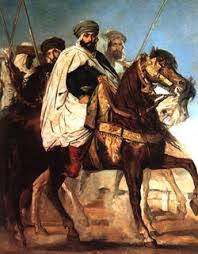
An army of 100,000 fanatical Muslims drew up near the border with Egypt and stopped.  There was no way they were going further with 20,000,000 Christians in front of them.  Or was there?

Cue, the welcome.  The Coptic Egyptians saw this impressive army and thought they could do a good job of overthrowing their unwelcome Greek Orthodox overlords.  So they invited them in (see Gibbon’s History referred to above chapter 51).  The well motivated Islamic army conquered the Greek army and sent the fleet packing.  Egypt came under Islamic rule and over the centuries since the population was pressured through discrimination to turn from being Christian to being Muslim.  Today 85-90% of the 100,000,000 people in Egypt are Muslims.

Eventually, the third head -that of the Greek Orthodox church and its capital Constantinople – fell to the Muslims in the mid 15th century.  This left only the Roman Catholic Pope left.

And that, my friends, is how Egypt welcomed Islam.  A sorry reflection on organised religion and no sign of the love of Christ anywhere.  This period was the beginning of the Dark Ages which were dark at least partly and probably mainly because of a great apostasy from Christ’s teachings (2 Thess. 2:3) even though there was plenty of so called “Christian” religion.

The similarities with the present state of Evangelical religion in the West should be obvious.

Submission

When Jesus was 12 He went up to Jerusalem with His parents.  When they went home He stayed behind, beginning the work His Father had called Him to do.  But they didn’t understand that when He told them.  So He went back with them and stayed in submission to them until the Jewish age of majority which was 30 in those days.  You can read about it in Luke 2:41-52.

I would hope I would recognise when my 12 or 13 year old was being called by God to do a work.  But I still think I would find it hard if they stayed behind without telling me when we had all gone somewhere together!  They would want to have a good reason!

Being subject to His parents for a further 18 years when they didn’t understand what His life’s calling was must have been hard.  If you find yourself in a similar situation think of that.


Loving the Greek…..

The New Testament was originally written in Greek since that was the “English” or “lingua Franca” of the the first century.  So I thought it would be a good idea to learn the NT or Koine Greek some years ago.  I must admit though that the vast range of English translations we have seem to capture most of the nuances of the Greek word meanings as far as I can tell.  But I am no expert.

There are a few things that the NT Greek does bring out:

1.  The simplicity of the language John uses compared with Paul.  It is really very easy to read John’s gospel and letters in the Greek especially in comparison to Paul’s.  It is a real and compelling miracle to see the depth of meaning and the deep subjects that John is able to explore with so few words.   I really don’t know anything equivalent in English.  However Revelation is no easier to read in Greek than it is in English which is one of the reasons many scholars believe that a different John wrote it.

2.  The Greek uses the continuous form of the verb “to be” far more than the English translations I have read do.  I am guessing that is because it would be being far more awkward to be reading.  But what the Greek brings out is a very important theological point or continuity rather:  You must keep on being saved to be saved.  There is no emphasis in the New Testament on point decisions or actions like the English translations seem to imply.  The examples are everywhere in the N.T. (Colossians 3:1 keep on seeking, Romans 8:1, 4 are not walking, etc., etc.).

3.  Of all the English translations I have read I have yet to come across one which brings out the distinctions in the Greek words for love in John 21:15-17. Knowing the differences significantly adds to the understanding of Jesus’ reinstatement of Peter and the qualifications for being a minister in God’s church.  Only the amplified version really brings it out but you can lose the significance in all the words.  Here is my version:

15 When they had eaten, Jesus said to Simon Peter, Simon, son of John, do you agape Me more than these? He said to Him, Yes, Lord, You know that I phileo You. He said to him, Feed My lambs.

16 Again He said to him the second time, Simon, son of John, do you agape Me? He said to Him, Yes, Lord, You know that I phileo You. He said to him, Shepherd My sheep.

17 He said to him the third time, Simon, son of John, do you phileo Me? Peter was grieved that He should ask him the third time, Do you phileo Me? And he said to Him, Lord, You know everything; You know that I phileo You! Jesus said to him, Feed My sheep.

Agape means love like Jesus’ love when He died for us on the Cross.  A supernatural love that comes straight from the Father.  Peter knew he didn’t love Jesus like that – not after his three denials on the night Jesus needed him most.  He wasn’t going to make the same mistake he had made before the crucifixion (John 13:37).

But he also knew that he had phileo –  a brotherly affection and natural love for Jesus.  So he had responded honestly.  He didn’t mind Jesus questioning his agape love but he was upset when he questioned even his phileo love.  He would have been devastated to discover that he didn’t even have that!

But actually Jesus was out to encourage him.  For each time He questioned Peter and each time Peter answered honestly and without pretense Jesus found in him someone He could trust.  Someone who could feed the young and tend to the needs of and even feed the more mature.

Some teachers would say that Pentecost (Acts 2: 1-4) added the agape to the phileo that Peter had.  And perhaps it did.  But for me I think I know what answer I would give to Jesus if I was asked the same questions, Pentecost or no Pentecost.

Only He knows really how qualified I am, or anyone is, to spiritually feed and tend His lambs or sheep.  But the qualifications are definitely not academic ones.  You don’t have to learn the Greek to love His people enough to feed them.

Fear

 “And I say to you, My friends, do not be afraid of those who kill the body, and after that have no more that they can do.But I will show you whom you should fear: Fear Him who, after He has killed, has power to cast into hell; yes, I say to you, fear Him!

“Are not five sparrows sold for two copper coins? And not one of them is forgotten before God. But the very hairs of your head are all numbered. Do not fear therefore; you are of more value than many sparrows.

Luke 12: 4-6. (Matthew: 10:28-31)

Fear and do not fear: one sentence after another.  First note that Jesus is speaking to His friends.  This is very important since Jesus says (in John 15:14) that you are His friends if you do what He commands you and it also presumes relationship with Him.

1.  Do not be afraid (v. 4 above).  That is do not be afraid of men. The original Greek word that was used  is the same one that we get our word for phobia from (e.g. arachnaphobia, technophobia, etc.).  If God is for us who can be against us? He who did not spare His own Son, but delivered Him up for us all, how shall He not with Him also freely give us all things? (Romans 8:31-32).  So don’t have phobias about what men can do.  They can only affect your body.

2.  Fear Him (v. 5).  It would be easier, perhaps nicer, if fear wasn’t the exact same word but it is, even in the Greek.  We do need to be afraid of God even if we are friends of Jesus because God can put both our body and soul in Hell after we die. And that is much worse than our body dying.

3.  Do not fear (v.6).  Same word again!  This time Jesus is assuring His friends that they don’t have to be afraid about being put into Hell.  Even though God can do it, He won’t do it to them because they are His friends.

The point is that we need to stay being His friends, i.e. in relationship with Jesus and obeying His commands. Otherwise why would Jesus tell us to fear Him?

On Eagle’s Wings

Dr. Loye Miller (1918) published the following account, as given to him by one of his students:

Last summer while my father and I were extracting honey at the apiary about a mile southeast of Thacher School, Ojai, California, we noticed a golden eagle teaching its young one to fly. It was about ten o’clock. The mother started from the nest in the crags, and roughly handling the young one, she allowed him to drop, I should say, about ninety feet, then she would swoop down under him, wings spread, and he would alight on her back. She would soar to the top of the range with him and repeat the process. One time she waited perhaps fifteen minutes between flights. I should say the farthest she let him fall was 150 feet.

My father and I watched this, spellbound, for over an hour. I do not know whether the young one gained confidence by this method or not. A few days later father and I rode to the cliff and out on Overhanging Rock. The eagle’s nest was empty. (Miss F.E. Shuman)

Deuteronomy 32:11-12 says this:

As an eagle stirs up its nest,
Hovers over its young,
Spreading out its wings, taking them up,
Carrying them on its wings,
12 So the Lord alone led him,
And there was no foreign god with him.

In Exodus 19:4 God says this:

‘You have seen what I did to the Egyptians, and how I bore you on eagles’ wings and brought you to Myself.’

Some other good commentary on the subject can be found here.

Abraham and Isaac

The post below is an attempt to imagine what both Abraham and Isaac were thinking as they went through the ordeal described in Genesis 22.  I also bring out the similarities between the story and that of the death of Jesus Christ at the hands of His Father.

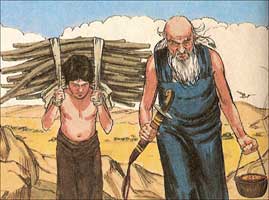
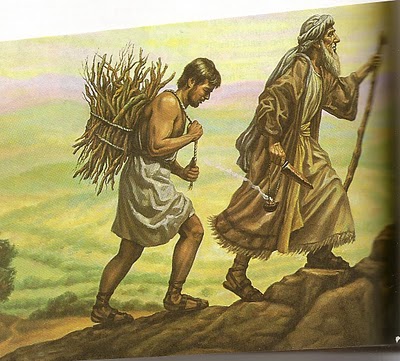
It was a very long trudge up Mt. Moriah as Abraham went to sacrifice his son to his God.  He was thinking about it as he went along.  He knew that it was a common enough thing among the gods of the people’s around him for them to ask for such sacrifices.  But somehow he had hoped it would be different with his One.  And then there was the confusing thing about that promise that through Isaac all his descendants would be named.  If there was one thing certain about the God Abraham served, it was that He kept His promises. “I bet you He is going to raise Isaac from the dead!” thought Abraham to himself.  That encouraged him a bit…. until he thought again about raising that knife….

ImageTrudging along with Isaac beside him.  How was he going to explain this to Sarah?  Hopefully Isaac would come back in one piece and it would be easier.

Isaac was a good lad.  Humble, submitted, meek as a lamb going to the slaughter.  Abraham was an old man, why did he have to go through this?  All his hopes and dreams were tied up in Isaac.  There was no one else like him.  But he had learnt a long time ago not to give into self-pity.

Silent, confused, trusting still, trudging along with Isaac beside him.

________________________

ImageThe wood was heavy.  It was biting into his shoulder as he trudged up the hill. Only a few days earlier he had travelled on a donkey, a foal of a donkey in some style but now their followers had been left behind and it was just him and his father walking.  He saw the fire and the knife…

He asked the question but he knew the answer somehow fitted.  He was the lamb that was led to the slaughter, uncomplaining.  God had indeed provided.  So he submitted silent, still while the altar was prepared, the wood arranged a cross it and the knife was raised.

___________________________

 “Abraham! Abraham!”

Image

Abraham looked down at his son who was in all his heart and all his mind and all his soul and all his strength –himself- and it had come to this!  The angel had said both their names.  So he thought and said: “Here I am”…  “My everything.  Ask me to sacrifice myself it would be easier!”

______________________________

God saw the transaction.  Yes, He had made man in His image so it was possible – the Father could slay His Son, this man had demonstrated that.  So infinitely difficult though, so distressing that He didn’t want a creature to have to endure what He as a Creator would, the loss of a son at His own hand.  He saw the intent, that was enough, now He would provide.  There had been times enough when fathers had lost their sons and there would be times again when it would happen, times without number.  He would do the best thing possible so that those who received the Gift would receive again their sons back from the dead, just as Abraham believed he would.

Disciples, Saints and Overcomers

Disciples is the term used in the four gospels and Acts, Saints is the term used in the letters and Overcomers is the term used in Revelation (chapters 2 & 3).  And I believe they all refer to the same thing – they mean Christians who are loving the Lord their God with all their hearts and all their minds and all their souls and all their strength and their neighbours as themselves (Matthew 22:37-40).

Disciples take up their cross daily and lose their lives so they may save them (Luke 14:26-27).  Saints live holy lives dedicated to their God and the fellowship of other saints.  Overcomers keep on coming over and over again to the Lord no matter what.  They all by faith and patient endurance take hold of the promises God has in store for those who love Him (Hebrews 6:11-12).

And the New Testament is written for them not for anyone else really.

Unless you are born again you cannot be a disciple and you cannot see the things they see (John 3:3 & 5). However being born again is not enough, you must also walk daily with Jesus if you want to gain the promises made to overcomers (Rev. 2:7, 11, 17, 26-28; 3:5, 12, 21) .

Three ways of looking at anything

Paul went into the third heaven (2 Cor. 12:2) and there are a number of other indicators in the Scriptures that there are three heavens as of now.

  1. The first one is the one we can see, the universe outside this earth that extends to 15 billion light years or so it seems. We don’t know too much about it but at least we can see some of it with our eyes and various forms of telescopes.
  2. The second one is mentioned in a few places such as Ephesians 6:12 and is the place where the devil reigns.
  3. The third one is described in Revelation. Moses made a copy of it in the Tabernacle (Hebrews 11:23,24). Paul was not the only human to go to the third heaven, Moses, John, Isaiah, Daniel and Ezekial all went there and probably a few others.

There is a hierarchy in the three heavens. God in the third rules over the other two and the second one rules over the first. Unless you are “in Christ” who is seated in the third heaven (Eph. 1:20) you are inevitably under the second heaven whether you know it or not. Or at least that is what the Scripture says. And we know who rules the second heaven.

So there are three ways of looking at everything:
1) From the third heaven: God’s viewpoint, totally in control, no surprises for Him and all He does is in love, justice, mercy and grace. As an example, God’s view of a faithful Christian’s death is that He called him/her home when He had decided they had accomplished all that they needed to accomplish and blessed all they could from down here. The “well done good and faithful servant” awaited him/her. This is the viewpoint of predestination.
2) The view from the second heaven. The devils and angels fight it out for the souls of men. Personally I don’t spend much time thinking of things from this point of view. Suffice to say you had better know what you are doing if you get involved in that conflict.
3) The view from the first heaven. This is the view of man where people make choices that determine their final destiny. The really important choices are all to do with accepting or rejecting God’s words. This is the Arminian viewing place for those familiar with those views.

If you want you can think of a faithful Christian’s death from the viewpoints of the other two heavens.  I think a lot of people do.  However, I for one am going to line my views up with God’s.  Ok, maybe I don’t know exactly what He is thinking of the brother /sister or all about why He called him/her home just now.  But imagining what He is thinking sure beats imagining how the devil or men are thinking about it.