Category Archives: His Story

A Cosmological World View based on Holy Scripture
A module in Life College

Dream – Lessons in Creativity from the Creator

God is very creative. When He puts together a group of people in a church and does things through them, the result can look very different from the constituent parts.

faithfulwon's avatarfaithfulwon

Knock, knock, knock!  I had heard that sharp sound before in middle of the night, and it had woken me up before, on at least two occasions.  The last two times I initially thought it was someone knocking on the door downstairs but then realised it had just been a dream, turned over and went back to sleep.  But a bit like the young Samuel in the bible, this third time I realised that this was actually God trying to get my attention.

“Here I am!  I stand at the door and knock.  If anyone hears my voice and opens the door, I will come in and eat with him and he with me.” (Rev. 3:20).

So I went to open the door and there Jesus was, all white and shining and making the inside of my head house look positively disgraceful.  I stood awkwardly at the door, saying that…

View original post 413 more words

Grace

God has done wonderful things for us as a family over the last many years. One of them was to give us the names of our children from the time of conception. Our youngest was given the names Bethany Grace Joy and Grace is the one that she uses everyday.

It is Grace’s birthday today.

Grace lives in the consciousness of the fact that she doesn’t deserve all the good things she gets. Her face lit up this morning when Ruth, her sister, showered presents on her. Thankfulness was written all over her as it often is.

When we were travelling to her school together we explored what Grace means. Grace is God’s master plan for His children. Here is how it works:

  1. Give people a whole pile of things (health, wealth, comfort, good companions and friends, a loving family, spiritual comfort and hope for the future, purpose, peace with God, an understanding that the God who created the Universe loves them enough to die for them, etc.)
  2. Make the giving of these things unconditional
  3. Use the created attributes of human beings to produce a response of joy, prayer for others and thankfulness in the recipients of all these blessings (see 1 Thess. 5:16-18).

It turns out that the mechanism that mediates this wondrous virtuous cycle to us is trust or faith. And that also is a gift of God (Ephesians 2:8).

If you want that gift just ask. You must be born from above to receive it (John 3:8) but that also is given to us by Grace.

Thanks be to God for His indescribable Gift!

Loving the Greek…..

I wrote this back in 2012. I thought it good enough to reblog.

faithfulwon's avatarfaithfulwon

The New Testament was originally written in Greek since that was the “English” or “lingua Franca” of the the first century.  So I thought it would be a good idea to learn the NT or Koine Greek some years ago.  I must admit though that the vast range of English translations we have seem to capture most of the nuances of the Greek word meanings as far as I can tell.  But I am no expert.

There are a few things that the NT Greek does bring out:

1.  The simplicity of the language John uses compared with Paul.  It is really very easy to read John’s gospel and letters in the Greek especially in comparison to Paul’s.  It is a real and compelling miracle to see the depth of meaning and the deep subjects that John is able to explore with so few words.   I really don’t know…

View original post 579 more words

Abraham and Isa…

The blog below is based on imagining what Abraham, Isaac and God were thinking during the working out of that astonishing command from God to Abraham that he should sacrifice his son (Genesis 22, cf. Hebrews 11:17-19).

faithfulwon's avatarfaithfulwon

Abraham and Isaac: Father and Son

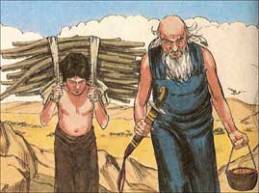
It was a very long trudge up Mt. Moriah as Abraham went to sacrifice his son to his God.  He was thinking about it as he went along.  He knew that it was a common enough thing among the gods of the people’s around him for them to ask for such sacrifices.  But somehow he had hoped it would be different with his One.  And then there was the confusing thing about that promise that through Isaac all his descendants would be named.  If there was one thing certain about the God Abraham served, it was that He kept His promises. “I bet you He is going to raise Isaac from the dead!” thought Abraham to himself.  That encouraged him a bit…. until he thought again about raising that knife….

ImageTrudging along with Isaac beside him.  How was he going to explain this to…

View original post 378 more words

All things you ask believing

There are several statements that Jesus makes about asking in faith:

“And all things, whatever you ask in prayer believing you will receive.” (Matthew 21:22 see also Matthew 7:7-11, Mark 11:24, Luke 11:9-13, John 14:13, 15:7,16b)

The emphasis in these statements of Jesus is asking the Father in faith knowing who He is. Nothing is impossible for God. We want His will to be done on earth as it is in heaven – he will always answer our prayers if it is His will.

Jesus illustrates how this works by His prayers in the Garden of Gethsemane (Matt. 26:39, 42). There was absolutely no question that Jesus could receive all the faith required to ask and receive. However, even He didn’t receive what He asked for from His Father – that this cup be taken away from Him. Jesus gives the answer to why this was the case: “Nevertheless, not as I will, but as you will” (Matt. 26:39) and “Your will be done” (Matt. 26:42).

God works all things according to the counsel or purpose of His will (Eph. 1:11). It becomes important then to find out what that is when we are asking God for something. One of the surest ways we know we are praying according to His will is that we will receive the faith to see it happen when we do. We will “know” as John puts it in 1 John 5:14,15 (cf. Heb. 11:1). If we ask anything according to His will, He hears us.

I have come across many situations both in my own life and in the life of others where prayers are not answered with a yes. Too often our prayers are us telling God what we want rather than listening first to hear what He wants (Eccl. 5:1).

You can rest assured that only His will will be done. Our aim is to find that out and fulfill Jesus wonderful prayer “Your Kingdom come, Your will be done on earth as it is in Heaven.” (Matt. 6:10).

If we come to God with our will only in prayer without listening to what He wants we will only see random, sporadic answers to prayer – sometimes we will be in line with what God wants, often we won’t.

We may know the Scriptures concerning healing for instance (Psalm 103: 3b, Isaiah 53:5) and so know the general desire of God to heal but, as Jesus showed when He was at the pool of Bethesda (John 5:1-9) not every sick person is healed. Similarly, it is God’s desire that all should be saved and come to the knowledge of the truth (1 Tim. 2:4), however we know from Jesus statement about Judas (the son of perdition John 17:12) that not everyone is saved.

I believe we should be seeing more healing and at least some resurrections from the dead. Likewise God wants to save this country and every person in it. It is up to us all to start that conversation with God about individuals we know and find His answers.

Being Reasonable

The following is taken from C.S. Lewis’ essay called “Why I am not a pacifist” written in 1940 and found now in a book called “Compelling Reason” published by Harper Collins in 1996.

….. Reason – by which I do not mean some separate faculty but ……, the whole man judging, …… about truth and falsehood.

Now any concrete train of reasoning involves three elements:

Firstly, there is the reception of facts to reason about. These facts are received either from our own senses, or from the report of other minds; that is, either experience or authority supplies us with our material. But each man’s experience is so limited that the second source is the more usual; of every hundred facts upon which to reason, ninety-nine depend on authority.

Secondly, there is the direct, simple act of the mind perceiving self-evident truth, as when we see that if A and B both equal C, then they equal each other. This act I call intuition.

Thirdly, there is an art or skill of arranging the facts so as to yield a series of such intuitions which linked together produce a proof of the truth or falsehood of the proposition we are considering. …. The skill comes in arranging the material into a series of intuitable ‘steps’. Failure to do this does not mean idiocy, but only lack of ingenuity or invention. Failure to follow it need not mean idiocy, but either inattention or defect of memory which forbids us to hold all the intuitions together.

Now all correction of errors in reasoning is really correction of the first or the third element. The second, the intuitional element, cannot be corrected if it is wrong, nor supplied if it is lacking. You can give the man new facts. You can invent a simpler proof, that is, a simple concatenation of intuitable truths. But when you come to an absolute inability to see any one of the self-evident steps out of which the proof is built, then you can do nothing. No doubt this absolute inability is much rarer than we suppose. Every teacher knows that people are constantly protesting that they ‘can’t see’ some self-evident inference, but the supposed inability is usually a refusal to see, resulting either from some passion which wants not to see the truth in question or else from sloth which does not want to think at all. But when the inability is real, argument is at an end. You cannot produce rational intuition by argument, because argument depends upon rational intuition. Proof rests upon the unprovable which has to be just ‘seen’. Hence faulty intuition is incorrigible. It does not follow that it cannot be trained by practice in attention and in the mortification of disturbing passions or corrupted by the opposite habits. But it is not amenable to correction by argument.

Before leaving the subject of Reason, I must point out that authority not only combines with experience to produce the raw material, the ‘facts’, but also has to be frequently used instead of reasoning itself as a method of getting conclusions. For example, few of us have followed the reasoning on which even 10 per cent of the truths we believe are based. We accept them on authority from the experts and are wise to do so, for though we are thereby sometimes deceived, yet we should have to live like savages if we did not.”

It is worth reading the whole article. From the above we can see that – according to C.S. Lewis – every judgement about truth and falsehood depends on three elements: Facts, intuition and putting together sequences of logical thought. C.S. Lewis goes onto argue that intuition is in-built and has to be learnt from childhood and cannot be argued against. It is the framework from which you start. For me that intuition is based in the Word of God both written and internally spiritual. I start with believing what God has said in His Word agreed with by the Spirit within and assess every fact and line of reasoning from that base. Or at least that is the aspiration. The times I don’t do that I can be a right pain in the a….

The reason I wanted to highlight and reproduce the passage from C.S. Lewis is because of something that seems self-evident to me and I think many others: There is a crisis occurring in many people’s minds when it comes to all three of the elements: Facts, intuition and putting together sequences of logical thought. The Internet is awash with “Facts” on everything. People’s intuition is not normally based nowadays on the Scriptures combined with the Spirit within and many people cannot or will not take the trouble to put together sequences of logical thought.

One example is the moon landing that happened over 50 years ago. I was 9 years old at the time and remember it well. There were thousands of people directly involved in engineering and building the rockets over 10 years. 13 massive Saturn V rockets took off from Cape Canaveral. The blast was so enormous that you had to stay at least 3.5 miles from the launchpad to be safe. 1 million people turned up to see the Apollo 11 launch alone. Over 100 million people watched the live pictures from the moon and saw and heard the astronauts talking and putting up the flag, etc. More recently a satellite called Lunar Reconnaissance Orbiter has been sending back pictures of the places where the different moon missions landed. Despite all this evidence and facts, some people still believe that the moon landing was a faked Hollywood story.

Of course such scepticism is not unusual and considering the amount of falsehoods people have believed over the centuries en masse, it is wise to be sceptical. My first problem with unreasonable scepticism though is that it has its origin in a lie told by someone:

A false witness shall perish,
But the man who hears him will speak endlessly.

Proverbs 21:28 (NKJV)

If anyone causes one of these little ones–those who believe in me–to stumble, it would be better for them to have a large millstone hung around their neck and to be drowned in the depths of the sea.

Matthew 18:6 (NIV)

According to C.S. Lewis in the passage above, there are two main things that cause people to believe a lie about something: 1. they want to because of some passion or other; 2. they are too lazy to give the matter enough attention. In the second case people lazily accept the statements they read or hear without questioning the source, verifiability or motives behind the propagator of the statements.

But he also points out that probably fewer than 10% of the facts we believe have been reasoned out. Normally we just accept them on authority. Hence the joke that people make about “Well, if it is written on the Internet then it must be true.” The Internet becomes the authority usually for those who are not paying attention to why someone has written something there. The initial lie, e.g. the flat earth hoax, gets picked up by thousands as truth. It is no wonder that the Scripture says:

Like a madman who throws firebrands, arrows, and death
19 is the man who deceives his neighbor
    and says, “I am only joking!”

Proverbs 26:18-19 (ESV)

Many people make the mistake of thinking they can deceive people and think that is harmless.

One of the complaints many people have about the Scripture is that God seems devoid of humour. If, by this, we mean that God doesn’t play tricks on people then, yes, He is devoid of that kind of humour. Practical jokes are not in His repertoire of ways of dealing with humans.

They shouldn’t be in ours either.

 

Communion

Few Christian doctrines have caused as much trouble and confusion down the centuries as has the doctrine of communion. On the one side you have those who take a very literal interpretation of the words of Jesus when He said: “This is My body” and on the other you have those that take an allegorical sense of those same words.

As is always the case with any Christian controversy, a true understanding can only come about by combining an understanding given by the Holy Spirit to the words of the inspired Bible. It is that combination of the Spirit and the written word that leads us to the Word of God or Christ Himself in whom dwells all the riches of knowledge and understanding (see Colossians).

If we are ignorant of either one of these – either the Holy Spirit or the Bible – things can get quite confusing. Take as an example Proverbs 9: 1-6 and compare it with the same chapter verses 13-18. In the first section Wisdom calls out to the “Simple” and those “without understanding” and in the second section a foolish woman (Folly) does the same. Both have houses and both offer food and drink. Wisdom offers bread and wine and Folly offers bread and water. Wisdoms food and drink is her own. Folly’s is stolen from somewhere else.

We know from Proverbs 8 that Wisdom is personified by Jesus. It is His own body and blood He offers us – not something stolen from someone else. He paid a high price to give us the spiritual food we so badly desire.

However Folly gives us far more insipid fare. Proverbs 20:17 tells us that her food will turn to gravel in our mouths. Those who try to be satisfied with anything other than the body and blood of Jesus will be disappointed.

But have you seen what I did there? Here is a spiritual truth revealed through physical simple elements. The reality is not in the bread and wine or the water for that matter. The reality is in what they represent.

Physical Realities

Methusalech was afraid. This was his normal emotion every time King Hezekiah called him in for a progress report on the tunnel. It was not that the King made him feel that way, it was just that he seemed to be continually bringing him bad news.

The King understood the difficulty of what he had asked. No one had done anything like this before. Even the Egyptians with all their building projects hadn’t attempted something as peculiar as this. Methusalech spent a lot of time before the LORD praying for guidance as a result.

God’s faithfulness was shown in the continual flow of the spring which was named “Bursting Forth” (Gihon). It was an ancient name. The first book of the Torah said that one of the 4 rivers of Paradise was called the same. The people of Jerusalem liked to think that their Bursting Forth was somehow the same river as the one that watered Paradise like the Tigris and Euphrates were also thought to be somehow related to their counterparts. Methusalech thought all this unlikely considering how much the great Flood had changed the face of the earth since then.

The great thing was that it never stopped flowing and producing enough water for all their needs.

Then the King had his dreams and revelations. One of them warned him that the Assyrians were going to come and take over the land. The second told him to not let the Bursting Forth waters be accessible to just anyone. He had a picture of the spring being like the city’s wife, she shouldn’t be available to any stranger but only to the city itself.

Then he had a dream of a tunnel with gently flowing waters (Shiloah) in it. And that’s when he called in Methusalech.

They had been digging for 6 months now and things were not going well. The original plan was to dig a straight line through the bedrock with two teams. One team was to start at the place where they were to collect the water (the Pool of Shiloah). The other was to start at the Gihon spring itself.

The problem was trying to dig in a straight line.

Methusalech realised early that they were going to have problems direction finding when deep underground. There were no stars or landmarks to go by, nothing but a general sense that they were going in the right direction.

The team that started from the pool end had already gone through several changes of direction. In some ways it wasn’t so difficult for them since they were not going under the mountain to the same extent. In theory they should be able to hear the men at the top thumping their big instruments. But the ground carried the sounds in all sorts of strange ways so they kept changing direction as they heard it change.

The Team that started from the Gihon spring had been led by Ahimoah. He was a good man. The original intention had been to bring the spring waters straight to the other side of the mountain of Ophel and then go down from there. However it was taking too long and the mountain rock was too hard. So they decided to change direction and head south instead. It would have helped if they could know what south meant under that much rock.

The Doctrine of the Crucified

18 For the word of the cross is foolishness to those who are perishing, but to us who are being saved it is the power of God. 19 For it is written,

“I will destroy the wisdom of the wise,
And the cleverness of the clever I will set aside
.”

2Where is the wise man? Where is the scribe? Where is the debater of this age? Has not God made foolish the wisdom of the world? 21 For since in the wisdom of God the world through its wisdom did not come to know God, God was well-pleased through the foolishness of the message preached to save those who believe. 22 For indeed Jews ask for signs and Greeks search for wisdom; 23 but we preach Christ crucified, to Jews a stumbling block and to Gentiles foolishness, 24 but to those who are the called, both Jews and Greeks, Christ the power of God and the wisdom of God. 25 Because the foolishness of God is wiser than men, and the weakness of God is stronger than men.

26 For consider your calling, brethren, that there were not many wise according to the flesh, not many mighty, not many noble; 27 but God has chosen the foolish things of the world to shame the wise, and God has chosen the weak things of the world to shame the things which are strong, 28 and the base things of the world and the despised God has chosen, the things that are not, so that He may nullify the things that are, 29 so that no man may boast before God. 30 But by His doing you are in Christ Jesus, who became to us wisdom from God, and righteousness and sanctification, and redemption, 31 so that, just as it is written, “Let him who boasts, boast in the Lord.”

(1 Corinthians 1:18-31)

Watch out if you are not foolish, base or despised! God is not likely to use you much or for long.

The following is not a statement from some obscure man from long ago. It is a command from God that we would do well to heed:

“I must decrease, He must increase.” (John 3:30)

When Paul was following Christ around Asia and being used by the Holy Spirit to plant churches he was particularly foolish. If you want to build anything in this world apart from Christ you don’t just go along to a place for a few weeks, appoint some obscure people as elders and then go off and abandon them. But Paul didn’t see things that way. He was just doing what the Spirit of Jesus was telling him to do and leaving the rest of it to Him. Sure, he prayed and wrote letters, all significant. But we don’t know who the elders are that he appointed in most of the churches. The emphasis wasn’t on the pastors or any individuals. The Holy Spirit was in control.

Conduits and Channels

I was watching a film on Netflix recently called “The Boy who Harnessed the Wind.” It tells the true story of 13-year-old William Kamkwamba who built a wind turbine to save his Malawian village from famine. From a combination of corporate exploitation and greed, Government corruption and a failed rainy season, the people of William’s village and surrounding areas were starving.

What was significant to me was that the village had a well which was not dry, there was enough water in it to supply all their needs. However, because there was no pump they could not draw enough of it quickly enough to irrigate their crops. And so they were starving.

Back in King Ahaz and Hezekiah’s time, Jerusalem faced a similar problem. There was an abundant supply of water in the Gihon spring but it was located outside the walls of Jerusalem. This meant that it had to be laboriously collected in buckets day by day. Its location also left the city vulnerable. If there was a besieging army it was easy for them to prevent the people getting to the spring.

King Ahaz lived around the time Isaiah was prophesying. He started to build a tunnel from the spring into the city and his son, King Hezekiah, probably completed it. You can read more about the inscription found in the 19th century and Isaiah’s softly flowing waters of Shiloah in my other blog on the subject.

This tunnel would have had a significant impact on the lives of the people of Jerusalem at the time. The water from the Gihon spring flowed through Hezekiah’s tunnel into the Pool of Siloam (Sent). Later on Jesus sent a blind man to that pool who returned seeing (John 9).

According to the understanding I have been given (hopefully by the Lord – I will let you be the judge of that) the following is what is represented by the spring, Hezekiah’s tunnel and the pool of Siloam (Sent):

  1. The Gihon spring represents the 5 fold ministries and gifts of the Body of Christ, His Church. Powerful and upwelling these gifts and ministries supply sustenance and support for any living church. Without them any church will die – or was never living in the first place.
  2. The tunnel represents a means of enabling the 5 fold ministries and spiritual gifts to function or be channelled into a church. I believe Paul has shown us how this is done using the model of church meetings he describes in 1 Cor. 14:26- 40.
  3. The Pool of Siloam is the healing place for the saints in the midst of the church. The 5 fold ministries and spiritual gifts are functioning in it and people are being healed, set free and delivered.

The literal tunnel in Jerusalem runs for 500m under the wall of the city and the waters emerge, gently flowing, in the centre of Jerusalem. However the work required to build it took two teams of workers coming at it from both directions and meeting in the middle. They didn’t have tunnel boring machines so this was wielding pickaxes and sledgehammers, blow by blow at the rock that underlaid the city’s foundations. There was risk involved. No doubt many said at the time it was too dangerous. Perhaps some lives were lost. But the results made it all worthwhile.

It wasn’t long after the tunnel was built that the King of Assyria arrived with a horrific army and a reputation for flaying people alive. All he could do was lock Hezekiah and his inhabitants up inside the city. He knew the water supply and no doubt tried to block up the tunnel but who knows how much valuable time Jerusalem gained while the waters still flowed. In the end not even the spring could save them but God intervened.

Without Him we can do nothing.

But with Him anything is possible.