Category Archives: Wisdom

The Secret Place (Psalm 91)

“He who dwells in the secret place of the Most High
Shall abide under the shadow of the Almighty.
I will say of the Lord, “He is my refuge and my fortress;
My God, in Him I will trust.”

Surely He shall deliver you from the snare of the fowler
And from the perilous pestilence.
He shall cover you with His feathers,
And under His wings you shall take refuge;
His truth shall be your shield and buckler.
You shall not be afraid ….” 

Psalm 91: 1-5 (NKJV)

The secret place is primarily a place of trust. We all have to face fear but it makes no sense to stay afraid when the God who made the universe is on your side.  That is, of course, if you know He is on your side.  So how do we know that?

The Scriptures say that God is for us not against us (Romans 8:31).    But this and other passages in the letters are written to disciples/ saints/ overcomers, those who have been born again and are walking in the light.

Before you can enter the secret place and dwell there you must have come to faith in Him.  Jesus says that we should fear Him (Matt. 10:28, Luke 12:5) and make peace with Him while we are on the way through this life (Matt. 5:25) before it is too late.  John points out that unless you are born from above you cannot be in His kingdom (John 3:8).  To be in God’s kingdom is to be under His protection.

It is only then that we can truly say that “He is my refuge and my fortress; My God, in Him I will trust.”Fortress

Practices of Discipleship: Prayer

Prayer is more about listening than talking:

Walk prudently when you go to the house of God; and draw near to hear rather than to give the sacrifice of fools, for they do not know that they do evil.

Do not be rash with your mouth,
And let not your heart utter anything hastily before God.
For God is in heaven, and you on earth;
Therefore let your words be few.
For a dream comes through much activity,
And a fool’s voice is known by his many words.

Eccles. 5:1-3

The main point of praying is putting yourself somewhere you can hear clearly.  There is both a physical and a moral/spiritual element to this placing.

Physically it should be quiet and alone (we are not talking about corporate prayer here which is a different thing).

Morally you need to be devoted, set aside or holy.  Your only desire should be to do His will otherwise you won’t hear properly:

17 If anyone wills to do His will, he shall know concerning the doctrine, whether it is from God or whether I speak on My own authority. 18 He who speaks from himself seeks his own glory; but He who seeks the glory of the One who sent Him is true, and no unrighteousness is in Him.

John 7:17,18

You also need to give this time and priority.  I find that first thing in the morning is best and an hour is a good length of time.

Once you are in the quiet place (Psalm 91), the aim is to take every thought captive to Christ (2 Cor. 10:5).

I find that the meditative technique of “centering down” helps here.  Thoughts actually come out of the heart or centre of you (not your head – Matt. 15:18, Luke 6:45) and therefore bringing your inner man to a place of quiet is important if you are to listen to God who is in you (Col. 1:27).

God is not far away, He is in fact very close to His children (Romans 10:8, Acts 17:28).   If you are born again and abiding in Jesus, His word is in your heart and written on your mind (Jeremiah 31:33, Hebrews 10:16).

When a thought comes to you, capture it and check it against the name or character of Jesus as He has been revealed to you through the Holy Spirit and His word.  If it requires action do it as long as it is something God would do.  If you are unsure ask another brother/sister who you trust and who loves you.

I am writing these things because I believe God has told me to and it is the kind of thing He does.  I also checked with Olive.

Think on These Things

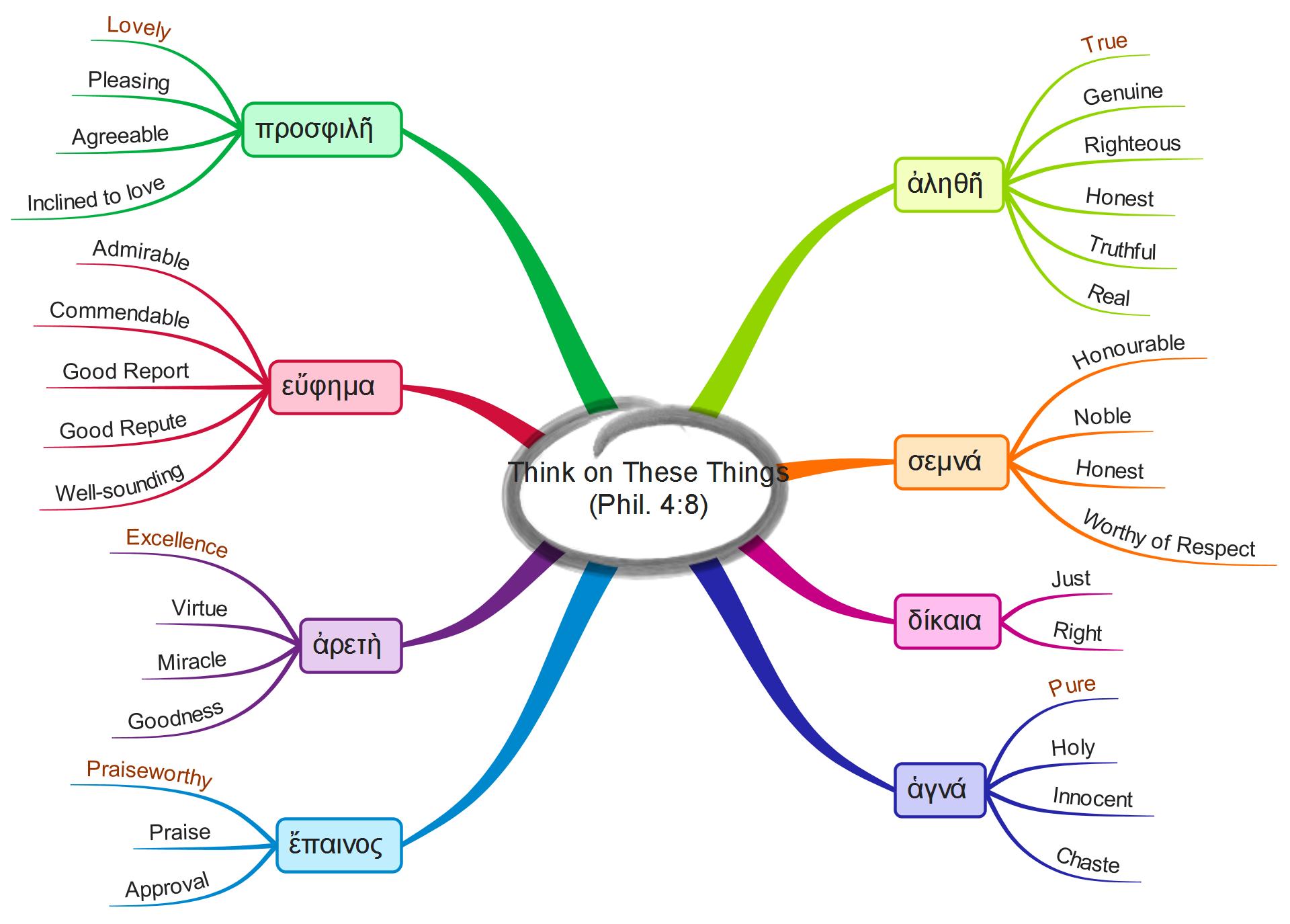
I have been taking a leaf out of Dr. Caroline Leaf’s book (sorry couldn’t resist that pun): “Switch on your Brain” and used a mind map to do a 21 day meditation on a single thought.

In this case the thought is Philippians 4:8:  “Finally, brethren, whatever is true, whatever is honourable, whatever is right, whatever is pure, whatever is lovely, whatever is commendable; if there is any excellence or anything praiseworthy; think on these things.”

In the mind map above I have taken the 8 words from the original New Testament Greek and put them in boxes around the central theme of the verse.  Then I have taken the most common translations of the Greek words and listed them against each box.  The words in a different colour (e.g. “true”) are the ones used most often, or, in some cases, exclusively by the main English translations (NIV, KJV, NKJV, NLT, NASB, ESV, NRSV).

I have also been spending quite a bit of time adding to the branches the things that are actually true, honourable, right, pure, lovely, commendable, excellent and praiseworthy.  It is quite amazing the amount of things that fall under those categories once you start to expand on them.  There are numerous elements to God, family, church, the bible, work, creation, music, books, films, etc. that fit into each category.  In other words, there are plenty of good things to think about.

Caroline’s basic thesis is that mind is over matter.  More specifically she says that thoughts are manifested in our brains as actual matter.  They grow on brain nerve endings like fruit on trees.  If we spend 21 days thinking on the same thing, that will turn it into a solid ripe piece of brain fruit that can modify your behaviour. Like it says in Romans 12:2: “Be transformed by the renewing of your mind.”

She advises that you hear what the Spirit is saying to you about a toxic thought to replace and what to replace it with.  Her book is well worth a read and implementation.

The Lord is my Shepherd

The image of us being sheep and God being our good shepherd is sprinkled lavishly across the Scripture both new and old.  Whole chapters are devoted to the idea (Psalm 23, John 10).  Men are like sheep to be slaughtered (Psalm 44:11), lost sheep (Luke 15:1-7) and scattered sheep (Matthew 9:36).  Sheep bully other sheep (Ezekiel 34:17-22).  The Good Shepherd lays down His life for His sheep (John 10:11).

sheep

There are 7 billion people on the earth.  Of those a tiny fraction are ever in the news personally.  Often groups of people are mentioned and people are tarred with the same brush, but that never tells the story of a single soul.  There are wars and rumours of wars and too many people live in absolute poverty and in ignorance.

But lift your eyes from the news and see what God has done.  There are 7 billion people in the world and most of them are at peace.  For many the Lord is their shepherd and where that is the case they lack nothing, He supplies good food, He leads them in peaceful places and restores their souls.  These ones – and I like to count me and my family among them – walk in righteousness so as not to bring shame to the character of Christ.  Yes we go through bad times but He is always there with us.  He uses the long, thin rod of discipline to keep us on the right path at such times and we know that His staff is strong enough to beat away all wolves.  Even in the midst of the devil and his angels, thrown down to the earth and as angry as hell, we still enjoy His presence and our lives are full and overflowing.  He takes what we are and have and anoints us to bless us and cause our works to multiply.  As we go on with Him, we leave a legacy of goodness and mercy behind us.  It is truly wonderful to know that this living with Him continues forever. (Psalm 23).

The grace of God has abundantly produced good in this world despite the depravity of man.  Let us think about those things instead of always watching and believing the news.

Resting in God’s Protection

The Psalms have several recurrent themes. One of them is that God’s protection is around those who trust in Him (see for example Psalm 125:2).

I have found that trust is an active thing on my part – I have to actively trust God by committing things to Him, praying to Him, spending time with Him and, very importantly, obeying what I believe He is saying to me. I can’t just carry on my own way and then say that I am trusting God.

There are things I have to do deliberately to ensure that I am trusting Him. One of these is to discipline my time so that I have set aside times in the day and the week to spend time praying alone with Him and reading the Scriptures. Another is to obey the commands that I am not to worry or be afraid, that I am to rejoice always, pray without ceasing and in everything to give thanks (1 Thess. 5:17). These are not always easy commands to obey and work is required to carry them out.

We have just finished a series of studies of James at our local church, Open Arms. Works and faith go hand in hand.

Seared Consciences

…seared in their own conscience as with a branding iron.

1 Tim 4:2

an hour is coming for everyone who kills you to think that he is offering service to God. 3“These things they will do because they have not known the Father or Me.…  

John 16:2,3

Oswald Chambers in his book “Biblical Psychology” describes conscience as being like the eye that colours everything we see depending on how it is enlightened.  He says (Chapter 16, section 1):

“Probably the best illustration of conscience is the human eye.  The eye records what it looks at, and conscience may be pictured as the eye of the soul recording what it looks at, and, like the eye, it will always record exactly what it is turned towards.”

He then talks about how we can look at something with the human eye and interpret what we see based on our experience of similar things we have looked at in the past – therefore not seeing with innocence.  Therefore,

“The recording power of conscience may be distorted or perverted and conscience itself may be seared.”

He then uses another analogy about how things can look differently depending on the colour of the light you are looking at it in:

“Then again,green-eye-afghan-girl-national-geographic if you throw a white light on trees, the eye records that the trees are green; if you throw a yellow light on the trees, the eye records that the trees are blue; if you throw a red light on trees, the eye records that the trees are brown.  Your logical faculties will tell you all the time that the trees are green, but the point of the illustration is that the eye has no business other than to record what it looks at; and it is the same with conscience.”

Or in other words, conscience is to the soul what the eyes are to the body.  Hence the reason Jesus talks about the “eye” of the body being clear in Matthew 6:22:

“The eye is the lamp of the body; so then if your eye is clear, your whole body will be full of light. 23“But if your eye is bad, your whole body will be full of darkness. If then the light that is in you is darkness, how great is the darkness!…”05-Eye-Soul-Beauty

This verse doesn’t just make literal sense, it also makes sense if you substitute conscience for eye and body for soul.  In fact that is probably the main way Jesus meant it to be understood:

“The conscience is the lamp of the soul; so then if your conscience is clear, your whole soul will be full of light. 23“But if your conscience is bad, your whole soul will be full of darkness. If then the light that is in you is darkness, how great is the darkness!…”

Note that the eye/ conscience is the lamp but not the light itself.  It is just a carrier of the light recording what goes through it.  A bad conscience or eye can be that way because of what is going through it – though in some ways the analogy begins to break down at this point.

But we can see from these verses that having a good conscience is so important.  Just like a bad eye leaves the body in darkness, so a bad conscience leaves the soul in the same way.  You can also mistake the little light you have that is in you as being the light you should live by.  As Jesus points out “how great is that darkness!”

We see this all the time in the lives of the Muslim fanatics.  Their consciences are bad since they have been taught that doing evil is good.  Ask a fanatic Muslim what should happen to a convert from Islam to Christianity and they will tell you that he should be killed and that by his older brother.  Hence the fear that rules in those societies where this is believed.  And hence their bad consciences.

Oswald goes on to illustrate how much the conscience can be affected and how unreliable it can be by giving the example of the Apostle Paul (chapter 16, section 1. c):

” “I verily thought with myself,” i.e., according to conscience, “that I ought to do many things contrary to the name of Jesus of Nazareth” (Acts 26:9). If conscience is the voice of God, we have a nice problem to solve!  Saul was the acme of conscientiousness.”

Then he goes on to say: “It is not sufficient for a Christian to live up to the light of his conscience; he must live in a sterner light, the light of the Lord Jesus Christ.”

So we shouldn’t be surprised at ISIS or other evil fanatics considering that they are doing the right thing for God and believing it to death.  It doesn’t change the fact that the light that is in them is darkness.

Our only hope is that they will encounter Jesus like Paul did and repent:

“I was once a blasphemer and a persecutor and a violent man, I was shown mercy because I acted in ignorance and unbelief. 14The grace of our Lord was poured out on me abundantly, along with the faith and love that are in Christ Jesus.

15Here is a trustworthy saying that deserves full acceptance: Christ Jesus came into the world to save sinners—of whom I am the worst. 16But for that very reason I was shown mercy so that in me, the worst of sinners, Christ Jesus might display his immense patience as an example for those who would believe in him and receive eternal life.” 

1 Timothy 1:12-17.

As in all things, the local church of Jesus Christ on the ground in these places is the only hope they have.  By contrast, US and Israeli arms will just send them to their eternal destiny quicker.

My prayer is that my brethren who are being crucified and suffering in the Middle East will not do so in vain and that in their suffering they will also know the overwhelming comfort of Jesus as they go to be with Him.


The Relationship between the Four Wisdom Books in Scripture

There is no substitute for a personal relationship with the Author when reading His Scriptures.  However in the mystery of the interaction of the Holy Spirit and our minds the guidance of others is always welcome.  We can get His gentle whisperings or the mind of Christ wrong at times.  So God has given us the collective mind of Christ in our brothers and sisters.

Well, anyway, I thought this* was so good that I had to write out chunks of it again here:

The Big Picture

“Each of the four wisdom books (Proverbs, Job, Ecclesiastes and Song of Songs) is different in its contribution to our education in wise living. … The four books balance each other theologically, and any one of them read out of the context of the others can be easily misunderstood.  Basically, Proverbs presents the rational, ordered norms of life, while the other three books present the exceptions and limitations to the rational, ordered approach to life.”

The Basic Approach to Life (Proverbs)

“Proverbs presents the rational, ordered norms of life.  The many proverbs in the book are not universals (i.e. things that are always true), but rather norms of life (i.e. things that are normally true).  …”

Exception 1:  The Suffering of the Righteous (Job)

“The book of Job demonstrates that there are often events in life that humans cannot grasp or understand through the wisdom approach delineated in Proverbs.  Sometimes tragedy strikes those who are wise, righteous and hard working, and God does not disclose the reasons behind such tragedy.  Proverbs teaches us that life is rational and that the wise person can understand it.  Job qualifies this with some real-world experience….. Our wisdom approach of Proverbs fails us in these situations, and we are forced to rely on faith in the Creator.  This is what we learn from Job.”

Exception 2:  The Failure of the Rational, Ordered Approach to Provide Ultimate Meaning to Life (Ecclesiastes)

“The book of Echardworkingclesiastes is an intellectual search for meaning in life.  While the author acknowledges that being wise is better than being stupid, he concludes that wisdom does not by itself provide meaning to life.  Also, while Job told the story of one exception to the norms of Proverbs, the cynical analysis in Ecclesiastes chronicles numerous exceptions to the thesis of an ordered, rational universe.  The ultimate conclusion in Ecclesiastes, not disclosed until the final verses, is that the only way to find meaning in life is to be in relationship with God.  Logic and rational thought (wisdom) can help you on a day-to-day basis, but ultimate meaning in life requires relationship with God.”

Exception 3:  The Irrationality of Romantic Love between a Husband and Wife (Song of Songs)

“Proverbs gives good, practical, wise advice about marriage.  It advises men not to marry women who are irrational love Piquarrelsome or ill-tempered (21:9, 19) and it depicts clearly for women the fate of lazy fools and drunkards, thus implicitly warning against marrying such men.  ….. All this advice is good and rational.

“However it is difficult to build a great love relationship in marriage with only logic and rational thought.  The Song of Songs celebrates the wild, irrational, mushy, and corny aspects of true love.  This book  suggests that in the marketplace husbands and wives may need to be the quiet, discerning, hard working people of Proverbs, but that once the lights go out in the privacy of their home, they need to be the crazy, madly-in-love, slightly irrational couple in Song of Songs.”

Amen to that.

*All quotes are taken from “Grasping God’s Word” 3rd Edition, by Duvall & Hays, Chapter 22.

A cure for the love of money!

Grasping God’s Word – Assignment 13-3

I Timothy 6:10a

For the love of money is a root of all kinds of evil. (NIV)

Grasping the Text in their town

Roman slave mosaicIf we take the verse in context the original readers would have seen this verse as a follow on to the earlier verses about being content with food and clothing (vv. 6-8).  These verses themselves relate to earlier verses (vv. 1-2) about slaves showing respect and serving their masters well despite the fact that they are slaves.  Far from a cry for slaves to pursue their freedom, Paul says that they should be content.  He also says in vv. 3-5 that anyone teaching otherwise is motivated by thinking that godliness is a means to financial gain.  This is the link verse to the remainder of what the chapter teaches about the love of money.  It is probable that the idea had got out that if you can be free you can make money and that money will bring about happiness.  Paul wants to knock that idea on the head.

The differences between their situation and ours

Slavery, per se, has been outlawed in nearly every country though variations of it exist all over the world.  Otherwise things aren’t much different as far as this passage is concerned.

The theological principles in the passage

love of moneyBut godliness with contentment is great gain. For we brought nothing into the world, and we can take nothing out of it. But if we have food and clothing, we will be content with that. Those who want to get rich fall into temptation and a trap and into many foolish and harmful desires that plunge people into ruin and destruction. 10 For the love of money is a root of all kinds of evil. Some people, eager for money, have wandered from the faith and pierced themselves with many griefs.

1 Timothy 6:6-10

Probably the main principle, for me anyway, is elaborated in verse 7:  “We brought nothing into the world and we can take nothing out of it.”  This makes the following three verses clear – being eager for money, loving it, can cause you to wander from the faith (v. 10).  The love of money is a root of all kinds of evil that stem from a wrong perspective on life, giving importance to those things that are not important since we won’t be bringing any of it with us.

Does this fit in with the teachings of the rest of the bible?

This principle is central to many of Jesus’ teaching and to the whole ethic of the NT.  Jesus attitude to money during His earthly ministry might at times be considered cavalier by those who give money more importance than He ever did.  In Matt. 6:19 – 34 Jesus teaches us to store up treasures in heaven rather than on earth.  He also says that no one can serve both God and money.  He also says not to worry about tomorrow or indeed anything to do with what we eat, drink or wear (the same things that Paul says we ought to be content with having – we shouldn’t be looking for more than these).  In Matthew 17:24-27 it is obvious that He and His disciples are penniless and cannot pay the temple tax.  However, Jesus isn’t bothered, He doesn’t even go looking for the money Himself but sends Peter to get it from a fish!  In Matt. 19: 16 – 26 Jesus warns that it is very hard for someone who trust in riches to enter the kingdom of heaven.  And so it goes on.

How should we apply this principle today?

Even though there aren’t many slaves that we know of today in Ireland anyway, many people feel like slaves either because they are in demanding low paid employment or because they are in debt.  The natural inclination of most people is not to be content in these situations, to want to find a way out.  But if it was true that those who were slaves in Paul’s time ought to be content with food and clothing (v.8) then it is also true for us now.

One of the biggest issues that I, and probably others, have is that we are not content with just food and clothing.  We feel we have a need for a whole plethora of other things:

  • Education9598540-cartoon-home-appliance-icon
  • Health care
  • Justice & security
  • Elaborate dwelling places with all sorts of facilities such as:
    • Hot showers
    • Electric ovens
    • Central heating
    • Flushable toilets
    • Comfortable furniture and beds
    • TV
    • Computers
    • etc.
  • Motor vehicles
  • Mobile phones
  • Holidays
  • Recreational trips
  • Eating out
  • etc.

But according to the bible we don’t actually need any of these things, just food and clothing (which presumably includes shelter) and with those we should be content.

Some chance!

september-9-11-attacks-anniversary-ground-zero-world-trade-center-pentagon-flight-93-second-airplane-wtc_39997_600x450But the reality is that all these things are very precarious.  The world economic system is continuously on a knife edge.  Economic disaster is never far away from any of us.  Wars can break out in the most unlikely places in unimaginable ways (9/11), there is no lasting security on this earth.  I, and perhaps you, live in the illusion that we will always have more than we need, I take it for granted and can’t imagine what it would be like not to have these “basics”.  But there is nothing basic about this list of things nor is there any certainty that any of us will have them.  The only thing we can be certain about is that our heavenly Father will give us what we truly need:  food & shelter.

The answer then is to start being truly thankful for everything else for as long as we have it all.

Which mightn’t be for long.

“Command those who are rich in this present world not to be arrogant nor to put their hope in wealth, which is so uncertain, but to put their hope in God, who richly provides us with everything for our enjoyment.”

1 Timothy 6:17

Be ThankfulThank you Jesus!

Word Study OT – Meditate

Word Study – The word translated “Meditate” in Josh 1:8

Grasping God’s Word Assignment 9-3

  1. Strong’s number: 1897.
  2. The Hebrew Word transliterated “Hagah” is used 24 times in the OT.
  3. The New American Standard (NAS) translates it as:
    • declare (1 time): Psalm 35:28
    • devise (2 times):  Psalm 38:12,  Proverbs 24:2
    • devising (1 time): Psalm 2:1
    • growls (1 time): Isaiah 31:4
    • make a sound (1 time): Psalm 115:7
    • meditate (5 times): Joshua 1:8, Psalm 63:6, Psalm 77:12, Psalm 143:5, Isaiah 33:18
    • meditates (1 time): Psalm 1:2
    • moan (3 times): Isaiah 16:7,  Isaiah 38:14, Jeremiah 48:31
    • moan sadly (1 time): Isaiah 59:11
    • mutter (2 times): Job 27:4, Isaiah 8:19
    • mutters (1 time): Isaiah 59:3
    • ponders (1 time): Proverbs 15:28
    • utter (2 times): Psalm 71:24, Proverbs 8:7
    • uttering (1 time): Isaiah 59:13
    • utters (1 time): Psalm 37:30
  4. Context – one instance in Joshua but the 23 others are confined to the wisdom books – mainly Psalms – and the prophets – mainly Isaiah.  Used about people in connection with God and good plans, people in connection with evil and evil plans, a lion over its prey.  Doves can do it and idols cannot.
  5. Semantic range of the Hebrew word transliterated hagah: I think this word is used to describe any deep connection between a thinking being (including animals) and the object upon which the word is used.  It sometimes includes considerable emotion (moan).  It is used in both a positive and negative sense – people can “hagah” and use it to work evil (3 times) or good or to be taken up with evil or good.  It also carries expression with it in 14 instances out of the 24 – declare, growls, make a sound, moan (sadly), mutter(s), utter(s)(ing).  The word “Meditate” doesn’t capture the expressive nuances of the Hebrew word “Hagah”.
  6. In Joshua 1:8 I prefer the words “deeply connect” to “meditate”:

“This book of the law shall not depart from your mouth, but you shall deeply connect with it day and night, so that you may be careful to do according to all that is written in it; for then you will make your way prosperous, and then you will have success.”

Note also the connection with speaking it out in the earlier part of the verse.  This suggests another way of saying “hagah” in this context, i.e. “allow it to well up and out”:

“This book of the law shall not depart from your mouth, but you shall allow it to well up and out of you day and night, so that you may be careful to do according to all that is written in it; for then you will make your way prosperous, and then you will have success.”

Maybe we can put both of the meanings together (with some danger of overcooking the word):

“This book of the law shall not depart from your mouth, but you shall deeply connect with it and allow it to well up and out of you day and night, so that you may be careful to do according to all that is written in it; for then you will make your way prosperous, and then you will have success.”

Not just meditation but expression arising from it as well.

Word Study – “Worry”

Based on Grasping God’s Word Assignment 9-2

What is the Greek word μεριμναο translated “worry” in Matthew 6:25?

Strong’s Number: 3309

Greek transliterated word for 3309: merimnao

Used in the NT 19 times.

New American Standard (NAS) Word Usage – Total: 19

(Taken from Bible Study Tools website, 2013).  The NAS translates the Greek word μεριμναο transliterated merimnao into the following English words:

anxious (1 time) in Philippians 4:6

care (1 time) in Matt. 6:34

concerned (5 times) in 1 Cor. 7:32 – 34 and Phil. 2:20

have…care (1 time) in 1 Cor. 12:25

worried (4 times) in Matt. 6:25, 27, 28 and Luke 10:41

worry (6 times) in Matt. 6:31, 34, 10:19; Luke 12:11, 22, 26

worrying (1 time) in Luke 12:25

The things we are told not to worry about

Matthew 6:25 – life, what we eat, drink or put on.

Matthew 6:27 – how long we live

Matthew 6:28 – clothing

Matthew 6:31 – food, drink, clothing

Matthew 6:34 – tomorrow

Luke 12:22 – life/ eating, body/clothing

Luke 12:25 – how long we live

Luke 12:26 – other matters!

What is the context in Matthew 10:19 and Luke 12:11?

Persecution, being in front of a court to defend yourself or your faith.

Is this a different kind of worry than that prohibited in Matthew 6:25?

The worry in Matt. 6:25 is about basic needs – this worry distracts us from the Lord.  The worry in Matt. 10:19 and Luke 12:11 is directed towards the Lord, about saying the wrong thing that may get us into trouble or might not glorify Him. However both are similar in that they show a lack of trust in God to provide.

What stands in contrast to Martha’s worry (Luke 10:41)?

Mary’s listening to the Lord.

How does this contrast help to define Martha’s worry?

Martha’s worry then becomes a lack of listening to God, being distracted from what really matters by constant activity.

Diego_Velázquez_Christ_in_the_House_of_Martha_and_Mary

In 1 Cor. 7 Paul uses the word 4 times.  Describe the context of this usage.

This time the word is again used in the context of being distracted from the Lord, this time by a spouse.

What do the contexts of 1 Corinthians 12:25 and Philippians 2:20 have in common?

They use the word in a different sense from the other verses, i.e. in the sense of care or concern for another person rather than worry about ourselves.

What kind of worry is Paul describing in Philippians 4:6?

All kinds of worry.

How do you know?

It says “Be anxious for nothing.”

The semantic range (various meanings) of the Greek word μεριμναο transliterated merimnao

Worrying (about life, (food, drink, clothing))

Being distracted (from the Lord)

Caring/ concerned (for someone else)

Being anxious or of an anxious mind.

Conclusion

Matthew 6:25 is about worrying about life, being of an anxious mind, being distracted from and not trusting the One that really matters – the Lord.  A good translation of the word for me in Matthew 6:25 would be “distracted”:

“For this reason I say to you, do not be distracted (from your devotion to God) by your life, as to what you will eat or what you will drink; nor for your body, as to what you will put on. Is not life more than food, and the body more than clothing?”